TREASURES IN THE OLD TESTAMENT: EZEKIEL

EZEKIEL 2

INTRODUCTION

Sadly, many Christians avoid the Old Testament, and especially the prophetic books. Except for the prophetic messages, these books are also rich in material that teaches us more about the character of God, what he loves and hates and how He deals with it.

In this presentation, I will not add anything else but a few headings and let the verses speak for themselves.

Just for some background, Ezekiel, a priest and a prophet, ministers during the darkest days of Judah’s history: the seventy-year period of Babylonian captivity. His first vision came in the time of King Jehoiachin’s captivity. Carried to Babylon before the final assault on Jerusalem, Ezekiel uses prophecies, parables, signs, and symbols to dramatize God’s message to His exiled people. Though they are like dry bones in the sun, God will reassemble them and breathe life into the nation once again. Present judgment will be followed by future glory so that “ye shall know that I am the LORD” (6:7).

The Hebrew name Yehezke’l means “God Strengthens” or “Strengthened by God.” Ezekiel is indeed strengthened by God for the prophetic ministry to which he is called (3:8, 9). The name occurs twice in this book and nowhere else in the Old Testament.

DO NOT FEAR MAN – GO OUT AND SHARE GOD’S TRUTHS

Ezekiel 2:6-7 And you, son of man, do not be afraid of them nor be afraid of their words, though briers and thorns are with you and you dwell among scorpions; do not be afraid of their words or dismayed by their looks, though they are a rebellious house. You shall speak My words to them, whether they hear or whether they refuse, for they are rebellious.

HEAR AND SEE

Ezekiel 3:27 But when I speak with you, I will open your mouth, and you shall say to them, Thus says the Lord God.’ He who hears, let him hear; and he who refuses, let him refuse; for they are a rebellious house.

Ezekiel 33:31-33 So they come to you as people do, they sit before you as My people, and they hear your words, but they do not do them; for with their mouth they show much love, but their hearts pursue their own gain. Indeed you are to them as a very lovely song of one who has a pleasant voice and can play well on an instrument; for they hear your words, but they do not do them. And when this comes to pass—surely it will come—then they will know that a prophet has been among them.”

ANOTHER LITTLE BOOK

Ezekiel 2:9 Now when I looked, there was a hand stretched out to me; and behold, a scroll of a book was in it. Then He spread it before me; and there was writing on the inside and on the outside, and written on it were lamentations and mourning and woe.

Ezekiel 3:1-3 Moreover He said to me, “Son of man, eat what you find; eat this scroll, and go, speak to the house of Israel.” So I opened my mouth, and He caused me to eat that scroll. And He said to me, “Son of man, feed your belly, and fill your stomach with this scroll that I give you.” So I ate, and it was in my mouth like honey in sweetness.

SHEPHERS AND WATCHMEN

Ezekiel 3:18-21 When I say to the wicked, ‘You shall surely die,’ and you give him no warning, nor speak to warn the wicked from his wicked way, to save his life, that same wicked man shall die in his iniquity; but his blood I will require at your hand. Yet, if you warn the wicked, and he does not turn from his wickedness, nor from his wicked way, he shall die in his iniquity; but you have delivered your soul. Again, when a righteous man turns from his righteousness and commits iniquity, and I lay a stumbling block before him, he shall die; because you did not give him warning, he shall die in his sin, and his righteousness which he has done shall not be remembered; but his blood I will require at your hand. Nevertheless if you warn the righteous man that the righteous should not sin, and he does not sin, he shall surely live because he took warning; also you will have delivered your soul.

Ezekiel 33:1-11 Again the word of the Lord came to me, saying, “Son of man, speak to the children of your people, and say to them: When I bring the sword upon a land, and the people of the land take a man from their territory and make him their watchman, when he sees the sword coming upon the land, if he blows the trumpet and warns the people, then whoever hears the sound of the trumpet and does not take warning, if the sword comes and takes him away, his blood shall be on his own head. He heard the sound of the trumpet, but did not take warning; his blood shall be upon himself. But he who takes warning will save his life. But if the watchman sees the sword coming and does not blow the trumpet, and the people are not warned, and the sword comes and takes any person from among them, he is taken away in his iniquity; but his blood I will require at the watchman’s hand.’ “So you, son of man: I have made you a watchman for the house of Israel; therefore you shall hear a word from My mouth and warn them for Me. When I say to the wicked, ‘O wicked man, you shall surely die!’ and you do not speak to warn the wicked from his way, that wicked man shall die in his iniquity; but his blood I will require at your hand. Nevertheless if you warn the wicked to turn from his way, and he does not turn from his way, he shall die in his iniquity; but you have delivered your soul. “Therefore you, O son of man, say to the house of Israel: ‘Thus you say, “If our transgressions and our sins lie upon us, and we pine away in them, how can we then live?” ’ Say to them: ‘As I live,’ says the Lord God, I have no pleasure in the death of the wicked, but that the wicked turn from his way and live. Turn, turn from your evil ways! For why should you die, O house of Israel?’

Ezekiel 34:7-10 ‘Therefore, you shepherds, hear the word of the Lord: “As I live,” says the Lord God, “surely because My flock became a prey, and My flock became food for every beast of the field, because there was no shepherd, nor did My shepherds search for My flock, but the shepherds fed themselves and did not feed My flock”— therefore, O shepherds, hear the word of the Lord! Thus says the Lord God: “Behold, I am against the shepherds, and I will require My flock at their hand; I will cause them to cease feeding the sheep, and the shepherds shall feed themselves no more; for I will deliver My flock from their mouths, that they may no longer be food for them.”

SINS

Ezekiel 16:30 How degenerate is your heart!” says the Lord God, “seeing you do all these things, the deeds of a brazen harlot.

Ezekiel 17:24-26 But when a righteous man turns away from his righteousness and commits iniquity, and does according to all the abominations that the wicked man does, shall he live? All the righteousness which he has done shall not be remembered; because of the unfaithfulness of which he is guilty and the sin which he has committed, because of them he shall die. Yet you say, The way of the Lord is not fair.’ Hear now, O house of Israel, is it not My way which is fair, and your ways which are not fair? When a righteous man turns away from his righteousness, commits iniquity, and dies in it, it is because of the iniquity which he has done that he dies.

JUDGEMENT AND WRATH

Ezekiel 5:9,11,13 And I will do among you what I have never done, and the like of which I will never do again, because of all your abominations. Therefore, as I live,’ says the Lord God, ‘surely, because you have defiled My sanctuary with all your detestable things and with all your abominations, therefore I will also diminish you; My eye will not spare, nor will I have any pity. Thus shall My anger be spent, and I will cause My fury to rest upon them, and I will be avenged; and they shall know that I, the Lord, have spoken it in My zeal, when I have spent My fury upon them.

Ezekiel 7:3-4 Now the end has come upon you, And I will send My anger against you; I will judge you according to your ways, And I will repay you for all your abominations. My eye will not spare you, Nor will I have pity; But I will repay your ways, And your abominations will be in your midst; Then you shall know that I am the Lord!’

Ezekiel 7:8-9 Now upon you I will soon pour out My fury, And spend My anger upon you; I will judge you according to your ways, And I will repay you for all your abominations. ‘My eye will not spare, Nor will I have pity; I will repay you according to your ways, And your abominations will be in your midst. Then you shall know that I am the Lord who strikes.

Ezekiel 7:27 The king will mourn, The prince will be clothed with desolation, And the hands of the common people will tremble. I will do to them according to their way, And according to what they deserve I will judge them; Then they shall know that I am the Lord!

Ezekiel 14:8 I will set My face against that man and make him a sign and a proverb, and I will cut him off from the midst of My people. Then you shall know that I am the Lord.

Ezekiel 16:43 Because you did not remember the days of your youth, but agitated Me with all these things, surely I will also recompense your deeds on your own head,” says the Lord God. “And you shall not commit lewdness in addition to all your abominations.

Ezekiel 16:59 For thus says the Lord God: “I will deal with you as you have done, who despised the oath by breaking the covenant.

Ezekiel 17:18-20a Since he despised the oath by breaking the covenant, and in fact gave his hand and still did all these things, he shall not escape. Therefore thus says the Lord God: “As I live, surely My oath which he despised, and My covenant which he broke, I will recompense on his own head. I will spread My net over him, and he shall be taken in My snare.

Ezekiel 22:20-22 As men gather silver, bronze, iron, lead, and tin into the midst of a furnace, to blow fire on it, to melt it; so I will gather you in My anger and in My fury, and I will leave you there and melt you. Yes, I will gather you and blow on you with the fire of My wrath, and you shall be melted in its midst. As silver is melted in the midst of a furnace, so shall you be melted in its midst; then you shall know that I, the Lord, have poured out My fury on you.’

Ezekiel 23:35 Therefore thus says the Lord God: ‘Because you have forgotten Me and cast Me behind your back, Therefore you shall bear the penalty, Of your lewdness and your harlotry.’

Ezekiel 24:13-14 In your filthiness is lewdness. Because I have cleansed you, and you were not cleansed, You will not be cleansed of your filthiness anymore, Till I have caused My fury to rest upon you. I, the Lord, have spoken it; It shall come to pass, and I will do it; I will not hold back, Nor will I spare, Nor will I relent; According to your ways And according to your deeds, They will judge you,” Says the Lord God.’”

Ezekiel 24:25 And you, son of man—will it not be in the day when I take from them their stronghold, their joy and their glory, the desire of their eyes, and that on which they set their minds, their sons and their daughters

Ezekiel 25:6-7 For thus says the Lord God: “Because you clapped your hands, stamped your feet, and rejoiced in heart with all your disdain for the land of Israel, indeed, therefore, I will stretch out My hand against you, and give you as plunder to the nations; I will cut you off from the peoples, and I will cause you to perish from the countries; I will destroy you, and you shall know that I am the Lord.

THE FAIRNESS OF GOD’S JUDGEMENT

Ezekiel 33:12-19 “Therefore you, O son of man, say to the children of your people: ‘The righteousness of the righteous man shall not deliver him in the day of his transgression; as for the wickedness of the wicked, he shall not fall because of it in the day that he turns from his wickedness; nor shall the righteous be able to live because of his righteousness in the day that he sins.’ When I say to the righteous that he shall surely live, but he trusts in his own righteousness and commits iniquity, none of his righteous works shall be remembered; but because of the iniquity that he has committed, he shall die. Again, when I say to the wicked, ‘You shall surely die,’ if he turns from his sin and does what is lawful and right, if the wicked restores the pledge, gives back what he has stolen, and walks in the statutes of life without committing iniquity, he shall surely live; he shall not die. None of his sins which he has committed shall be remembered against him; he has done what is lawful and right; he shall surely live. “Yet the children of your people say, ‘The way of the Lord is not fair.’ But it is their way which is not fair! When the righteous turns from his righteousness and commits iniquity, he shall die because of it. But when the wicked turns from his wickedness and does what is lawful and right, he shall live because of it. Yet you say, The way of the Lord is not fair.’ O house of Israel, I will judge every one of you according to his own ways.”

Ezekiel 34:17 And as for you, O My flock, thus says the Lord God: “Behold, I shall judge between sheep and sheep, between rams and goats.

Ezekiel 34:20-23 Therefore thus says the Lord God to them: “Behold, I Myself will judge between the fat and the lean sheep. Because you have pushed with side and shoulder, butted all the weak ones with your horns, and scattered them abroad, therefore I will save My flock, and they shall no longer be a prey; and I will judge between sheep and sheep. I will establish one shepherd over them, and he shall feed them—My servant David. He shall feed them and be their shepherd.

FALSE PROPHETS

Ezekiel 13:2-3,6-9a “Son of man, prophesy against the prophets of Israel who prophesy, and say to those who prophesy out of their own heart, ‘Hear the word of the Lord!’ Thus says the Lord God: “Woe to the foolish prophets, who follow their own spirit and have seen nothing!” They have envisioned futility and false divination, saying, ‘Thus says the Lord!’ But the Lord has not sent them; yet they hope that the word may be confirmed. Have you not seen a futile vision, and have you not spoken false divination? You say, ‘The Lord says,’ but I have not spoken. Therefore thus says the Lord God: “Because you have spoken nonsense and envisioned lies, therefore I am indeed against you,” says the Lord God. “My hand will be against the prophets who envision futility and who divine lies; they shall not be in the assembly of My people

Ezekiel 12:22-23 Because with lies you have made the heart of the righteous sad, whom I have not made sad; and you have strengthened the hands of the wicked, so that he does not turn from his wicked way to save his life. Therefore you shall no longer envision futility nor practice divination; for I will deliver My people out of your hand, and you shall know that I am the Lord.

Ezekiel 13:9-10 And if the prophet is induced to speak anything, I the Lord have induced that prophet, and I will stretch out My hand against him and destroy him from among My people Israel. And they shall bear their iniquity; the punishment of the prophet shall be the same as the punishment of the one who inquired

Ezekiel 22:28 Her prophets plastered them with untempered mortar, seeing false visions, and divining lies for them, saying, ‘Thus says the Lord God,’ when the Lord had not spoken.

THE PROUD WILL FALL

Ezekiel 17:24 And all the trees of the field shall know that I, the Lord, have brought down the high tree and exalted the low tree, dried up the green tree and made the dry tree flourish; I, the Lord, have spoken and have done it.

GOD WILL NOT HEAR THEM

Ezekiel 7:22,25-26I will turn My face from them, And they will defile My secret place; For robbers shall enter it and defile it. Destruction comes; They will seek peace, but there shall be none. Disaster will come upon disaster, And rumor will be upon rumor. Then they will seek a vision from a prophet; But the law will perish from the priest, And counsel from the elders.

Ezekiel 8:18 Therefore I also will act in fury. My eye will not spare nor will I have pity; and though they cry in My ears with a loud voice, I will not hear them.

REMNANT

Ezekiel 6:8 Yet I will leave a remnant, so that you may have some who escape the sword among the nations, when you are scattered through the countries.

Ezekiel 12:16 But I will spare a few of their men from the sword, from famine, and from pestilence, that they may declare all their abominations among the Gentiles wherever they go. Then they shall know that I am the Lord.

Ezekiel 14:14,22a Even if these three men, Noah, Daniel, and Job, were in it, they would deliver only themselves by their righteousness,” says the Lord God. Yet behold, there shall be left in it a remnant who will be brought out, both sons and daughters; surely they will come out to you, and you will see their ways and their doings.

MARK ON THE FOREHEAD

Ezekiel 9:4 and the Lord said to him, “Go through the midst of the city, through the midst of Jerusalem, and put a mark on the foreheads of the men who sigh and cry over all the abominations that are done within it.

SOVEREIGNTY OF GOD

Ezekiel 6:10 And they shall know that I am the Lord; I have not said in vain that I would bring this calamity upon them.

Ezekiel 12:13a I will also spread My net over him, and he shall be caught in My snare.

Ezekiel 12:25,28 For I am the Lord. I speak, and the word which I speak will come to pass; it will no more be postponed; for in your days, O rebellious house, I will say the word and perform it,” says the Lord God. Therefore say to them, ‘Thus says the Lord God: “None of My words will be postponed any more, but the word which I speak will be done,” says the Lord God.’

Ezekiel 14:23b you shall know that I have done nothing without cause that I have done in it,” says the Lord God.

Ezekiel 20:3 “Son of man, speak to the elders of Israel, and say to them, ‘Thus says the Lord God: “Have you come to inquire of Me? As I live,” says the Lord God, “I will not be inquired of by you.”

Ezekiel 20:33 As I live,” says the Lord God, “surely with a mighty hand, with an outstretched arm, and with fury poured out, I will rule over you.

Ezekiel 20:48 All flesh shall see that I, the Lord, have kindled it; it shall not be quenched.

Ezekiel 22:14 Can your heart endure, or can your hands remain strong, in the days when I shall deal with you? I, the Lord, have spoken, and will do it.

SALVATION

Ezekiel 11:19-21 Then I will give them one heart, and I will put a new spirit within them, and take the stony heart out of their flesh, and give them a heart of flesh, that they may walk in My statutes and keep My judgments and do them; and they shall be My people, and I will be their God. But as for those whose hearts follow the desire for their detestable things and their abominations, I will recompense their deeds on their own heads,” says the Lord God.

Ezekiel 36:26-27 I will give you a new heart and put a new spirit within you; I will take the heart of stone out of your flesh and give you a heart of flesh. I will put My Spirit within you and cause you to walk in My statutes, and you will keep My judgments and do them.

Ezekiel 16:5-9 No eye pitied you, to do any of these things for you, to have compassion on you; but you were thrown out into the open field, when you yourself were loathed on the day you were born. “And when I passed by you and saw you struggling in your own blood, I said to you in your blood, ‘Live!’ Yes, I said to you in your blood, ‘Live!’ I made you thrive like a plant in the field; and you grew, matured, and became very beautiful. Your breasts were formed, your hair grew, but you were naked and bare. “When I passed by you again and looked upon you, indeed your time was the time of love; so I spread My wing over you and covered your nakedness. Yes, I swore an oath to you and entered into a covenant with you, and you became Mine,” says the Lord God. “Then I washed you in water; yes, I thoroughly washed off your blood, and I anointed you with oil.

Ezekiel 16:60,62-63 Nevertheless I will remember My covenant with you in the days of your youth, and I will establish an everlasting covenant with you. And I will establish My covenant with you. Then you shall know that I am the Lord, that you may remember and be ashamed, and never open your mouth anymore because of your shame, when I provide you an atonement for all you have done,” says the Lord God.’

Ezekiel 18:4-5, 8-9, 17 Behold, all souls are Mine; The soul of the father, As well as the soul of the son is Mine; The soul who sins shall die. But if a man is just And does what is lawful and right; If he has not exacted usury. Nor taken any increase, But has withdrawn his hand from iniquity, And executed true judgment between man and man; If he has walked in My statutes, And kept My judgments faithfully— He is just; He shall surely live!” Says the Lord God. Who has withdrawn his hand from the poor, And not received usury or increase, But has executed My judgments, And walked in My statutes—He shall not die for the iniquity of his father; He shall surely live!

Ezekiel 18:21-23 But if a wicked man turns from all his sins which he has committed, keeps all My statutes, and does what is lawful and right, he shall surely live; he shall not die. None of the transgressions which he has committed shall be remembered against him; because of the righteousness which he has done, he shall live. Do I have any pleasure at all that the wicked should die?” says the Lord God, “and not that he should turn from his ways and live?

Ezekiel 18:30-32 Therefore I will judge you, O house of Israel, every one according to his ways,” says the Lord God. “Repent, and turn from all your transgressions, so that iniquity will not be your ruin. Cast away from you all the transgressions which you have committed, and get yourselves a new heart and a new spirit. For why should you die, O house of Israel? For I have no pleasure in the death of one who dies,” says the Lord God. “Therefore turn and live!

Ezekiel 20:43 And there you shall remember your ways and all your doings with which you were defiled; and you shall loathe yourselves in your own sight because of all the evils that you have committed.

THE DRY BONES LIVE – EZEKIEL 37

The hand of the Lord came upon me and brought me out in the Spirit of the Lord, and set me down in the midst of the valley; and it was full of bones. Then He caused me to pass by them all around, and behold, there were very many in the open valley; and indeed they were very dry. And He said to me, “Son of man, can these bones live?”

So I answered, “O Lord God, You know.”

Again He said to me, “Prophesy to these bones, and say to them, ‘O dry bones, hear the word of the Lord! Thus says the Lord God to these bones: “Surely I will cause breath to enter into you, and you shall live. I will put sinews on you and bring flesh upon you, cover you with skin and put breath in you; and you shall live. Then you shall know that I am the Lord.” ’ ”

So I prophesied as I was commanded; and as I prophesied, there was a noise, and suddenly a rattling; and the bones came together, bone to bone. Indeed, as I looked, the sinews and the flesh came upon them, and the skin covered them over; but there was no breath in them.

Also He said to me, “Prophesy to the breath, prophesy, son of man, and say to the breath, ‘Thus says the Lord God: “Come from the four winds, O breath, and breathe on these slain, that they may live.” ’ ” So I prophesied as He commanded me, and breath came into them, and they lived, and stood upon their feet, an exceedingly great army.

Then He said to me, “Son of man, these bones are the whole house of Israel. They indeed say, Our bones are dry, our hope is lost, and we ourselves are cut off!’ Therefore prophesy and say to them, ‘Thus says the Lord God: “Behold, O My people, I will open your graves and cause you to come up from your graves, and bring you into the land of Israel. Then you shall know that I am the Lord, when I have opened your graves, O My people, and brought you up from your graves. I will put My Spirit in you, and you shall live, and I will place you in your own land. Then you shall know that I, the Lord, have spoken it and performed it,” says the Lord.’ ”
LET’S TALK PROPHECY

0 IMPORTANCE OF PROPHECY

ALL PROPHECIES ARE FROM GOD

“Search from the book of the Lord, and read: Not one of these shall fail; Not one shall lack her mate. For My mouth has commanded it, and His Spirit has gathered them.” (ISAIAH 34:16)

Isaiah understood that his words were the words of the Lord and not his own. It also tells us that Isaiah meant that his prophecy should be understood literally. “After Edom has become a wasteland, men will take out the scroll and verify that Isaiah’s predictions came true.” (Wolf)

“Who has directed the Spirit of the LORD, Or as His counselor has taught Him? With whom did He take counsel, and who instructed Him, And taught Him in the path of justice? Who taught Him knowledge, And showed Him the way of understanding?” (ISAIAH 40:13-14)

God needs no counsel, no instruction, no teacher, and no one to show Him the way of understanding. Our instruction from the Lord is not to seek for all kinds of mystical or hidden spiritual messages in the prophesies but to occupy until Jesus comes. When we read the prophesies and realize how quickly they are coming into fulfilment, there is not much time left to shine our lights in the darkness.

“Thus says the LORD, the King of Israel, And his Redeemer, the LORD of hosts: “I am the First and I am the Last; Besides Me there is no God. And who can proclaim as I do? Then let him declare it and set it in order for Me, Since I appointed the ancient people. And the things that are coming and shall come, Let them show these to them. Do not fear, nor be afraid; Have I not told you from that time, and declared it? You are My witnesses. Is there a God besides Me? Indeed there is no other Rock; I know not one.” (ISAIAH 43:6-8)

God is Master of both the past (the former things) and the future (new things). Being the Master of both the future and the past, God also has the present well in hand and therefore He can declare… “new things, even before they spring forth.”

“Thus says God the LORD, Who created the heavens and stretched them out, Who spread forth the earth and that which comes from it, Who gives breath to the people on it, And spirit to those who walk on it: “I, the LORD, have called You in righteousness, And will hold Your hand; I will keep You and give You as a covenant to the people, As a light to the Gentiles, To open blind eyes, To bring out prisoners from the prison, Those who sit in darkness from the prison house. I am the LORD, that is My name; And My glory I will not give to another, Nor My praise to carved images. Behold, the former things have come to pass, And new things I declare; Before they spring forth I tell you of them.” (ISAIAH 42:5-9)

Peter’s message in the New Testament is also very clear. “And so we have the prophetic word confirmed, which you do well to heed as a light that shines in a dark place, until the day dawns and the morning star rises in your hearts; knowing this first, that no prophecy of Scripture is of any private interpretation, for prophecy never came by the will of man, but holy men of God spoke as they were moved by the Holy Spirit.” (2 PETER 1:19-21)

“Thus says the LORD, your Redeemer, And He who formed you from the womb: “I am the LORD, who makes all things, Who stretches out the heavens all alone, Who spreads abroad the earth by Myself; Who frustrates the signs of the babblers, And drives diviners mad; Who turns wise men backward, And makes their knowledge foolishness; Who confirms the word of His servant, And performs the counsel of His messengers; Who says to Jerusalem, ‘You shall be inhabited,’ To the cities of Judah, ‘You shall be built,’ And I will raise up her waste places; Who says to the deep, ‘Be dry! And I will dry up your rivers’; Who says of Cyrus, ‘He is My shepherd, And he shall perform all My pleasure, Saying to Jerusalem, “You shall be built,” And to the temple, “Your foundation shall be laid.”’ (ISAIAH 44:24-28)

Here God proves that He is who He claims to be by announcing the name of a deliverer for Israel’s Babylonian exiles – and Isaiah wrote this more than 200 years before Cyrus fulfilled this prophecy. The prophet alluded to the king who would bring about Israel’s release from captivity in Isaiah 41:2, but in this passage, he mentions him by name! With such amazingly specific claims, God proves who He is through predicted and fulfilled prophecy. No other god, or any other religion can do this.

“Remember this, and show yourselves men; Recall to mind, O you transgressors. Remember the former things of old, For I am God, and there is no other; I am God, and there is none like Me, Declaring the end from the beginning, And from ancient times things that are not yet done, Saying, ‘My counsel shall stand, And I will do all My pleasure.’ (ISAIAH 46:8-10)

The essential point is that God’s people must remember that He knows the end from the beginning and is in control of all things. We can have tremendous courage in our God when we understand and remember who He is and what He does.

“For as the rain comes down, and the snow from heaven, And do not return there, But water the earth, And make it bring forth and bud, That it may give seed to the sower And bread to the eater, So shall My word be that goes forth from My mouth; It shall not return to Me void, But it shall accomplish what I please, And it shall prosper in the thing for which I sent it.” (ISAIAH 55:8-9)

The rain and snow eventually do return to heaven, but not before accomplishing their purpose on earth. Even so, God’s Word, when He sends it down from heaven, does not return to Him void. Instead, it always fulfills His purpose on earth.

THE BIBLICAL HISTORY OF PROPHECY

God sent prophets throughout history to guide and warn His people. One of the first things Jesus did after the resurrection, was to rebuke some of his disciples for being “slow of heart to believe all that the prophets have spoken” (Luke 24:25).

The prophets were most prominent after the tribes of Israel divided into the northern kingdom of Israel and the southern kingdom of Judah. All of the great prophets, lived during these few centuries, from roughly 800 B.C. – 450 B.C. Most of them prophesied before the Babylonian Exile, but there were also a few (Haggai, Zechariah, and Malachi) thereafter. In the historical books in the Old Testament we also read of other prophets, such as Joshua, Judges, 1 & 2 Samuel, 1 & 2 Kings, 1 & 2 Chronicles, Ezra, and Nehemiah. Prophets arose when the priests failed to teach God’s law to the people, and kings and judges failed to govern the country justly. The prophets were thus sent to declare to the people where they stood and the prophecies contained words of rebuke, words of assurance, threats, and sometimes words of consolation. Often the prophets also had messages for the nations surrounding Israel as these nations were relevant to Israel’s own situation.

Israel as a nation had to die, but it will also be resurrected. God will bring judgment upon his people, but he promised to bring them back to their land and to restore a remnant of them spiritually.

“The surety of the judgments of the LORD. “Search from the book of the LORD, and read: Not one of these shall fail; Not one shall lack her mate. For My mouth has commanded it, and His Spirit has gathered them. He has cast the lot for them, And His hand has divided it among them with a measuring line. They shall possess it FOREVER; From generation to generation they shall dwell in it.” (ISAIAH 34:16-17)

“DOUBLE FULFILMENT” (NEAR AND FAR VIEW, OR MULTIPLE FULFILLMENT)

Thomas Hartwell Horne explains “Double Fulfilment” in the interpretation of prophecy as follows: “The same prophecies frequently have a double meaning, and refer to different events, the one near, the other remote; the one temporal, the other spiritual or perhaps eternal. The prophets thus having several events in view, their expressions may be partly applicable to one and partly to another, and it is not always easy to make the transitions. What has not been fulfilled in the first, we must apply to the second; and what has already been fulfilled, may often be considered as typical of what remains to be accomplished.”

THE PRINCIPLE OF DOUBLE FULFILLMENT IN INTERPRETING PROPHECY – DAVID JEREMIAH

From the abovementioned definition, we make the following observations: 1. The first fulfillment of the prophecy is usually found in a person or an event close in time to the prophetic utterance. 2. The first fulfillment is usually only a partial fulfillment of the total prophetic message. 3. The ultimate fulfillment is usually found in the person of Christ or the affairs of His kingdom. 4. The first fulfillment is usually temporal, whereas, the ultimate fulfillment may be spiritual or eternal. 5. Part of the prophetic message may be fulfilled close at hand, and that fulfillment in turn becomes a second prophecy.

A double fulfillment prophecy loses none of its literalness when it is fulfilled the second or even the third time. This would violate our basic system of hermeneutics. “Double fulfillment is literal fulfillment and therefore consistent with basic rules of interpretation. By accepting the doctrine of double fulfilment, we avoid opening up the door to all kinds of unbiblical notions as we so often find with those who use allegorical interpretation.

It is important to note the unchronological character of the Old Testament Prophecy. Because two events are spoken of together or in close sequence, is no proof that these events will take place simultaneously or even in immediate succession, unless the Scripture specifically affirms so. Often two widely separated events were referred to in the same chapter or verse, as the Holy Spirit enabled the prophet to bring these events together.

The most important aspect of the prophecy to the prophet was the immediate not the future. He wanted the people to repent and return to the God. Nevertheless, according to Christ’s own words, the message of the Old Testament was the coming Messiah. Although the prophets looked first at their own situation, they ultimately prophesied about the first and the second coming Messiah.

One of the most powerful arguments for the literal fulfillment of prophecy relating to Christ’s second coming is the fact that prophecy was literally fulfilled at His first coming. Those who argue that prophecy will not be fulfilled literally in the future go against God’s past pattern and have no biblical basis for their claims.

“Then the LORD answered me and said: “Write the vision And make it plain on tablets, That he may run who reads it. For the vision is yet for an appointed time; But at the end it will speak, and it will not lie. Though it tarries, wait for it; Because it will surely come, It will not tarry.” (HABAKKUK 2:2-3)

A LACK OF KNOWLEDGE

“But you, Daniel, shut up the words, and seal the book until the time of the end; many shall run to and fro, and knowledge shall increase.” (DANIEL 12:4)

The words had to be kept safely until the time of the end. Daniel’s prophecy certainly was of some value in his own day. But there would come a day, the time of the end, when his prophecy would be of even more importance. When John wrote the book of Revelation, God gave us a very good insight to the things awaiting both believers and unbelievers.

Daniel describes a characteristic of the time of the end. Many take this prediction as being fulfilled in the travel (run to and fro) and information explosions (knowledge shall increase) of our modern age. But this has more the idea of searching after knowledge rather than rapid forms of transportation. People would run around trying to find answers to important questions, especially in reference to future events taking place.

True Christians would seek answers in the Word of God and thus, ‘knowledge of the book itself shall be increased.’

The “Blue Letter Bible” website mentions that Daniel has revealed enough to us so that the book really can be sealed. From Daniel 11:36 to Daniel 12:3, we see:

  • A world ruler, utterly opposed to God.
  • A world religion, based on the abomination of desolation.
  • A world war, which defeats the ruler.
  • A time of great tribulation for Israel lasting three and one-half years.
  • Deliverance for the people of God after the tribulation.
  • Resurrection and judgment.
  • The reward of the righteous.

Sadly, very few churches preach on prophecy and it’s literal meaning.

“My people are destroyed for lack of knowledge. Because you have rejected knowledge, I also will reject you from being priest for Me; Because you have forgotten the law of your God, I also will forget your children.” (HOSEA 4:6)

“Who is wise? Let him understand these things. Who is prudent? Let him know them. For the ways of the LORD are right; The righteous walk in them, But transgressors stumble in them.” (HOSEA 14:9)

A FEW IMPORTANT THINGS TO REMEMBER …

Time is running out and a return to the Lord is immenent if we had gone astray.

“Behold, the days are coming,” says the Lord GOD, “That I will send a famine on the land, Not a famine of bread, Nor a thirst for water, But of hearing the words of the LORD. They shall wander from sea to sea, And from north to east; They shall run to and fro, seeking the word of the LORD, But shall not find it. In that day the fair virgins And strong young men Shall faint from thirst.” (Amos 8:11-13)

“Seek the LORD, all you meek of the earth, Who have upheld His justice. Seek righteousness, seek humility. It may be that you will be hidden In the day of the LORD’s anger.” (ZEPHANIAH 2:3)

“Seek the LORD while He may be found, Call upon Him while He is near. Let the wicked forsake his way, And the unrighteous man his thoughts; Let him return to the LORD, And He will have mercy on him; And to our God, For He will abundantly pardon.” (ISAIAH 55:6-7)

What a glorious promise! When we turn to the LORD, He will have mercy on us and abundantly pardon!

Secondly, need to be aware that are living in an age where “the devil walks about like a roaring lion, seeking whom he may devour,” more than ever. (1 PETER 5:8) It is so easy to be drown into the wrong things this world has to offer. Continuously pray that God would “deliver us from the evil one.”

Also, do not allow tests, trials and tribulations to beat us down. During such times, we do not always understand why these things are allowed to happen to us or why prayers are not answered in the way we want them to be. But God is wiser than us and “we know that all things work together for good to those who love God, to those who are the called according to His purpose.” (ROMANS 8:28)

“For My thoughts are not your thoughts, Nor are your ways My ways,” says the LORD. “For as the heavens are higher than the earth, So are My ways higher than your ways, And My thoughts than your thoughts.” (ISAIAH 55:8-9)

As Christian watchmen (and women), all of the evil we see all around us sometimes makes us weary as we are in this world, but not of this world. I guess, if we’ll be honest, we can relate to Habakkuk in our weakest moments.

O LORD, how long shall I cry, And You will not hear? Even cry out to You, “Violence!” And You will not save. Why do You show me iniquity, And cause me to see trouble? For plundering and violence are before me; There is strife, and contention arises. Therefore the law is powerless, And justice never goes forth. For the wicked surround the righteous; Therefore perverse judgment proceeds.” (HABAKKUK 1:2-4)

Are You not from everlasting, O LORD my God, my Holy One? We shall not die. O LORD, You have appointed them for judgment; O Rock, You have marked them for correction. You are of purer eyes than to behold evil, And cannot look on wickedness. Why do You look on those who deal treacherously, And hold Your tongue when the wicked devours A person more righteous than he? Why do You make men like fish of the sea, Like creeping things that have no ruler over them? They take up all of them with a hook, They catch them in their net, And gather them in their dragnet. Therefore they rejoice and are glad. Therefore they sacrifice to their net, And burn incense to their dragnet; Because by them their share is sumptuous And their food plentiful. Shall they therefore empty their net, And continue to slay nations without pity?” (HABAKKUK 1:12-17)

BUT GOD … knows the future and we are not without hope. The blessing of fellowship is enormous as we are able to encourage one another to endure until that glorious day.

“Strengthen the weak hands, And make firm the feeble knees. Say to those who are fearful-hearted, “Be strong, do not fear! Behold, your God will come with vengeance, With the recompense of God; He will come and save you.” (ISAIAH 35:3-4)

“Search from the book of the LORD, and read: not one of these shall fail.” This time of great tribulation is certainly coming upon the earth. This is beyond all doubt and our part isn’t to bring it or to prevent it, but simply to be ready, and to “pray always that you may be counted worthy to escape all these things that will come to pass, and to stand before the Son of Man” (Luke 21:36).


THE CATHOLIC HERESY OF AUGUSTINE – AMILLENNIALISM

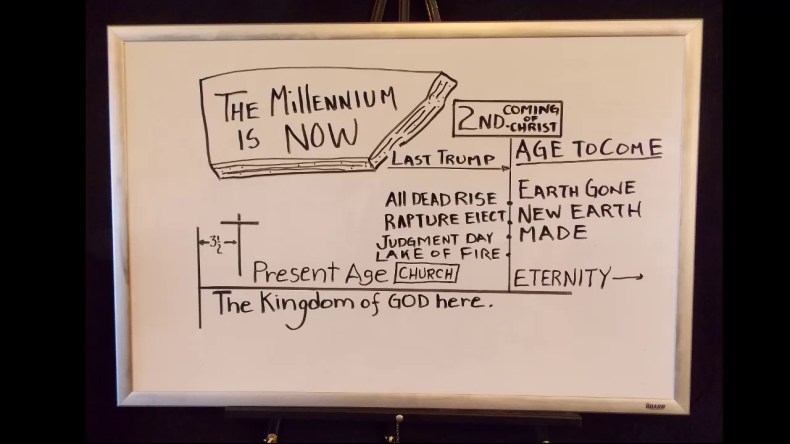
AMILLENNIALISM 1

Amillennialism do not believe in the future one-thousand-year reign of Jesus Christ on earth. Sadly, it is the predominant concept of end time events in Christendom today. It is the official view of the Roman Catholic Church, as well as the doctrine held by most mainline Protestant denominations.

They believe that the current Church Age will end abruptly with the appearance of Jesus for the redeemed. At that point the redeemed will be resurrected in spiritual bodies, the unrighteous will be consigned to Hell, the material universe will cease to exist, and the redeemed will take up residence eternally with God in Heaven.

The amillennial view was invented in 400 A.D. by St. Augustine and adopted by the Roman Catholic Church in 431 A.D. at the Council of Ephesus. When this view was originally presented by St. Augustine, it caused a considerable stir because it differed so drastically from the premillennial view that had been the orthodox doctrine up to that time.

THE MILLENNIUM

Instead of denying outright that there would ever be a Millennium, Augustine argued that the Millennium began at the Cross and would continue for a thousand years until the return of Jesus. Later, when the Lord failed to return after a thousand years, amillennialists simply spiritualized the thousand years to mean an indefinite period of time from the Cross to the Second Coming. This serves as a good example on how Scripture is being twisted to fit their man-made eschatology, irrespective of the warning in Revelation 22:18-19 (ESV);

“I warn everyone who hears the words of the prophecy of this book: if anyone adds to them, God will add to him the plagues described in this book, and if anyone takes away from the words of the book of this prophecy, God will take away his share in the tree of life and in the holy city, which are described in this book.”

Note carefully that Augustine did not deny the Millennium; he simply redefined it to mean the spiritual reign of Christ through the Church during the Church Age.

That means we have been living in the Millennium for almost 2,000 years, although there is no correspondence between the Bible’s prophecies about the Millennium and the reality of the world in which we live.

We live in a world that is rotten to the core. The Bible says that during the Millennium, “the earth will be flooded with the knowledge of the glory of the Lord as the waters cover the sea” (Isaiah 11:9; Habakkuk 2:14). The nations of the world today are all in rebellion against God and His Anointed One. The prophecies say that during the Millennium the nations will all be in subjection to the Lord and will glorify His name (Psalm 22:27-31). If the Lord is reigning over the nations of the world today, He is doing a very poor job of it. Isaiah says that when the Lord reigns, the world will be characterized by peace, righteousness, and justice (Isaiah 9:7).

The amillennial response to this is usually to argue that we are in the Millennium because the Holy Spirit is in the world restraining evil. If the Holy Spirit were not here, things would be much worse. But the Bible doesn’t speak in relative terms about the Millennium. It states that there will be absolute international peace, justice, righteousness and lovingkindness (Hosea 2:18-20).

THE TRIBULATION

Augustine said that we are simultaneously in both the Millennium and the Tribulation! We are in the Millennium because the Holy Spirit is restraining evil, but we are also in the Tribulation because the Church will suffer persecution until the Lord returns. He simply denied the fact that the Bible says that the Tribulation will last only seven years, by saying that the number is symbolic. He argued that the number seven represents a complete period of time, and therefore it represents the period from the Cross to the Second Coming. Both the books of Daniel and Revelation specifically mention the two halves of the tribulation in years, months and even days.

THE BINDING OF SATAN

The Bible says that Satan will be bound at the beginning of the Millennium (Revelation 20:1-3). Augustine argued that Satan was bound at the Cross. Let’s admit that there is a sense in which Satan has always been bound, as he is not omnipotent and not free to do anything he desires. The book of Job reveals that Satan could not touch Job without God’s permission.

It is also true that Satan was further bound by the Cross. Since that time believers in Jesus have received the indwelling power of the Holy Spirit, enabling them to be overcomers in their combat with Satan. The Word says that “He who is within us is greater than he who is in the world” (I John 4:4).

But the limitations which the Cross placed on Satan do not constitute the binding of Satan that the Scriptures say will take place at the beginning of the Millennium. Revelation says Satan will be bound so that he can no longer “deceive the nations” (Revelation 20:3). How can anyone argue that the nations are not deceived today? Satan is without a doubt still the “ruler of this world” (John 16:11).

THE TWO RESURRECTIONS

The Bible says there will be two resurrections, one of the just and another of the unjust (Acts 24:15). It further states that these two resurrections will be separated by a thousand years (Revelation 20:5-6). The amillennial view has only one resurrection, occurring at the end of the Church Age.

Augustine “solved” this problem by spiritualizing the first resurrection. He said the first resurrection is a spiritual one that occurs when a person accepts Jesus as Lord and is born again. The second resurrection is the one that will occur when the Lord returns and everyone, both the just and the unjust, will be resurrected from the dead.

This exercise in imaginative interpretation shows what happens when you start spiritualizing. Scripture starts meaning whatever you want it to mean.

REPLACEMENT / FULFILLMENT THEOLOGY

Amillennialists claim that “God washed His hands of the Jews” because of their unbelief, and He therefore has no purpose left for them. This doctrine has led to much anti-Semitism in the Church. The fact of the matter is that the Jews are still the Chosen People of God, and the Lord intends to fulfill every promise He has ever made to them as a nation.

The book of Romans makes all this very clear. In Romans 3:1-4 Paul asks a rhetorical question: “Has the unfaithfulness of the Jews nullified God’s faithfulness to them?” For almost 1,700 years the Church has said “Yes!” What does Paul say? His answer is, “May it never be!”

Likewise, in Romans 11:1 Paul asks, “Has God rejected His people?” Again, for almost two thousand years the Church has answered, “Yes!” But what does Paul say in response to his question? He says, “May it never be!” And then he adds, “God has not rejected His people whom He foreknew” (Romans 11:2). He then proceeds to explain that a great remnant of the Jews will be saved in the end times (Romans 9:27; 11:25-32).

The Jewish people have been set aside as a result of God’s discipline. But He has not forgotten them. In Isaiah 49:16 the Lord says He could never forget the Jewish people because He has them tattooed on the palms of His hands! In Jeremiah 31:35-37 the Lord asks, “When will the offspring of Israel cease to be a nation before Me?” His answer is that they will continue to be special in His eyes until the fixed order of the universe departs or until the day all the heavens and all the oceans have been fully explored. In Romans 11:29 Paul says that the “gifts and calling of God are irrevocable.” And in Romans 9:1-5 he speaks of promises to the Jews that God fully intends to fulfill.

That’s the reason the Jews are being regathered from the four corners of the world right now. It is one of the greatest miracles of history. The Lord intends to provoke them to repentance by bringing all the nations of the world against them (Zechariah 12:1-3). When they become totally desperate, they will look to the Lord for their salvation. That is when they will repent. They will “look on Him whom they have pierced, and they will mourn” (Zechariah 12: 10). And on that glorious day, a fountain of salvation will be opened for the house of David (Zechariah 13:1).

God will then establish these believing Jews as the prime nation of the world during the Millennium, and through them He will once again bless all the nations on earth (Isaiah 60-62).

Due to this evil doctrine, amillennials are also blinded to understanding one of the key purposes of the millennial reign and the reason for the rapture.

THE KINGDOM ON EARTH

There is no doubt that the Church is God’s current kingdom on the earth today. Since Pentecost, the kingdom has been expressed in the institution of the Church (Colossians 1:13). But the Bible promises different expressions of the kingdom in the future first, in the form of a thousand year rule of Jesus upon this earth (Revelation 2:26-27), and second, in the form of an eternal rule of God upon a new earth (1 Corinthians 15:24-28).

The kingdom is past, present, and future. It is currently expressed in the Church, but it is like a rose in the bud, yet to bloom in its full glory. Even during the Millennial reign of Jesus, the kingdom will be coming, for the Bible teaches that rebellion will be lurking in the hearts of men (Revelation 20:7-10). The consummation of the kingdom will not come until all enemies of God have been subdued. That will occur at the end of the Millennial reign of Jesus, at which time He will surrender the kingdom to His Father, and God Himself will reign forever over a redeemed creation (1 Corinthians 15:24-28).

INTERPRETATION OF REVELATION

Amillennialism believe that Revelation 20:1-6 describes what takes place during the entire history of the church, beginning with the first coming of Christ. The various sections in Revelation are parallel to each other and they also reveal a certain amount of eschatological progress. The last section, for example, takes us further into the future than the other sections. Although the final judgment has already been announced in 1:7 and has been briefly described in 6:12-17, it is not set forth in full detail until we come to 20:11-15. Though the final joy of the redeemed in the life to come has been hinted at in 7:15-17, it is not until we reach chapter 21 that we find a detailed and elaborate description of the blessedness of life on the new earth (21:1-22:5). Hence this method of interpretation is called progressive parallelism.

In essence, they believe that the book of Revelation depicts the struggle between Christ and his church on the one hand and the enemies of Christ and the church on the other. Some say that the first half of the book (chapters 1-11) describes the struggle on earth, picturing the church as it is persecuted by the world. The second half of the book, however (chapters 12-22), gives us the deeper spiritual background of this struggle, describing the persecution of the church by the dragon (Satan) and his helpers. In the light of this analysis we see how the last section of the book (chapters 20-22) falls into place. This last section describes the judgment which falls on Satan, and his final doom. Since Satan is the supreme opponent of Christ, it stands to reason that his doom should be narrated last. Ironically, this seems to contradicts their view that Satan is already bound!

CONCLUSION

The amillennial view is based on a spiritualizing approach to Scripture which contends that the Bible does not mean what it says. Even worse, they take the position that the Bible always means what it says unless it is talking about Israel and the Second Coming of Jesus!

The amillennial view does not stand the test of either the Scriptures or reality. Society is disintegrating before our eyes, and the Bible says it will get worse the closer we come to the Lord’s return (2 Timothy 1-5). How can anyone truly believe that Satan is bound today? The Bible says “the whole world lies in the power of the evil one” (1 John 5:19).

How can anyone truly believe that the Church is reigning with Christ over the nations? Try telling that to persecuted and suffering Christians all over the world.

How could anyone truly believe God has no purpose left for the Jews? After 2,000 years of dispersion all over the world, they are being regathered to Israel in what Jeremiah calls a miracle greater than the deliverance from Egyptian captivity (Jeremiah 16:14-15).

Let’s stop playing games with God’s Word. Let’s allow it to mean what it says. Bible prophecy is really not hard to understand. It is just hard to believe if you choose to blindly follow heretic teachings of church fathers such as Augustine rather than studying the true Word of God.

It reflects the attitude of a person who is too lazy to search the Scriptures to see what God has promised in the future.

Certainly it matters what you believe about Bible prophecy. It matters what you believe about anything, because your beliefs determine the way you live. The amillennial church lives with little hope and excitement about the coming of our Lord, Jesus Christ. Still wonder why these churches are dying?

Bible prophecy surge our hope while we are still in this evil world, and motivates us live a holy life. Although your perception of Bible prophecy it is not related to your justification, it has an immediate impact upon your sanctification, upon how you walk before the Lord in this life. As the apostle John put it: “Everyone who has his hope fixed on Him purifies himself, just as He is pure” (1 John3:3).

Main Sources:

The article “Amillennial problems” by Lamb & Lion Ministries

And

The article “Amillennialism: Introduction and The Book of Revelation” by Anthony Hoekema

THE REALITY OF CHRISTIAN PERSECUTION

A persecution

The persecution of Christians is often a topic many prefer to avoid but it is a reality. Throughout the New Testament, we read that the world hates Christians and that they will be persecuted. Here are a few of the verses:

  • Matthew 5:44, “But I say to you, love your enemies and pray for those who persecute you.”
  • Mark 10:29-30, “Jesus said, “Truly, I say to you, there is no one who has left house or brothers or sisters or mother or father or children or lands, for my sake and for the gospel, who will not receive a hundredfold now in this time, houses and brothers and sisters and mothers and children and lands, with persecutions, and in the age to come eternal life.”
  • Luke 6:22, “Blessed are you when people hate you and when they exclude you and revile you and spurn your name as evil, on account of the Son of Man!”
  • John 15:20, “Remember the word that I said to you: ‘A servant is not greater than his master.’ If they persecuted me, they will also persecute you. If they kept my word, they will also keep yours.”
  • Acts 14:22, “strengthening the souls of the disciples, encouraging them to continue in the faith, and saying that through many tribulations we must enter the kingdom of God.”
  • Romans 8:35, “Who shall separate us from the love of Christ? Shall tribulation, or distress, or persecution, or famine, or nakedness, or danger, or sword?”
  • Romans 12:14, “Bless those who persecute you; bless and do not curse them.”
  • 2 Corinthians 12:10, “For the sake of Christ, then, I am content with weaknesses, insults, hardships, persecutions, and calamities. For when I am weak, then I am strong.”
  • 2 Timothy 3:12, “Indeed, all who desire to live a godly life in Christ Jesus will be persecuted.”

In an article called “The Promise of Persecution,” Greg Laurie mentioned that the period in church history from A.D. 100 to A.D. 314 was known as the Martyr Period, when literally thousands of Christians sealed their fate with their blood for their believes. According to secular historians, there have been 10 great persecutions against the church. These were all major attempts to wipe out Christianity from the face of the earth, starting with the wicked Caesar Nero and ending with Diocletian. Believers were fed alive to wild animals. They were taken to Roman arenas for sport. They were torn apart, tortured, and burned at the stake.

But persecution is not a thing of the past. As a matter of fact, as we approach the soon return of Christ, the persecution of Christians in different parts of the world is reaching “genocidal” levels, according to a new report commissioned by the British government in December 2018. In terms of an interim report issued by an Independent Review set up at the request of the UK foreign secretary, are overwhelmingly the most targeted religious group in the world, and “acts of violence and other intimidation against Christians are becoming more widespread.” In some regions, the level and nature of persecution is arguably coming close to meeting the international definition of genocide, according to that adopted by the UN. Christianity is now facing “the possibility of being wiped out in parts of the Middle East where its roots go back furthest. As an example, in Iraq, Christian numbers have slumped from 1.5 million before 2003 to below 120,000 today. In Syria the Christian population has declined from 1.7 million in 2011 to below 450,000. The report notes that violent persecution exists “in many forms,” and can include both state and non-state actors. In an article published by CBS News on 3 May 2019, 80 percent of religious believers who are being persecuted around the world are Christians.

Even in the western world we see how the removal of crosses and the destruction of Church buildings and other Church symbols are on the increase. The 116th class of US Congress is one of the most diverse to serve the United States and the Bible is no longer the only religious book in use to swear in officials – the Quran now enjoys equal status. FFRF Co-President Annie Laurie Gaylor asserted in an op-ed written for the Tribune News Service that the officially sanctioned National Day of Prayer — observed on May 2 this year — “goes against the spirit of the secular Constitution.” Prayers and Biblical teachings have basically been removed from all schools and universities. Christian businesses are often being forced to provide services that go against their religion, like baking wedding cakes for homosexual couples, while some churches are summoned to marry such couples. We also see attacks and discrimination increasing against Christians on social media. These are but only a few examples.

The Easter Sunday massacres in Sri Lanka (the third Easter in a row that has been targeted by radical Islamists) during which 359 Christians died, should still be fresh in our minds. These horrendous murders made the press for a day or two, while the world generally cared more about the fire in the famous Catholic Notre Dame cathedral than it does about those people who have their bodies blown to bits in architecturally less significant places of worship. Terrible massacres on Christians in Africa hardly enjoyed any news coverage, while the entire world mourned when 50 Muslims were gunned down in New Zealand in March 2019.

BUT WHY ARE CHRISTIANS BEING PERSECUTED?

In John 15:18 Jesus said, “If the world hates you, know that it has hated me before it hated you.” As Christians, we are not like the world—vain, earthly, sensual, and given to pleasure, wealth, and ambition— and the world therefore opposes and hates us. Christian morals also stand in the way of globalism, socialism and for the Antichrist to be revealed.

Jesus also said, ” ‘A servant is not greater than his master.’ If they persecuted Me, they will also persecute you” (John 15:20). Peter says of Jesus, “When they hurled their insults at Him, He did not retaliate; when He suffered, He made no threats. Instead, He entrusted Himself to Him who judges justly” (1 Peter 2:23). In Matthew 5:10-12 we also read, “Blessed are those who are persecuted for righteousness’ sake, for theirs is the kingdom of heaven. Blessed are you when others revile you and persecute you and utter all kinds of evil against you falsely on my account. Rejoice and be glad, for your reward is great in heaven, for so they persecuted the prophets who were before you.”

The persecution of Christians allows them to share in a unique fellowship with the Lord. Paul serves as an excellent example. James argues that trials test the Christian’s faith, develop endurance in his life, and help develop maturity (James 1:2–4). It strengthens the character of believers and enables them to better value the support of true brothers and sisters in the body of Christ. Hardship can stimulate the Lord’s people toward a greater resolve to love and comfort one another and lift one another to the throne of grace in prayer.

Even in the face of Christian persecution, we can press on and during such times, we are in constant communication with God through prayers.

Also, instead of growing weaker during these times of persecution, the body of Christ (real believers) actually grows stronger. Persecution separates the real from the false. If you are a true follower of Jesus, then you won’t back down if persecution comes your way. If God allows persecution in your life, then He will give you the strength to face it.

Sometimes we whine about how hard it is to be a Christian, even when experiencing the smallest bit of tests, trials and tribulations in our lives. Maybe we need to stop for a moment and consider our experience in comparison to that of Christians in countries such as India and in the Middle East.


We should prepare ourselves as I do believe that persecution will intensify as we get closer to the Lord’s return.


THE NATION OF ISRAEL – FOR THE SAKE OF GOD’S NAME

God has chosen Israel as His physical nation, in the same way He has chosen individuals from the gentile nations as His elect. Prophecies are clear that God will be faithful to keep the promises given to their Fathers (Abraham, Isaac and Jacob) even though the nation of Israel has disobeyed Him. Ezekiel 36:16-28 describes that they sinned and would therefore be scattered among the nations (which started in 70AD). But it continues by saying that God will bring them back to their land (which started when they became a nation again in 1948). God is not doing this, based on their obedience, but because of His name’s sake. Lastly the passage states that God will cleanse them and pour out His Spirit upon them and they will be His people, forever.

This will occur during the second coming of Christ. In Romans 11, Paul assured us that the nation of Israel will be saved after the fullness of the gentiles has come in.

Eze 36:16 Moreover the word of the Lord came to me, saying:

Eze 36:17 “Son of man, when the house of Israel dwelt in their own land, they defiled it by their own ways and deeds; to Me their way was like the uncleanness of a woman in her customary impurity.

Eze 36:18 Therefore I poured out My fury on them for the blood they had shed on the land, and for their idols with which they had defiled it.

Eze 36:19 So I scattered them among the nations, and they were dispersed throughout the countries; I judged them according to their ways and their deeds.

Eze 36:20 When they came to the nations, wherever they went, they profaned My holy name–when they said of them, ‘These are the people of the Lord, and yet they have gone out of His land.’

Eze 36:21 But I had concern for My holy name, which the house of Israel had profaned among the nations wherever they went.

Eze 36:22 “Therefore say to the house of Israel, ‘Thus says the Lord God: “I do not do this for your sake, O house of Israel, but for My holy name’s sake, which you have profaned among the nations wherever you went.

Eze 36:23 And I will sanctify My great name, which has been profaned among the nations, which you have profaned in their midst; and the nations shall know that I am the Lord,” says the Lord God, “when I am hallowed in you before their eyes.

Eze 36:24 For I will take you from among the nations, gather you out of all countries, and bring you into your own land.

Eze 36:25 Then I will sprinkle clean water on you, and you shall be clean; I will cleanse you from all your filthiness and from all your idols.

Eze 36:26 I will give you a new heart and put a new spirit within you; I will take the heart of stone out of your flesh and give you a heart of flesh.

Eze 36:27 I will put My Spirit within you and cause you to walk in My statutes, and you will keep My judgments and do them.

Eze 36:28 Then you shall dwell in the land that I gave to your fathers; you shall be My people, and I will be your God.

Hebrew scholar Arnold Fructembaum says:

“The re-establishment of the Jewish state in 1948 has not only thrown a wrench in amillennial thinking, but it has also thrown a chink in much of premillennial thinking. Amazingly, some premillennialists have concluded that the present state of Israel has nothing to do with the fulfilment of prophecy. For some reason the present state somehow does not fit their scheme of things, and so the present state becomes merely an accident of history. On what grounds is the present state of Israel so dismissed? The issue that bothers so many premillennialists is the fact that not only have the Jews returned in unbelief with regard to the person of Jesus, but the majority of the ones who have returned are not even Orthodox Jews. In fact the majority are atheists or agnostics. Certainly, then, Israel does not fit in with all those biblical passages dealing with the return. For it is a regenerated nation that the Bible speaks of, and the present state of Israel hardly fits that picture. So on these grounds, the present state is dismissed as not being a fulfilment of prophecy. However, the real problem is the failure to see that the prophets spoke of two international returns. First, there was to be a regathering in unbelief in preparation for judgment, namely the judgment of the tribulation. This was to be followed by a second world-wide regathering in faith in preparation for blessing, namely the blessings of the messianic age. Once it is recognized that the Bible speaks of two such regatherings, it is easy to see how the present state of Israel fits into prophecy.”

The first worldwide return (fulfilled in the establishment of the nation of Israel in 1948 and the subsequent return of its people) is in unbelief, in preparation for judgement, and is in fulfilment of such verses as Ezek. 20:33-38; 22:17-22; 36:22-24; 37:1–14; Isa. 11:11-12; Zeph. 2:1-2 and Ezek. 38–39

The second worldwide regathering is in belief and is a fulfilment of verses such as Deut. 4:29-31; 30:1-10; Isa. 27:12-13; 43:5-7; Jer. 16:14-15; 31:7-10; Ezek. 11:14-18; Amos 9:14-15; Zech. 10:8-12; Matt. 24:31

The return from Babylon does not fulfil these scriptures as many amillennials and preterists believe:

  1. Isaiah 11 (above) speaks of a 2nd gathering from a world wide (the four corners of the earth) dispersal. The Babylonian captivity was not a worldwide captivity. The worldwide dispersal started in 70AD. The first regathering, as mentioned above, from the world wide dispersal was in unbelief following the formation of Israel as a nation again in 1948. The second one mentioned is in belief at that end of the tribulation.
  2. The return from the Babylonian captivity was a return from the east. The return from the worldwide dispersal is from all directions such as stated in Isa 43:5-6.
  3. The prophets foretold of a regathering of the Jews to Israel from which they would never be uprooted from again. Seeing that they were uprooted in 70Ad and dispersed among the nations, these prophecies can only apply to a regathering after 70AD – and it says they will never be uprooted again.

‘I will plant them, and not uproot them.’ (Jeremiah 24:6). ‘I will plant Israel in their own land, never again to be uprooted from the land I have given them.’ (Amos 9:15). Jerusalem ‘shall never again be uprooted or overthrown.’ (Jeremiah 31:40).

(MAIN SOURCE: JESUSPLUSNOTHING)

ISLAMIC TIES TO JERUSALEM

“The burden of the word of the LORD against Israel. Thus says the LORD, who stretches out the heavens, lays the foundation of the earth, and forms the spirit of man within him: “Behold, I will make Jerusalem a cup of drunkenness to all the surrounding peoples, when they lay siege against Judah and Jerusalem. And it shall happen in that day that I will make Jerusalem a very heavy stone for all peoples; all who would heave it away will surely be cut in pieces, though all nations of the earth are gathered against it. In that day,” says the LORD, “I will strike every horse with confusion, and its rider with madness; I will open My eyes on the house of Judah, and will strike every horse of the peoples with blindness.” (ZECHARIAH 12:1-4)

God says that in a coming day Jerusalem will intoxicate and stupefy the surrounding peoples. The Arab peoples surrounding Jerusalem have a passion for possessing the city that is not justified by history. Muslims claim Jerusalem as their third-holiest city, but Jerusalem is not mentioned once in the Koran. “During the centuries when Jerusalem was under complete Arab control, no Arab ruler or Islamic leader ever made it the object of a religious pilgrimage – again a strange indifference toward a city which is now considered to be the third-holiest religious site in Islam after Mecca and Medina” (Dave Hunt).

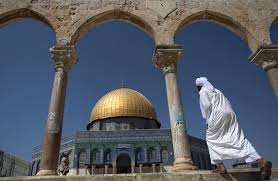
Jerusalem’s importance to Muslims comes from the belief that in the Dome of the Rock shrine there is a rock where two significant things happened – where Abraham intended to offer Isaac as a sacrifice, and where Mohammed allegedly ascended into heaven. Though this tradition is firmly in the Muslim mind, it is of recent origin. It was invented by Yasser Arafat’s uncle – Haj Amin el-Husseini, who was the past Grand Mufti of Jerusalem. He promoted this myth in the 1920’s and 1930’s to arouse Arab passions against the growing Jewish presence in Jerusalem.

The verse in the Koran that describes Mohammed’s trip to heaven is Surah 17:1: Glorified be He who carried His servant by night from the Inviolable Place of Worship to the Far Distant Place [al-Aqsa] of Worship the neighbourhood whereof We have blessed, that We might show him of Our tokens! The Islamic interpretation says that the Inviolable Place of Worship is Mecca, and this is accepted by all. It then says that the Far Distant Place of Worship is Jerusalem – but this has no substantiation because Jerusalem had never been a place of Islamic worship to that time, nor would it be for centuries afterward. Jerusalem isn’t even mentioned by name in the Koran, so how could it be a place of worship according to the Koran? Most significantly, inside the Dome of the Rock hundreds of verses from the Koran are inscribed – and Surah 17:1 is not among them! The very passage that later supposedly justified the building of the Dome of the Rock is not even included among the hundreds of passages of the Koran inscribed in it!

The Dome of the Rock was built not because of the Koran, but because the Muslim ruler Abdal-Malik wanted to gain revenue from pilgrims and worshippers, and because he wanted to prevent the rebuilding of a Jewish Temple. Islamic passion for Jerusalem is indeed like drunkenness.

This is exactly fulfilled in modern Jerusalem. In recent peace negotiations between Israel and the Palestinian Authority, Israel was willing to concede almost everything to the Palestinians in an amazing willingness to make peace. The only thing Israel would not concede was sovereignty over Jerusalem, and the entire deal was ruined over that one point. The problem between Jews and the Arab world has boiled down to one point: Jerusalem.

If Muslim passion for Jerusalem is a mystery, the Jewish claim to the city is entirely Scriptural. “The very fact that Jerusalem is mentioned more than 800 times in the Bible makes it worthy of special attention. This unique city is the only one upon which God has bestowed His distinctive blessing and protection (Ps 132:13-14), and the only city for whose peace we are commanded to pray (Ps 122:6). God says He has chosen Jerusalem as the place where He has put His name forever (2 Chr 6:6; 33:7; Ps 46:4; 48:1-8; 87:3). The new heavens and new earth will contain ‘the city of my God…new Jerusalem’ (Rv 3:12; 21:2). That there will be a ‘heavenly Jerusalem’ (Heb 12:22) but no ‘heavenly’ New York, Paris, London, Damascus, Cairo, etc. speaks volumes” (Dave Hunt, The Berean Call – September 2000).

(SOURCE: ENDURING WORD ©2018 David Guzik)

THE “GOOD NEWS” FOR ISRAEL – EZEKIEL THE PROPHET

As watchmen, we are lately so entangled in Ezekiel 38 and 39 (the Gog and Magog war), that we almost forget about the good news relating to the physical and spiritual restoration that was prophesied for Israel.

When studying Ezekiel chapters 34 to 37, there should be no doubt that these prophecies must and will have a literal fulfillment. To allegorize these chapters to support Replacement / Fulfillment theology is not only dishonoring holy Scripture but also making God a liar.

RESTORATION OF THE NATION OF ISRAEL (EZEKIEL 34:10-36:15)

PHYSICAL RESTORATION

God promised to rescue the Jews in Israel’s future restoration (v. 10). He declared that He Himself would search for His sheep and rescue them from where they had been scattered (vv. 11–12). God promised, “I will bring them out from the nations and gather them from the countries, and I will bring them into their own land. I will pasture them on the mountains of Israel, in the ravines and in all the settlements in the land” (v. 13). This prediction of the future regathering of Israel from all over the world is still in progress and will be fulfilled when the coming millennial kingdom begins.

God will especially care for those who are weak or injured and who had been trampled by the stronger sheep and will bring them to rich pastures. He will shepherd them and will serve as a judge “between the fat sheep and the lean sheep” (vv. 14-20).

Central to God’s plan of restoration for Israel will be the resurrection of David as a true shepherd who will serve as a prince under Christ as King of Kings and Lord of Lords (vv. 23–24). This places the fulfillment at the second coming when Old Testament saints will be resurrected (Dan. 12:1–3).

God also promised that this would be a time of peace when the wild beasts will not afflict them, when they will receive showers to water the land, and trees will bear their fruit (Ezek. 34:25–27).

God also promised to keep them in safety, no longer allowing the nations to plunder them, and would deliver them from famine (vv. 28–29). As a result of God’s work in restoration of Israel, “Then they will know that I, the LORD their God, am with them and they, the house of Israel, are my people, declares the Sovereign LORD. You my sheep, the sheep of my pasture, are people, and I am your God,’ declares the Sovereign LORD” (vv. 30–31). This will be fulfilled in the millennium (Jer. 23:5–8).

Ezekiel 36:8–36 continues to describe the blessings. She will be restored like a tree producing branches and fruit (v. 8). God will increase the number of the house of Israel, and her cities will once again be inhabited and her ruins rebuilt (v. 10). Even animals will be more plentiful and the land will become fruitful (v. 11). God not only promised that the children of Israel would walk on her ancient land and possess it but also that nothing would deprive them of their children (v. 12), referring to the fact that Israel would be permanently established in her land when her final restoration takes place (Amos 9:15). God declared that never again will the children of Israel be destroyed and suffer taunts from the nations (Ezek. 36:13–15).

THE SCATTERING OF THE CHILDREN OF ISRAEL

God reminded the children of Israel, however, of their wickedness and how they were judged and dispersed among the nations because they had sinned against Him (vv. 16–18). God declared that the Israelites would be “scattered through the countries; I judged them according to their conduct and their actions” (v. 19).

THE SPIRITUAL CLEANSING OF ISRAEL

God would not restore Israel because she deserved it, but because of His desire to show her His righteousness and His holiness (vv. 22–23). In her restoration God would cleanse her and give her His Holy Spirit: “For I will take you out of the nations; I will gather you from all the countries and bring you back into your own land. I will sprinkle clean water on you, and you will be clean; I will cleanse you from all your impurities and from all your idols. I will give you a new heart and put a new spirit in you; I will remove from you your heart of stone and give you a heart of flesh. And I will put my Spirit in you and move you to follow my decrees and be careful to keep my laws” (vv. 24–27). The Holy Spirit will indwell them in that day, in contrast to the Mosaic dispensation when only a few were indwelt.

In that day when the Israelites again live in their Promised Land, they will belong to God, and God will be their God (v. 28). God will make their grain plentiful and they will no longer have famine (vv. 29–30). When God will prosper them in their day of the restoration, they will think back to their wickedness and know that God has shown them His grace.

The land is described as resettled, rebuilt, no longer desolate but like the garden of Eden (vv. 33–35). This will be a testimony to the nations that God has restored Israel (v. 36). Most important, Israel will know that the Lord is her God and that He has restored her.

This entire chapter requires a future millennial kingdom after the second coming of Christ for its complete and literal fulfillment (Jer. 23:5–8). Just as the prophecies of judgment were literally fulfilled in connection with Israel and the nations, so her future restoration will be literally fulfilled and she will experience the marvelous grace of God.

DIVISION OF THE DRY BONES: THE RESTORATION OF ISRAEL (EZEKIEL 37:1-14)

In Ezekiel 37:1–10, the prophet was given a vision of a valley filled with dry bones. The Lord asked him the question, “Son of man, can these bones live?” (v. 3). Ezekiel was cautious in replying, indicating that only the Lord would know (v. 3).

Ezekiel then was instructed to prophesy that these dry bones would come to life, that the bones would come together, that flesh would cover them, and finally that they would have the breath of life much like Adam (Gen. 2:7).

Then God spoke to Ezekiel, “Prophesy to the breath; prophesy, son of man, and say to it, ‘This is what the Sovereign LORD says: Come from the four winds, O breath, and breathe into these slain, that they may live’” (Ezek. 37:9). When Ezekiel obeyed the Lord and prophesied, “breath entered [the bones]; they came to life and stood up on their feet—a vast army” (v. 10).

In Ezekiel 37:11–14, the Lord now interpreted the vision for him. He was informed that the bones represented Israel. Her hopeless, dried condition illustrated her hopelessness of ever being restored. In response to this, God promised to bring her back from death and to the land of Israel. God would put His Holy Spirit in her, and she would be settled in her own land.

The Lord said, “Son of man, these bones are the whole house of Israel. They say, ‘Our bones are dried up and our hope is gone; we are cut off.’ Therefore prophesy and say to them: ‘This is what the Sovereign LORD says: O my people, I am going to open your graves and bring you up from them; I will bring you back to the land of Israel. Then you, my people, will know that I am the LORD, when I open your graves and bring you up from them. I will put my Spirit in you and you will live, and I will settle you in your own land. Then you will know that I the LORD have spoken, and I have done it,’ declares the LORD” (vv. 11–14).

In biblical interpretation today, many affirm that Israel will never be restored. They share the hopelessness that gripped the Israelites as they were scattered from their land to Assyria and Babylon. Contradicting this hopeless situation, God promised to restore Israel and in the strongest possible terms indicated that He would bring new life to her, and she would be restored as a nation, that she would be indwelt by the Holy Spirit, and she would settle in her own land in safety.

The prediction that she would be brought up from the grave is partly symbolic in that the nation seemed to be dead and will be restored to physical life. But it is also to be considered literally, because according to Daniel 12:1–3, at the close of the great tribulation when Christ returns in His second coming, there will be a resurrection of Old Testament saints. Both figuratively and literally Israel will be restored and given new life.

Those who have died and who were saved will be resurrected to share in the millennial kingdom as resurrected saints. The promise that His Holy Spirit would be in Israel goes beyond her experience under the Law, when the Holy Spirit was with her but not necessarily in her (John 14:17).

SIGN OF THE TWO STICKS – A SINGLE NATION AGAIN (EZEKIEL 37:15-28)

Ezekiel 37:15–17. Ezekiel was commanded, “Son of man, take a stick of wood and write on it, ‘Belonging to Judah and the Israelites associated with him.’ Then take another stick of wood, and write on it, ‘Ephraim’s stick, belonging to Joseph and all the house of Israel associated with him.’ Join them together into one stick so that they will become one in your hand” (vv. 16–17).

The situation being addressed was that of the divided kingdom. After Solomon, the ten tribes following Jeroboam became the kingdom of Israel; the two remaining tribes in Jerusalem, Judah and Benjamin, became the kingdom of Judah. The ten tribes were carried off to Assyria in 722 BC, and the two remaining tribes were carried off by Babylon between 605 and 586 BC. The situation where these two kingdoms were divided will end, and as this and other prophecies predict, the two kingdoms will become one nation (cf. Jer. 3:18; 23:5–6; 30:3; Hosea 1:11; Amos 9:11). No fulfillment has ever been recorded in history, and the future regathering of Israel will occur in the millennium.

Ezekiel 37:18–23. Ezekiel was instructed to answer the questions of those who asked the meaning of the two sticks, and he was to tell them, “This is what the Sovereign LORD says: I am going to take the stick of Joseph—which is in Ephraim’s hand—and of the Israelite tribes associated with him, and join them to Judah’s stick, making them a single stick of wood, and they will become one in my hand” (v. 19).

God then further interpreted this, saying, “I will take the Israelites out of the nations where they have gone. I will gather them from all around and bring them back into their own land. I will make them one nation in the land, on the mountains of Israel. There will be one king over all of them and they will never again be two nations or be divided into two kingdoms” (vv. 21–22). God promised He would keep Israel from defiling herself as she has done in the past, and He declared, “I will save them from all their sinful backsliding, and I will cleanse them. They will be my people, and I will be their God” (v. 23). This will be fulfilled in the millennial kingdom.

Ezekiel 37:24–25. As predicted in 34:23–24, so here again the prophecy was given, “My servant David will be king over them, and they will all have one shepherd. They will follow my laws and be careful to keep my decrees. They will live in the land I give my servant Jacob, the land where your fathers lived. They and their children and their children’s children will live there forever, and David my servant will be their prince forever” (37:24–25).

Though some have attempted to take this prophecy in less than its literal meaning, the clear statement is that David, who is now dead and whose body is in his tomb in Jerusalem (Acts 2:29), will be resurrected. This will occur at the second coming (Dan. 12:1–3), indicating plainly that the restoration of Israel will be subsequent to, not before, the second coming. This requires Christ’s coming before the millennium or in fulfillment of the premillennial promises. The promise that David would be her prince forever must be interpreted as being fulfilled in the thousand-year reign. Actually, the word forever is a translation of an expression “to the ages,” which may be interpreted as forever or until eternity begins.

Ezekiel 37:26–28. As Jeremiah stated, God predicted here a covenant of peace with Israel that will be “an everlasting covenant” (v. 26). Though announced in the Old Testament, it will replace the Mosaic covenant and will have its primary fulfillment for Israel at the time of the second coming when Israel is restored nationally and spiritually.

Scholars have puzzled over the precise meaning of the new covenant, earlier announced by Jeremiah (Jer. 31:31–34). Probably the simplest explanation is that in dying on the cross, God made possible a covenant of grace for those who would trust the Lord. This covenant of grace is the basis for the salvation of every individual, from the time of Adam to the last person who is saved. It is preeminently illustrated in the present age when God saves the church by grace and the Lord’s Supper commemorates the new covenant. The new covenant as applied here to Israel primarily has a prophetic meaning, which is indicated here as being fulfilled in the peace, righteousness, and restoration that will characterize the millennial kingdom.

At the time of the fulfillment of this covenant, the number of Israelites in the land will increase greatly, especially during the millennial kingdom. A preliminary prophecy that God will provide a sanctuary (Ezek. 37:28) referred to a millennial temple that is described later in Ezekiel (40–48).

God promised to be with Israel and dwell among her in the millennial kingdom (v. 27). This will also be true in the new earth in eternity. The restoration of Israel will be a sign to the world so that the nations will know that it will be accomplished by the holy Lord, who is able to cleanse Israel and make her holy.

(Source: John F. Walvoord – Every Prophecy of the Bible: Clear Explanations for Uncertain Times)


IS COVENANT THEOLOGY BIBLICAL?

As stated in a previous study, amillennialism is the belief that there will be no literal millennium or future reign of Jesus Christ on planet earth. It’s also linked with what is called “Covenant Theology” because this system of theology follows the allegorization method of interpretation and embraces a non-literal approach to the millennium.

Covenant Theology rejects dispensationalism since dispensationalism believes in the literal approach to prophetic Scripture and sees a clear distinction between Israel and the church and also believes in a literal 1,000-year kingdom reign upon earth. Dispensationalism teaches that God still has a plan for national Israel and that God has not abandoned His covenant promises given to His people. Therefore, the system of Covenant Theology strongly rejects this system of interpretation, which threatens their spiritualized scheme of thinking on the Bible.

A SHORT HISTORY OF COVENANT THEOLOGY 

Covenant theology is primarily a Post-Reformation teaching formulated in Europe in the 16th and 17th centuries that was introduced to America primarily through the Puritans. This system of theology was not developed in the early church, the Middle Ages or by the prominent Reformers such as Luther, Calvin, Zwingli or Melanchthon.

Louis Berkhof says: “In the early Church Fathers the covenant idea is not found at all.”

According to Berkhof, Kasper Olevianus (1536-1587), a secondary Reformer, was the real founder of a well-developed Covenant Theology. Herman Witsius (1636-1708) was credited for teaching that this covenant of grace was created in eternity past when the Godhead agreed upon the terms for redemption. These were men whose influence was secondary to the great Reformers of the time. The main Reformers did not teach or develop a covenant scheme like other lesser-known men. A German named Johannes Cocceius (1603-1669) actually set forth the view of two covenants of works and grace in a work published in 1648. However, the teaching was spreading, since one year before the publication of Cocceius’s work the Westminster Confession’s covenant of works and grace appeared.

Renald Showers adds this important note: “The system started to be developed in the Reformed Churches of Switzerland and Germany and passed to the Netherlands, Scotland, and England. In 1647 the Westminster Confession of Faith in England became the first confession of faith to refer to Covenant Theology.”

Covenant theology came to America through the writings of Francis Turretin and Herman Witsius and was championed in the new world in the works of John Cotton and others.

THE THREE COVENANTS

Covenant Theology represents the whole of Scripture as being covered by two or three covenants. This theological system begins its allegorization scheme of interpretation by claiming that God only made two or three covenants.

Covenant of Redemption

The first covenant is a covenant of redemption between the Godhead in eternity past. This theological system claims that this covenant came about because of some secret agreement that was made between the Father and Son. God the Son agreed to provide salvation through His death upon the cross and the Father agreed that the Son would be the Redeemer and head of the elect.

Covenant of Works

Second, there is a covenant of works, which God made with Adam (Gen. 2:17). God promised life for his obedience and death for his disobedience. Adam was temporarily put on probation to see what he would do. When he failed he plunged the world into sin and spiritual death and became the head of a human race that would be separated from God.

Covenant of Grace

The third covenant consisted of a covenant of grace after Adam sinned (Gen. 3:15) which was the promise of salvation through a coming Redeemer. God offered the covenant to Adam in order to bring salvation to him through Jesus Christ. And today God is operating under this same grace-redemption covenant purpose, which is now being extended to the elect. The covenant of grace is actually based upon the covenant of redemption, which was made in eternity past.

Interpretation of Jewish promises

According to Covenant Theology, there is the need to simplify the national Jewish covenant promises, through the process of figurative/spiritualized language, since this makes the unifying concept of salvation and grace easier to be seen and understood throughout history.  This leads them to nullify the covenant promises given to the Jews and spiritualize them. When the covenant programs of God are interpreted literally and the distinctions between God’s covenant programs are clearly seen, it will allow for a future kingdom for national Israel.

This is the crux of covenant theology and the amillennial position: The promises given to Israel about a land, a nation, a king and a kingdom (Gen. 12:2; 15:18-20; 2 Sam. 7:12-16) have been given to the church and take on a new spiritual dimension and meaning.

Since the old Israel rebelled against God’s conditional covenants and ultimately rejected Christ, she forfeited her right to enjoy any earthly kingdom. Calvin went so far to say that the literal interpretation of Israel’s earthly promises were not even to be interpreted by the Jews to mean a literal earthly kingdom. Rather, they were given to teach realities about their glorious prospect of heaven.

Calvin States: “The point of controversy between us and these persons, is this: they maintain that the possession of the land of Canaan was accounted by the Israelites their supreme and ultimate blessedness, but that to us, since the revelation of Christ, it is a figure of the heavenly inheritance. We, on the contrary, contend, that in the earthly possession which they enjoyed, they contemplated, as in a mirror, them, in heaven.”

Of course, this is an incredible hoax on the Bible. It is huckstering the Bible (2 Cor. 4:2) to try and fit a Platonic interpretive scheme that is contrary to belief in a literal Bible. This is called “Replacement theology.”

SQUEEZING GOD’S PLANS INTO A SINGLE BOX

Covenant theology views both history and prophecy through the lenses of this proposed covenant of grace and this is what directs their interpretation of Scripture, causing the prophecies about the millennium to be spiritualized and interpreted figuratively, as the present day church.

It’s very significant that there is no mention of these proposed covenants in Scripture. The first time the word covenant is used is with Noah (Gen. 6:18; 9:11). The covenant of works and grace are not Biblical covenants as Reformed Theology teaches. Covenant theologians base their entire system of theology on a deduction rather than a clear statement of Scripture.

Abraham no doubt understood that a covenant was being made when he cut the animals in half and when God passed through the pieces of the sacrifice (Gen. 15:17-21). But this cannot be said of Adam. Adam was not aware of some kind of covenant of works and grace taking place as Covenant theology assumes happened.

It must be understood that the covenants of redemption, works and grace are man-made theological covenants but not biblical covenants. God’s dealing with Adam was in the form of a test and the subsequent provisions given to Adam if he fails the test. It was not necessarily a covenant. Scripture never verifies that this was a covenant as it does with the other covenants (Gen. 6:18 = Noahic; Gen. 15:18; 17:2 = Abrahamic; Deut. 4:12-13 = Mosaic; Deut. 29:1 with 30:3-10 = Land; 2 Chronicles 21:7; Ps. 89:3 with 2 Samuel 7:8-18 = Davidic; Jer. 31:31; Heb. 8:8 = New). Thus, the whole premise of Covenant Theology crumbles because they argue for covenants that are not even directly or clearly mentioned and revealed in the Bible as covenants.

Even if one was to assume that a covenant of works was made to Adam and a covenant of grace was the result of Adam’s failure, it does not mean that every other covenant mentioned in the Bible must be spiritualized to fit into some kind of single covenant scheme of grace, which leads to nullifying other covenants of their literal promises to national Israel. Covenant Theology is in error because it tries to make all of the other covenants subservient to the one imaginary covenant of grace.

It’s true that other covenants contain a picture of God’s grace in that He acts on the behalf of the people. Even in the Mosaic Covenant there is the institution of the gracious sacrificial system. But this conclusion does not give the interpreter the permission to spiritualize the other covenants in an attempt to give them one common goal – salvation by grace. Covenant Theology has only one goal that it focuses on – salvation by grace. But this single goal throughout history is too narrow.

We must remember that God has other goals that He intends to fulfill during the course of history which contribute to His ultimate purpose for history. God has different goals for nations (Job 12:23; Isa 14:24-27) and rulers (Dan. 2:21, 4:17). God has judgment plans for planet earth (Revelation 6-19). He has plans for Satan (Rev. 12:7-10, 20:1-3) and even for the redemption of nature (Matt. 19:28; Rom. 8:19-22). Likewise, God has a plan for the Gentiles (Rom. 11:25) and for the Jews or national Israel (Romans 11:26-27). He promises the Jews a literal kingdom (Daniel 7:27; Luke 12:32). These goals cannot be overlooked or spiritualized in order to try and unify the working of the grace of God in some kind of generalized and spiritualized program of one common people and goal that embraces grace and salvation. To try and narrow the goals or plans of God by squeezing them into a single covenant of grace does not do justice to God’s other plans that He is working out in history.

Renald Showers observes: “Since God has many different programs which He is operating during the course of history, all of them must be contributing something to His ultimate purpose for history. Thus, the ultimate goal of history has to be large enough to incorporate all of God’s programs, not just one of them.”

Distinctions cannot be set aside without falling into grievous error. For instance, Paul makes a clear distinction between the Mosaic covenant and Abrahamic Covenant by arguing that the promised seed cannot be based upon both the Law and Abrahamic covenant at the same time (Gal. 3:18). One said, “Do this and you will be blest” where the other said, “I will do this for you so you will be blessed.” The Mosaic Covenant instituted conditions that were not required in any earlier covenants. There is also an expressed distinction between the Mosaic Covenant and the New Covenant (Jer. 31:32). Furthermore, the Mosaic Law was an administration of death (2 Cor. 3:9) whereas the New Covenant is an administration of righteousness (2 Cor. 3:9). In addition the Old Mosaic Law was written on tables of stone whereas the New Covenant is said to be written upon the tables of the heart (2 Cor. 3:3). The idea that all of the covenants have a single meaning, purpose and common goal attached to them (salvation by grace) is too narrow.

We have the Noahic covenant with the rainbow of promise (Gen. 9:11-15). We have the Mosaic covenant with the demands to obey for blessings and resulting curses for failure (Deut. 27:14-26). Then we have the Abrahamic, Land and Davidic covenants with the promises of a continuing people, future land and future kingdom. We have the New Covenant with the promise of the permanent indwelling ministry of the Holy Spirit (Ezek. 36:27). The differences are more than minor as Covenant Theologians suggest. They are major differences that demonstrate the outworking purposes of God as being much more involved than just salvation by grace. (For this reason I get highly upset when Christians in a disrespectful manner refer to biblical aspects, other than salvation, as “secondary” or “non-salvic” issues, as if they don’t matter – to God they matter!)

Covenant Theology follows our earlier amillennial teaching, which claims that the church today has inherited the Old Covenant promises of Israel in a generalized spiritual way. The Covenant Theology of amillennialism views all the covenants of the Bible to be progressive revelations of the one covenant of grace. They are all squeezed into the same mold as the covenant of grace. And since there is only one general covenant that God is working with throughout history it is proposed that there can be only one group of people that He is working with in both the old and new dispensation – the church. And to keep the unifying principle of the covenant of grace intact there must be a spiritual or figurative transfer of the Old Testament covenant promises to the church today.

Covenant Theology attempts to simplify God’s sovereign program by combining different people into one entity and various dispensational economies into one generic phase of God’s work. Amillennialism opts for an oversimplification of God’s earthly plans and tries to avoid unwanted distinctions at all costs to keep what they term as “A more feasible working hermeneutic.”

The point of Covenant Theology is trying to make is that too many different covenants and different programs would steer us away from God’s common plan of grace and no longer create a common picture of redemption throughout history. This is why the church today is called “Abraham’s spiritual seed.” They have received or inherited the Old Testament promises in a spiritual or figurative way as evidence by the New Testament.

According to Covenant Theology and their New Testament analysis, those covenants that are mentioned in the Bible (Abrahamic, Palestinian, Davidic and New) are all viewed as being a spiritual or non-literal extension of the covenant of grace. Furthermore, it’s promoted by this interpretive system that all of the Old Testament covenants are in some way related to the promised salvation blessings given to the universal church down through the ages of time – even the New Testament church of today.

For many the Abrahamic covenant (Genesis 12) is seen to be the official beginning of the covenant of grace and the institutional church. Abraham is seen as the head of the covenant of grace. Other amillenarians see Adam as fulfilling this role as head of the covenant of grace and view the church beginning back in Genesis chapter 3:15 with the promise of the Redeemer. Berkhof suggests that in Genesis 3:15 we see the revelation of this covenant but it was not until the time of Abraham that this covenant was officially established.

PRESENT DAY BELIEFS AND INFANT BAPTISM (ALSO CALLED PAEDOBAPTISM, COVENANT BAPTISM, AND HOUSEHOLD BAPTISM)

Reformed Theology of today continues to embrace this covenant of grace relationship with God and claims that the children of saved parents are born within the covenant of grace relationship. Like Old Testament Israel, those born to regenerate parents (the new Israel) experience a “legal relationship” with God within this covenant relationship.

These children become like the spiritual seed of the believers and enter this covenant of grace by physical birth. When they come to the age of accountability before God they are then expected to enter the “communion of life” aspect of this covenant, which involves salvation. As a rule, they believe God gathers the number of His elect out of those who stand in this legal covenant relationship with Him. Those who are born in the covenant of grace relationship have a privileged position and it is believed that God gives them special blessings such as the Spirit’s conviction, striving and common grace (Gen. 6:3; Mt. 13:18-22; Heb. 6:4-6). By the process of spiritual transfer and replacement the new sign of the covenant relationship between God and His people today (the new Israel) is baptism (sprinkling), which replaces the old sign of circumcision in the Old Testament Abrahamic covenant. This is the seal of the covenant of grace and the young children are considered the “children of the kingdom” to which the Gospel must be preached first of all (Matt. 8:12; Luke 14:16-24; Acts 13:46).

This Reformed way of thinking and baptismal practice of infants runs contrary to Scripture. The Bible never calls circumcision the “seal” of the Abrahamic covenant let alone baptism becoming the seal of the New Covenant. This is terminology not used in the Bible. The Holy Spirit is the seal of the present dispensation (2 Cor. 1:22; Eph. 1:13; 4:30). Furthermore, nowhere in the Bible does it state that infant baptism and circumcision is the same thing. They cannot signify the same thing since children of believing parents are not Israelites and since circumcision was only performed on males whereas baptism was practiced on both males and females.

In addition, New Testament baptism followed the salvation of any person, no matter what age they had reached, whereas circumcision was performed on children eight days old (Gen. 17:12). To argue that baptism replaces circumcision and becomes a seal of the covenant of grace that we have with God is nowhere stated nor even assumed in the entire Bible. If the baptism of boys replaces the Old Testament practice of circumcision then what does the practice of infant girls replace?

Verses that are used by covenant theologians to support the notion that infant baptism replaces infant circumcision teach nothing about baptizing infants (Col. 2:11; Matt. 19:14). The supposed proof text of Colossians 2:11-12, which Reformed theologians use to support the idea of baptism replacing the sign of circumcision, says nothing of infants! However, this passage does teach that salvation is a spiritual operation of circumcision that does not involve the hands of man. It does teach that salvation takes place through the spiritual operation that God performs in our life when we are spiritually identified with the death, burial and resurrection of our Lord and brought into new life with Him.

By comparison, where do we read that all the people within Old Testament Israel, who were in covenant relationship with God, were actually saved? Even today Paul says that all Jews, who are born as Israelites and circumcised, are not necessarily part of the true regenerated Israel (see Romans 9:6). This tells us that it is dangerous to assume that some person born into a covenant relationship with God possesses eternal life. These kinds of confusing statements made by Reformed Theologians result when failing to distinguish between membership in a covenant people and membership in the true church through faith in Christ (Heb. 12:23).

Reformed Theology also teaches that since Jesus is the Mediator of the New Covenant (Heb. 8:6; 9:15; 12:24), it’s reasonable to assume that Christ is the Mediator of the Covenant of Grace. It is Jesus Christ who goes between God and sinful man and brings man into right relationship with a holy God. But problems arise when churches begin to identify baptism as some kind of sealing agent into the covenant of grace. The dangers arise when people understand that the Mediator of the covenant transfers His actual saving work to their lives through the act of baptism. This is nothing more than a works salvation (Eph. 2:8-9).

Perhaps covenant theologians do not intend to teach that baptism regenerates little children but their statements would teach otherwise. The statements of covenant theologians seem to imply salvation by the act of baptism.

Murray says: “Baptized infants are to be received as the children of God and treated accordingly.” Bromiley, writing about the children of promise, says: “Baptism declares the inward regenerative cooperation of the Holy Spirit which makes us conformable to Jesus Christ.”

In his book entitled Baptism: It’s purpose, Practice and Power, Green wrote these words: “Baptism is the initiation of the Christian person. It is his inclusion in the salvation history of God. It is the incorporation into the church, the Body of Christ.”

Calvin, writing in his “Institutes of the Christian Religion” recorded these words: “The sign [of infant baptism] … opens to them a door into the church, that, adopted into it, they may be enrolled among the heirs of the Kingdom of heaven.”

CONCLUSION

This interpretive scheme leaves large areas of the Old Testament Scripture and prophecies without any generally accepted meaning or explanation by the Amillennialists. This is because when you advance your own mind upon the Scriptures there are a countless number of conclusions that will be promoted for the meaning of Scriptural texts. Amillennialism, with its multiplied spiritualized schemes to find hidden meanings behind literal texts in the Old Testament, is a blight upon the understanding of Scripture and causes wreckage to occur in the study of the Bible (2 Tim. 2:15). It comes to the Scripture with subjective reasoning where the meaning of a text is at the mercy of the interpreter instead of interpreting God-breathed Scripture objectively in its grammatical, ordinary and literal sense.


(Source: Pastor Kelly Sensenig)


A BASIC OVERVIEW OF AMILLENNIALISM

A FIGURATIVE 1000 YEARS

In short, Amillennialism is the theory or system of interpretation that says that there will be no literal, earthly kingdom following the Second Coming of Christ. Amillennialism teaches that when Christ returns, eternity begins with no prior thousand-year millennial reign occurring on planet earth.

Amillennialism is the most prominent view among Christians today. The use of the prefix “a” before a word comes from the practice of the Greek language and negates the word (nullifies or denies the word as being true) when placing this letter in front of it. Therefore, the word amillennial actually means no millennium. Of course, the Latin words “mille” (thousand) and “annus” (years) means 1,000 years. But when the letter “a” is placed before the Latin word it cancels out the millennium and literally means “no thousand years.”

Actually, the amillennialist does believe in a “millennium” but not a literal millennium. It is a spiritual millennium instead of a literal earthly millennium. They see the N.T. references to the 1,000 years and the kingdom as being allegorical or figurative in meaning and teach that these references point to Christ’s reign over the church in the time period between Christ’s first and second advent. The amillennial view holds that the kingdom promises in the Old Testament are fulfilled spiritually rather than literally in the New Testament church.

Jay Adams, who is amillennial, chooses to call his system of interpretation by the name “realized millennialism.” This simply means that the millennium is a present reality existing in the hearts of people. The millennium or kingdom becomes a present realization in the hearts of God’s saints.

NO PROMISES TO PHYSICAL ISRAEL

The promises to Israel about a land, nationality and throne (Gen. 12:2; 15:18-20; 2 Sam. 7:12-16) are now being fulfilled in a figurative or spiritual way among believers. They claim that these promises given to Israel have been cancelled out due to their past disobedience. This means that God is finished with Old Testament Israel or the Jewish nation as a whole. The promises of an earthly kingdom have taken on a spiritual dimension and have been transferred to the church where Christ becomes King as He reigns over believers today. In this way the church replaces Israel of old and becomes the new “spiritual” Israel that God is working with today. Thus, the term “replacement theology” is given to this scheme of interpretation.  

 Spiritualized interpretation therefore is a scheme of interpretation that changes the literal meaning of the O. T. covenant promises to a figurative meaning. By a process of figurative interpretation national Israel assumes the title of “spiritual Israel” and the earthly millennium becomes a “spiritual kingdom” (the present day church of saints).

SATAN ALREADY BOUND

In brief, amillennial theology also teaches that Satan was bound at the first coming of Christ through His death and resurrection. Hence, the kingdom of God began at the first advent and continues as a present spiritual reality with Christ reigning in the hearts of His saints or over the new spiritual Israel – the New Testament church.

MOST PROPHETIC EVENTS IN REVELATION ALREADY FULFILLED

The amillenarian views most of the book of Revelation as dealing with prophetic events already fulfilled before or during the actual time of the book being written (past fulfillment), or as present day events and conditions that are happening on earth right now.

Idealistic View

This view spiritualizes the book and makes it fit into the present day conflict between evil and good and sees it as an apocalyptic dramatization of the continuous battle between God and evil. It is simply a picture of the continual struggle between right and wrong that goes on in the heart of man. This is often being referred to as the Idealistic view.

Preterist View

Then there is the Preterist view of the book of Revelation, which assigns a past meaning to the book. In other words, the events of this book were fulfilled in John’s day.

Historicist View

Others hold the Historicist view of the book of Revelation, which sees the book as giving a history of the church from apostolic times to the end. This view is shared borrowed from the Roman Catholic Church. This group is basically forced to also associate many of the judgments predicted in the book with events in the past.

Most amillennialists in some measure assign a past historical fulfillment to the book of Revelation but at the same time still hold that the book contains a present-day fulfillment of what is happening in the world in connection with the tribulation that the church faces today. In other words, there is a mixing or blending together of the idealistic, preterist and historicist views. This is the theory that the Roman Catholic, Augustine held.

Heavently Millennium View

The noted Benjamin Warfield (1851-1921) taught this spiritualized concept of the 1,000 years in Revelation chapter 20 even though he was actually a postmillennialist believing in an earthly millennium. It can be observed that various segments of amillennial teaching overlap with postmillennial beliefs. For some amillennialists the millennium has nothing to do with any spiritual reign of Christ upon earth over believer’s lives but with the blessed condition of the saints in heaven where Christ is ruling over their disembodied spirits. This theory holds that there is some kind of “heavenly millennium.” In other words, the Old Testament promises are also being fulfilled in heaven right now.

This more contemporary view within amillennialism was only developed in the nineteenth century and has become a popular and acceptable idea of the millennium. Instead of the church being the millennium / kingdom on earth the millennium / kingdom is in heaven where Christ is seen ruling over His departed saints as the Davidic King.

There is thus, division in the ranks of amillennialism when it comes to interpreting and understanding what the millennium is and how it is being fulfilled today. We can see how spiritualization only breeds confusion.

To summarize, the millennium or the 1,000 years is not a literal and specific reference to time but a reference to Christ’s rule over the church today and finally in the splendor of heaven itself.

THE RETURN OF CHRIST AND A GENERAL JUDGEMENT

Amillennialism believe that Christ will literally return. This return will result in a literal, physical and universal resurrection of all the people from Adam to the last person who has died. The remainder of people living on earth will be translated to this scene of judgment so that all the people born throughout time will stand together in a time of general judgment. All the unsaved of earth’s history will be judged and cast into the Lake of Fire and the saved will enter into the eternal state.

Amillennialists will normally use a passage such as Matthew 25:1-46 to teach their theory of a general judgment on the last day (John 5:29). But in their attempt to push this theory of a general judgment they fail to realize that the judgment in Matthew 25 does not picture any resurrection but only a judgment of those gathered nations living upon the earth when the Messiah returns.

In addition, the differences between the judgments of the church at the Bema Seat of Christ (2 Cor. 5:10), the judgment of the surviving nations following the tribulation period (Matthew 25:31-46), the judgment of Israel (Ezekiel 2:33-38), the judgment of fallen angels (2 Peter 2:4; Rev. 20:10) and the Great White Throne Judgment (Rev. 20:11-15) are glossed over and these separate events are lumped together and looked upon as one single event. This creates serious mistreatments of Bible texts and confusion.

ETENAL STATE

What the eternal state will be to the amillennialist varies since some take the new heavens and new earth (Rev. 21-22) as only a spiritual description of what Paul calls the “new creation” of the church (2 Cor. 5:17). Some apply the vision of the new heavens and earth to a nonmaterial state of existence in heaven. Other more conservative amillennialists and postmillennialists seem to stress the idea of people living on a brand new planet after the Second Coming.

QUESTIONS AMILLENNIALISTS CANNOT ANSWER

The idea of only one general resurrection, one combined judgment, one people of God, and one return of Christ seems much easier for the amillennialist to grasp. But we must ask ourselves these questions: Why can’t there be a Rapture and Second Coming of Christ to earth? Why can’t there be three resurrections instead of just one? Why can’t there be three different judgments? Why can’t there be two classes of people on earth? The answer of the amillennialist to these questions is that it conflicts with his amillennial theology. But on the contrary, these findings do not contradict the Bible when it is literally interpreted.

Prophetic parables and other portions of Scripture that deal with the tribulation and kingdom are seen to be already fulfilled historically and/or in respect to Christ reigning over the church today as King. The great prophetic portions of the Word of God are spiritualized as presenting contemporary events that the church faces today in the world while Christ reigns within the hearts of His redeemed saints.

CHURCHES APPLYING AMILLENNIALISM

This amillennial concept is the view of the Roman Catholic Church, the Greek Orthodox Church and the major view among the large segment of Protestantism – both conservative and liberal. The Roman Catholic Church, Greek Orthodox Church, major sections of the Presbyterian and Reformed churches, certain branches of the Lutheran Church, Methodist Church, Southern Baptists and even various segments in the Church of God, embrace this kind of spiritualized theology. Of course, this does not make it the correct view of Scripture in regards to the interpretation about the kingdom, church and other prophetic truth.

THE DANGER OF SPIRITUALIZING OR ALLEGORIZING SCRIPTURE

It is very interesting to remember how the liberals also embraced this amillennial position because it fit into their way of viewing the Scriptures. If Christ’s millennium or kingdom could be spiritualized then Christ’s resurrection, miracles and His Second Coming and judgment of people in hell could also be spiritualized to mean something else. Modern liberals can justify whatever they want by the use of the same hermeneutical rules of interpretation that the amillennialist follows. This mishandling of Scripture opens the door for liberalism to treat the Scriptures in the same way – in an unbelieving and spiritual\allegorical way – instead of a literal way. The history of higher criticism of the Bible lends itself to the amillennial interpretation of Scripture.

The danger of this type of figurative interpretation of Scripture should be apparent to everyone who respects the inspiration of Scripture and the plain, normal and literal meaning of the Bible. This method regards nonfigurative language as figurative and its only limitation is the mind of the interpreter. This type of “spiritual hermeneutic” has robbed the Bible of its legitimate meaning. If words mean something then the words of Scripture in their grammatical, normal and literal understanding can adequately express truth without the process of spiritualization.

I’m reminded of how Paul reprimanded Hymenaeus and Philetus for spiritualizing that the physical resurrection was something already past. These men were affected by Greek philosophy and like Origen and Augustine they tried to harmonize the two together – both Greek philosophy and Scripture. They were the “spiritualizers” and “allegorizers” of the early church. Like the Sadducees, they rejected the literal concept of the resurrection (Acts 23:8).

2 Timothy 2:17-18 says:

“And their word will eat as doth a canker: of whom is Hymenaeus and Philetus; Who concerning the truth have erred, saying that the resurrection is past already; and overthrow the faith of some.”

Amillennial teaching is like gangrene eating away at the foundational truth of the prophetic Word and God’s clear mind about the meaning of words and His literal covenant promises to Israel. When one abandons the literal interpretation of the Bible and reduces literal words to mean figurative truth they reduce the Bible to nothing more than a book of symbols in the whimsical or fanciful hands of man’s own creativity. It can only discredit God’s Word and lead to unbelief and error in connection with God’s eschatological program.

Kenneth Kantzer has said:

“The only way to appropriate biblical authority and to refrain from reducing the Bible to a book of mere suggestions and optional opinions is to understand the Bible in the plain, normal sense intended by the authors.”

(Source: Pastor Kelly Sensenig)


DO NOT INSULT THE WATCHMEN!

watchmen

Many may think that I am obsessed with end time prophecies, the rapture and my strong opposition against heretic theologies such as amillennialism, replacement or fulfilment theology and the unbiblical allegorical interpretation of God’s holy Scripture. But whatever people may think is fine with me as I honestly believe that being a watchman is a calling from God. And in no way do as say this in arrogance.

As watchmen we are often being accused by those who reject the literal meaning of Bible prophecy and who follow the eschatology of men, that we are wasting time that could rather have been used on preaching the Gospel of Salvation to an unbelieving world.

But what does the Bible teach on this topic?

THE GREAT COMMISSION AND UNITY IN DIVERSITY

We read about the Great Commission in Matthew 28:16-20.

“16 Then the eleven disciples went away into Galilee, to the mountain which Jesus had appointed for them. 17 When they saw Him, they worshiped Him; but some doubted. 18 And Jesus came and spoke to them, saying, “All authority has been given to Me in heaven and on earth. 19 Go therefore and make disciples of all the nations, baptizing them in the name of the Father and of the Son and of the Holy Spirit, 20 teaching them to observe all things that I have commanded you; and lo, I am with you always, even to the end of the age.”

In this passage, we see three key activities – Make disciples, baptize them and teach them.

1 Corinthians 12 says, “4 There are diversities of gifts, but the same Spirit. 5 There are differences of ministries, but the same Lord. 6 And there are diversities of activities, but it is the same God who works all in all. 7 But the manifestation of the Spirit is given to each one for the profit of al.”

This is indeed how things work, even today. There are evangelists, some going to foreign countries, to preach the gospel. We also see street preachers and many Christians who share the Gospel on social media, only to name a few. On the other hand, there are preachers running churches – baptizing and teaching those who have already heard of the Gospel. And so does each and every reborn Christian plays his or her role in light of the Great Commission – some roles bigger and some smaller. “If the whole body were an eye, where would be the hearing? If the whole were hearing, where would be the smelling? (v.7)

But there is also another type of ministry … that of the watchmen, who teach and prepare people to be ready for the return of Jesus Christ. Unfortunately, these are the brothers and sisters who often get mocked when executing their God-given assignments.

WATCHMEN IN ANCIENT TIMES

In ancient times, watchmen stood guard on a city’s walls to see to the welfare of its citizens and to warn of coming trouble. Through Isaiah the prophet, God promises the watchful eye of servants who will hold day and night vigils for the peace of Jerusalem and its inhabitants:

“I have set watchmen on your walls, O Jerusalem; they shall never hold their peace day or night. You who make mention of the Lord, do not keep silent, and give Him no rest till He establishes and till He makes Jerusalem a praise in the earth” (Isaiah 62:6-7).

Jeremiah and others like him have stood in the role of a watchman. “Also, I set watchmen over you, saying, ‘Listen to the sound of the trumpet!’ But they said, ‘We will not listen.’ Therefore hear, you nations … Behold, I will certainly bring calamity on this people —the fruit of their thoughts, because they have not heeded My words nor My law, but rejected it” (Jeremiah 6:17-19).

The role of the ancient watchmen is best described in Ezekiel 33:1-6;

“1 Again the word of the Lord came to me, saying, 2 “Son of man, speak to the children of your people, and say to them: ‘When I bring the sword upon a land, and the people of the land take a man from their territory and make him their watchman, 3 when he sees the sword coming upon the land, if he blows the trumpet and warns the people, 4 then whoever hears the sound of the trumpet and does not take warning, if the sword comes and takes him away, his blood shall be on his own head. 5 He heard the sound of the trumpet, but did not take warning; his blood shall be upon himself. But he who takes warning will [a]save his life. 6 But if the watchman sees the sword coming and does not blow the trumpet, and the people are not warned, and the sword comes and takes any person from among them, he is taken away in his iniquity; but his blood I will require at the watchman’s hand.”

WATCHMEN AND THE GREAT COMMISSION

If we continue to read from Ezekiel 33, we soon realize that the role of the watchman still applies today and also forms part of the Great Commission.

Ezekiel 33:8-11;

8 When I say to the wicked, ‘O wicked man, you shall surely die!’ and you do not speak to warn the wicked from his way, that wicked man shall die in his iniquity; but his blood I will require at your hand. 9 Nevertheless if you warn the wicked to turn from his way, and he does not turn from his way, he shall die in his iniquity; but you have [b]delivered your soul. 10 “Therefore you, O son of man, say to the house of Israel: ‘Thus you say, “If our transgressions and our sins lie upon us, and we pine[c] away in them, how can we then live?” ’ 11 Say to them: ‘As I live,’ says the Lord God, ‘I have no pleasure in the death of the wicked, but that the wicked turn from his way and live. Turn, turn from your evil ways! For why should you die, O house of Israel?’

WATCH FOR THE COMING OF CHRIST

In the New Testament, we as Christians are instructed to watch and prepare for the coming of our Lord, Jesus Christ. In Mark 13:33-37, during Jesus’ prophecy of the end time, He urges His disciples three times to “watch” during the times leading to His second coming.

Paul warns in 1 Thessalonians 5:1-6;

1 But of the times and the seasons, brethren, ye have no need that I write unto you. 2 For yourselves know perfectly that the day of the Lord so cometh as a thief in the night. 3 For when they shall say, Peace and safety; then sudden destruction cometh upon them, as travail upon a woman with child; and they shall not escape. 4 But ye, brethren, are not in darkness, that that day should overtake you as a thief. 5 Ye are all the children of light, and the children of the day: we are not of the night, nor of darkness. 6 Therefore let us not sleep, as do others; but let us watch and be sober.

Paul also wrote: “And do this, knowing the time, that now it is high time to awake out of sleep; for now our salvation is nearer than when we first believed” (Romans 13:11) The closer we draw to the second coming of Christ, the more urgent it is that we awake out of spiritual sleep! Indeed, we have entered the fearful end-time years that are the grand climax of human civilization. If ever there was a time to pay attention and get prepared, it is now!

To know where to focus our attention, we particularly need to know the Bible prophecies of the end time, especially the prophecies surrounding the second coming of Christ. We are to “eagerly wait for” Christ’s return, not just passively wait around (Hebrews 9:28). Jesus was emphatic that His followers should hope for His return, expect His return and pray for His return! In addition, our enthusiastic anticipation and excitement will intensify as we see more and more world events fulfilling Bible prophecies—especially those that point to the increasing nearness of Christ’s return.

“Let your waist be girded and your lamps burning; and you yourselves be like men who wait for their master, when he will return from the wedding, that when he comes and knocks they may open to him immediately. Blessed are those servants whom the master, when he comes, will find watching ” (Luke 12:35-36).

Jesus concluded His message by saying, “Therefore you also be ready, for the Son of Man is coming at an hour you do not expect” (Luke 12:40).

Luke 21:28 says, “And when these things begin to come to pass, then look up, and lift up your heads; for your redemption draweth nigh” and in verse 36 we read, “Watch therefore, and pray always that you may be counted worthy to escape all these things that will come to pass, and to stand before the Son of Man”

In Revelation 16:15  we read, “Blessed is he who watches, and keeps his garments, lest he walk naked and they see his shame”

According to the Gospel of Matthew 25:1-13, the five virgins who are prepared for the bridegroom’s arrival are rewarded, while the five who are not prepared are disowned.

God warns us through the message of the prophets that sins will demand a day of reckoning. People cannot continue worshipping the false gods of materialism and self, blindly stumbling along in their own righteousness, and expect their affluent standard of living to continue.

By prayer and righteous living, we stay tuned to Jesus Christ. Through this way of life one can discern the moral climate of the times and avoid being tossed around with every shifting ideology of modern culture. Walking in God’s laws and instruction insulates us from the course of the world and its deceptions.

In his article, “The Role Of A Watchman,” Darris McNeely writes;

“Amos the prophet walked into the city of Samaria, capital of the northern kingdom of Israel, and boldly told the king and city leaders to repent or face captivity at the hands of the Assyrians. He pointed to neighboring states that had fallen and said, “You are no better than they were.”

He rebuked those who did not want to hear a “message of doom.” To those who stocked their homes with the finest luxury goods and gourmet foods, trusting that affluence was a sign of God’s blessing, he said, “Don’t trust in materialism.” The citizenry, at all levels, looked only to their comfort and ease and did not grieve “for the affliction of Joseph” (Amos 6:6).

Those who “grieve” and “sigh and cry” over societal sins are called to a unique role. They are part of God’s elect, called to the duty of proclaiming the announcement of the Kingdom of God. That message includes the good news of Jesus Christ’s return to restore all things (see Acts 3:19-21). The message also contains a warning to repent and receive God’s blessing or ignore the warning and face the judgment of God. It is a double-edged message—plain-spoken, yet full of hope.”

MORE ON THE ROLE OF THE WATCHMEN

Do we sigh and cry for the moral condition of our nation? Do we see the world through God’s eyes and understand how far people have strayed from His righteous commandments? If so, then we have a duty to help others understand what is coming when God sets His hand in judgment on the nations.

Do you see yourself in this group of watchmen? Is there a role for you among those who watch today’s world and yearn to make it better? Putting a number of scriptural commands and principles together, it becomes clear that today’s true Christians are meant to shoulder this grave responsibility now in the last days. We are to share in the role of standing vigil like a watchman of old, and showing the way forward through the suffering and evil in much of our world.

Fulfilling the role of a watchman requires courage, perseverance and a love for the people addressed. One of the best examples of this was the prophet Jeremiah. Jeremiah spent more than 40 years in the role of a watchman to the nation of Judah, urging people to heed his warnings and return to the ways of God.

These special servants understand the dangers of the present world. They see the dark clouds gathering on the world’s horizon and are moved to proclaim a warning message to all who will hear.

The message would also include teaching the way to personal peace for those who listen. It will show the true teachings of God and the way to salvation and how one could escape the judgment God will bring on the world.

The end result of fulfilling the role of a watchman within the Body of Christ—to be found standing in the faith, blessed of God at the dawn of His Kingdom on this earth. “How beautiful upon the mountains are the feet of him who brings good news, who proclaims peace, who brings glad tidings of good things, who proclaims salvation, who says to Zion, ‘Your God reigns!’ Your watchmen shall lift up their voices, with their voices they shall sing together; for they shall see eye to eye when the Lord brings back Zion” (Isaiah 52:7).

(Main source: “The Role Of A Watchman” by Darris McNeely)