OLD TESTAMENT HISTORY – CREATION AND THE FALL

There are four main historical facts to keep in mind:

  • The creation of all things by the word of God’s power. The first verse in the book of Genesis simply states the general fact, that “In the beginning” — whenever that may have been — “God created the heaven and the earth.”
  • The descent of all men from our common parents, Adam and Eve. “He has made of one blood all nations, for to dwell on the face of the earth.”
  • Our connection with Adam as the head of the human race, through which all mankind were involved in his sin and fall;
  • That One descended from Adam, yet without his sin, by suffering freeD us from the consequences of the fall, and as the second Adam became the Author of eternal salvation to all who trust in Him.
  • To these four vital truths there might be added, as a fifth, the institution of one day in seven to be a day of holy rest unto God.

God “created all things by Jesus Christ;” (Ephesians 3:9) and “all things were created by Him, and for Him,” (Colossians 1:16) and “of Him, and through Him, and to Him are all things.” (Romans 11:36. See also 1 Corinthians 8:6; Hebrews 1:2; John 1:3). This gives not only unity to all creation, but places it in living connection with our Lord Jesus Christ.

The seventh day, God rested and called it the Sabbath. It is upon the original institution of the Sabbath as a day of holy rest that our observance of the Lord’s day is finally based, the change in the precise day — from the seventh to the first of the week — having been occasioned by the resurrection of our Lord Jesus Christ, by which not only the first, but also the new creation was finally completed. (See Isaiah 65:17)

Of all His works God only “created man in His own image: in the image of God created He him.” God “put him into the garden of Eden to dress it and to keep it,” and gave him a companion in Eve, whom Adam recognized as bone of his bones, and flesh of his flesh. He also laid in Paradise the foundation of civil society by the institution of marriage and of the family. (Comp. Mark 10:6, 9)

But evil was already in this world, for Satan and his angels had rebelled against God. We are told that “the tree of the knowledge of good and evil” had been placed “in the midst of the garden,” and of the fruit of this tree God forbade Adam to eat, or face death. On the other hand, there was also “the tree of life” in the garden, probably as symbol and pledge of a higher life, which we should have inherited if our first parents had continued obedient to God.

The serpent approached Eve, denied the threatening of God, and deceived her as to the real consequences of eating the forbidden fruit. This, followed by the enticement of her own senses, led Eve first to eat, and then to induce her husband to do likewise.

Their eyes were indeed opened, as the serpent had promised, “to know good and evil;” but only in their own guilty knowledge of sin, which immediately prompted the wish to hide themselves from the presence of God.

In the day he sinned man died in body, soul, and spirit. As Adam was the head of his race who represented the whole, the consequences of his disobedience have extended to us all; and as “by one man sin entered into the world, and death by sin,” so “death passed upon all men, for that all have sinned.” Even “creation itself,” which had been placed under his dominion, was made through his fall “subject to vanity,” and came under the curse, as God said to Adam: “Cursed is the ground for thy sake; in sorrow shalt thou eat of it all the days of thy life; thorns also and thistles shall it bring forth to thee.”

God however, in His infinite mercy, did not leave man to perish in his sin. He was indeed driven forth from Paradise but before that, God had pronounced the curse upon his tempter, Satan, and had given man the precious promise that the seed of the woman should bruise the head of the serpent. Our blessed Savior, “born of a woman,” would redeem us from the power of sin and of death, through His own obedience, death, and resurrection.

Therefore, when our first parents left the garden of Eden, it was not without hope, nor into outer darkness. They carried with them the promise of a Redeemer and the assurance of the final defeat of the great enemy.

In Adam all have sinned and fallen. But, on the other hand, it also determines our spiritual relationship to the Lord Jesus Christ, as the second Adam. For “as we have borne the image of the earthy, we shall also bear the image of the heavenly,” and “as in Adam all die, even so in Christ shall all be made alive.” “For as by one man’s disobedience many were made sinners, so by the obedience of one shall many be made righteous.”

(Source: Alfred Edersheim, Bible History: Old Testament)

JOHN’S VISION OF THE CHURCH IN HEAVEN

church in heaven

REVELATION 4:1–11.

This chapter follows the messages to the seven churches and is introduced by the important phrase “AFTER THIS.” Most of the struggles of scholars attempting to interpret the book of Revelation stem from a failure to understand that the book of Revelation is a book of prophecy and that prophecy has a chronological order. This becomes the key to unlocking the book of Revelation.

In Revelation 1:9–20, John was instructed, “Write, therefore, what you have seen, what is now and what will take place later” (v. 19). Simplistic as this statement is, it provides an inspired outline of the book of Revelation.

  • “What was” — it refers to the experience of John seeing Jesus in His glory in chapter 1;
  • “What is now” – it refers to the messages to the seven churches, that represent the churches in this present age;
  • “What will take place later” – it refers to that which is future.

Confusion in the interpretation of Revelation stems almost entirely from the failure to observe this divine outline. The opening of chapter 4 with the phrase “AFTER THIS,” referring to the churches, should make clear that as from chapter 4 onwards, the book of Revelation is dealing with future events.

Apart from these indications in the text of the chronological outline, a number of important arguments support this concept, which is so essential in understanding this book. One of the most convincing arguments that the future is discussed as from chapter 4, is the fact that the events described, either in symbolic or other ways, find no literal fulfillment in the history of the church. The historical school of interpretation, which regards the book of Revelation as being fulfilled in history, has been unable to provide any consensus on its interpretation and offers only confusion.

If the events described have any literal fulfillment, they, accordingly, must be fulfilled at some future time. This is in harmony with the concept that the book is prophetic rather than history or simply descriptive of the moral conflict that exists in the world. This also explains why, apart from the futuristic prophetic view, there has been no coherent, or majority interpretation. Each of the major views—allegorical, preterist, and historical—when applied to this book yield entirely different answers according to the person doing the study. Only the futurist view provides any reasonable coherence between what the book states and what the fulfillment of its prophecy would indicate. Though there are some instances where interpretation is not entirely clear, other events stand out as being specific future events and provide enough guidance so that the book of Revelation becomes a majestic unfolding of the future with the revelation of Christ at the second coming as its main theme.

One of the important conclusions in prophecy is the concept that the church composed of the saved of the present age will be in heaven while the great events of the tribulation and of the end time take place. This is exactly what is described in Revelation 4–5. The church in heaven is in contrast to the great time of trouble that will take place on the earth prior to the second coming of Christ. Accordingly, though the specific prophecies regarding the church are not the main topic of these two chapters, the vision of heaven plays off when the saints and angels and the sovereign God on His throne form an intelligent background for other events that will take place both in heaven and on earth.

John stated at the opening of Revelation 4: “AFTER THIS I looked, and there before me was a door standing open in heaven. And the voice I had first heard speaking to me like a trumpet said, ‘Come up here, and I will show you what must take place after this’” (v. 1).

Actually, John was on the Isle of Patmos where he had been exiled, and the revelation was given to him at this location. In this instance, however, he stated, “At once I was in the Spirit, and there before me was a throne in heaven with someone sitting on it” (v. 2). It may be debated whether John was physically caught up to heaven or whether simply in his vision he is caught up in heaven. In either case, he saw the scene as he would if he had been present. The voice that provided the invitation, according to John, was the same voice he had heard in 1:10 where he was instructed to write the message to the seven churches (v. 11).

Because John’s experience is similar to what will happen at the rapture when the church is caught up to heaven, some have equated the two events, but actually, John was not raptured, and his natural body was probably still on the Isle of Patmos. Accordingly, it is better to regard this as a special situation. It may be going on beyond the intent of this passage to hint that the rapture is going to take place in the period following the church age, but from the context in which the event is placed in the book of Revelation, it is reasonable to conclude that the rapture has taken place and that what John is seeing is a setting for events in heaven that will take place in heaven and on earth in the period after the rapture.

The word church, prominent in chapters 2–3, does not re-occur until 22:16, though the bride mentioned in 19:7, no doubt, is a reference to the church. The total absence of any reference to the church or any synonym of the church in chapters 4–18 is highly significant because ordinarily the church would be in the center of the activities. Rather, Jews and Gentiles are spoken of separately as individuals who are saved or unsaved.

John’s first experience upon arrival in heaven was to behold “a throne in heaven with someone sitting on it” (4:2). He described the personage on the throne in these words: “And the one who sat there had the appearance of jasper and carnelian. A rainbow, resembling an emerald, encircled the throne” (v. 3). The personage on the throne is said to resemble in His glory the jasper and the carnelian stones. The jasper, described in 21:11, is a clear stone in contrast to the jasper stone known on earth as an opaque stone. Accordingly, some have concluded that it may be a diamond in appearance. The carnelian stone is red in color like a ruby.

Though the colors of the stone, enhanced by the rainbow, resembling an emerald, which is green in color, provide the glorious appearance, the significance of these stones may be derived from their use in Israel. On the breastplate of the priest there were twelve stones, each representing a tribe of Israel. The high priest represented all twelve tribes before God when he performed his priestly functions. The jasper and the carnelian stones were the first and last of the twelve stones (cf. Ex. 28:17–21). Further, the jasper represented the tribe of Reuben, the first tribe, and the carnelian stone represented Benjamin, the youngest tribe. Mention of these two stones, accordingly, was intended to include all the twelve tribes of Israel.

Further, the names of Reuben and Benjamin have significance because Reuben has the meaning of “behold the son,” and Benjamin means “son of my right hand.” Christ, of course, fulfills both of these functions, and He is the first-begotten Son. Like Benjamin, He is “the Son of My right hand,” also speaking of Christ in His relationship to God the Father. Taking all these things into consideration, it would seem best to interpret this passage as a description of God the Father sitting on a throne. This is also supported by the fact that Christ is pictured in a different way in this passage as separate from the One on the throne, though actually He occupies the throne with the Father also. The main purpose of this vision, however, was to show the glory of God.

As John surveyed the scene in heaven, he also saw twenty-four other thrones and recorded, “Surrounding the throne were twenty-four other thrones, and seated on them were twenty-four elders. They were dressed in white and had crowns of gold on their heads” (Rev. 4:4). They are obviously a representative group. In Israel, for instance, the many priests were divided into twenty-four groups, and one priest would represent each of the twenty-four.

The question has been raised, however, as to whether these twenty-four elders represent all the saints, both Old and New Testament, or only the church of the present age, or perhaps they are angelic figures. These and other interpretations have been advanced by scholars.

They were described as having white robes, speaking of righteousness in the presence of God, and wearing crowns of gold, which were not the crown of a ruler (Gr., diadem), but rather the crown of a victor (Gr., stephanos), crowns awarded victors in the race. The implication is that these have already been rewarded as symbolized in the throne.

In reconstructing the events of the end time, if the church is raptured before the end-time events and is judged at the judgment seat of Christ, it would provide a plausible explanation that these twenty-four elders are representatives of the church.

John was then made aware of ominous sounds indicating divine judgment: “From the throne came flashes of lightning, rumblings and peals of thunder” (4:5). The setting in heaven foreshadows the judgments to come on the earth. A similar experience of thunders, lightnings, and trumpets was experienced in the giving of the Mosaic law in Exodus 19:16. The scene in heaven that he saw was, of course, the forerunner of the terrible judgments to be inflicted on the earth in the period that followed.

John also recorded, “Before the throne, seven lamps were blazing. These are the seven spirits of God” (Rev. 4:5). Mention of these seven spirits is found earlier in 1:4 and 3:1. Though no explanation is given, it is probably best to consider this a representation of the Holy Spirit in a sevenfold way rather than consider them relating to seven angels, which would be an alternate explanation.

The Holy Spirit, not ordinarily visible, on certain occasions has assumed physical form as here, and in the case of the Holy Spirit descending as a dove on Christ at His baptism (Matt. 3:16; Mark 1:10; Luke 3:22; John 1:32). On the day of Pentecost the Holy Spirit was seen as “tongues of fire that separated and came to rest on each of them” (Acts 2:3). In this scene from heaven not only God the Father was revealed on the throne and Christ in the next chapter as “the Lion of the tribe of Judah” (Rev. 5:5) but the Holy Spirit as well, all three persons of the Trinity being present. The term of “seven” in relation to the lamps and the spirits of God is in keeping with the concept that the number seven indicates perfection, and is in keeping also with the seven qualities or attributes of the Holy Spirit revealed in Isaiah 11:2–3.

John recorded, “Also before the throne there was what looked like a sea of glass, clear as crystal” (Rev. 4:6). Though the expression is not interpreted here, there seems to be a relationship to the laver or a bronze basin filled with water in the tabernacle in the Old Testament and the “Sea” in the temple (1 Kings 7:23–25), both of them being washstands designed to provide the priest with water for cleansing. Together they represent the sanctifying power of the Word of God symbolized by the water.

John also recorded, “In the center, around the throne, were four living creatures, and they were covered with eyes, in front and in back. The first living creature was like a lion, the second was like an ox, the third had a face like a man, the fourth was like a flying eagle. Each of the four living creatures had six wings and was covered with eyes all around, even under his wings” (Rev. 4:6–8). There is considerable diversity among interpreters concerning what the four living creatures represent. Probably the best interpretation is that they are physical embodiments of the attributes of God, as the seven lamps represent the Holy Spirit (v. 5). They are compared to a lion, ox, man, and flying eagle. Some relate this to the four Gospels: Matthew represented the lion or the king; Mark, the ox or servant; Luke, man in his humanity; and John, the flying eagle representing the deity of Christ. Still others compare them to angels and find support in the fact they had six wings. Their ministry was to worship God, and John recorded, “Day and night they never stopped saying: ‘Holy, holy, holy is the Lord God Almighty, who was, and is, and is to come’” (v. 8).

Their worship of God also is a call to the twenty-four elders to worship. “Whenever the living creatures give glory, honor and thanks to him who sits on the throne and who lives for ever and ever, the twenty-four elders fall down before him who sits on the throne, and worship him who lives for ever and ever” (vv. 9–10). The twenty-four elders also give their praise to the Lord, “They lay their crowns before the throne and say: ‘You are worthy, our Lord and God, to receive glory and honor and power, for you created all things, and by your will they were created and have their being’” (vv. 10–11).

Though the entire content of chapter 4 is what John saw in heaven, it also is a revelation of the glory and honor given to God in the future and therefore has a prophetic base. Most important, it emphasizes what events will occur in heaven while end-time events take place on earth.

In Revelation 5:1–10, attention is focused on the fact that Jesus Christ is in heaven and worthy to take the seven-sealed scroll. A separate article will still be posted on this chapter.

(Source: John F. Walvoord –  Every Prophecy of the Bible: Clear Explanations for Uncertain Times (p. 525-530)).

THE IMPORTANCE OF PROPHECY AND ITS CORRECT INTERPRETATION

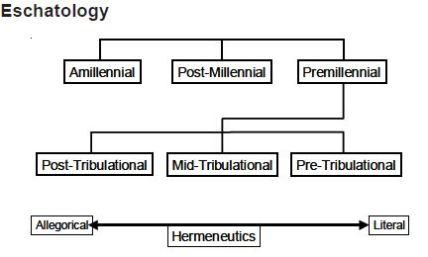
Hermeneutics

THE IMPORTANCE OF PROPHECY

In the history of the church, the eschatological or prophetic portions of Scripture have suffered more from inadequate interpretation than any other major theological subject. The reason for this is that the church turned aside from a normal and grammatical literal interpretation of prophecy to one that is nonliteral and subject to the caprice of the interpreter. This false approach to interpreting prophecy is contradicted beyond question by the fact that so many hundreds of prophecies have already been literally fulfilled.

In the first two centuries of the Christian era the church was predominantly premillennial, interpreting Scripture to teach that Christ would fulfill the prophecy of His second coming to bring a thousand-year reign on earth before the eternal state will begin. This was considered normal in orthodox theology. The early interpretation of prophecy was not always cogent and sometimes fanciful, but for the most part, prophecy was treated the same way as other Scripture.

In the last ten years of the second century and in the third century, the heretical school of theology at Alexandria, Egypt, advanced the erroneous principle that the Bible should be interpreted in a nonliteral or allegorical sense. In applying this principle to the Scriptures, they subverted all the major doctrines of the faith, including prophecy. The early church rose up and emphatically denied the Alexandrian system and to a large extent restored the interpretation of Scripture to its literal, grammatical, historical sense. The problem was that in prophecy there were predictions that had not yet been fulfilled. This made it more difficult to prove that literal fulfillment was true of prophecy. The result was somewhat catastrophic for the idea of a literal interpretation of prophecy, and the church floundered in the area of interpretation of the future.

Augustine (AD 354–430) rescued the church from uncertainty as far as nonprophetic Scripture is concerned, but continued to treat prophecy in a nonliteral way with the purpose of eliminating a millennial kingdom on earth. Strangely, Augustine held to a literal second coming, a literal heaven and a literal hell, but not to a literal millennium. This arbitrary distinction has never been explained.

Because amillennialism, which denies a literal millennial kingdom on earth following the second coming, is essentially negative and hinders intelligent literal interpretation of prophecy, there was little progress in this area. The church continued to believe in heaven and hell and purgatory, but neglected or explained away long passages having to deal with Israel in prophecy and the kingdom on earth as frequently revealed in the Old Testament. Even in the Protestant Reformation, prophecy was not rescued from this hindrance in its interpretation.

Though remnants of the church still advanced the premillennial view, it was not until the nineteenth and twentieth centuries that a movement to restore the literal truth of prophecy began to take hold. The twentieth century was especially significant in the progress of prophetic interpretation in that many details of prophecy were debated and clarified in a way that was not possible before. Though amillennialism continues to be the majority view of the church, among those who hold a high view of Scripture the premillennial interpretation has been given detailed exposition, serving to provide an intelligent view of the present and the future from the standpoint of biblical prophecy.

The importance of prophecy should be evident, even superficially, in examining the Christian faith, for about one-fourth of the Bible was written as prophecy. It is evident that God intended to draw aside the veil of the future and to give some indication of what His plans and purposes were for the human race and for the universe as a whole. The neglect and misinterpretation of Scriptures supporting the premillennial interpretation is now to some extent being corrected.

In the nature of Christian faith a solid hope for the future is essential. Christianity without a future would not be basic Christianity. In contrast to the eschatology of heathen religions, which often paint the future in a forbidding way, Christianity’s hope is bright and clear and offers a Christian the basic idea that the life to come is better than this present life. As Paul stated in 2 Corinthians 5:8, “We are confident, I say, and would prefer to be away from the body and at home with the Lord.” In the Christian faith the future is painted as one of bliss and happiness in the presence of the Lord without the ills that are common to this life.

The revelation of prophecy in Scripture serves as important evidence that the Scriptures are accurate in their interpretation of the future. Because approximately half of the prophecies of the Bible have already been fulfilled in a literal way, it gives a proper intellectual basis for assuming that prophecy yet to be fulfilled will likewise have a literal fulfillment. At the same time it justifies the conclusion that the Bible is inspired of the Holy Spirit and that prophecy, which goes far beyond any scheme of man, is instead a revelation by God of that which is certain to come to pass. The fact that prophecy has been literally fulfilled serves as a guide to interpret the prophecies that are yet ahead.

Scriptural prophecy, properly interpreted, also provides a guideline for establishing the value of human conduct and the things that pertain to this life. For a Christian, the ultimate question is whether God considers what he is doing of value or not, in contrast to the world’s system of values, which is largely materialistic.

Prophecy is also a support for the scriptural revelation of the righteousness of God and a support for the assertion that the Christian faith has an integral relationship to morality. Obviously, the present life does not demonstrate fully the righteousness of God as many wicked situations are not actively judged. Scripture that is prophetic in dealing with this indicates that every act will be brought into divine judgment according to the infinite standard of the holy God, and accordingly, prophecy provides a basis for morality based on the character of God Himself.

Prophecy also provides a guide to the meaning of history. Though philosophers will continue to debate a philosophy of history, the Bible indicates that history is the unfolding of God’s plan and purpose for revealing Himself and manifesting His love and grace and righteousness in a way that would be impossible without human history. In the Christian faith, history reaches its climax in God’s plan for the future in which the earth in its present situation will be destroyed, and a new earth will be created. A proper interpretation of prophecy serves to support and enhance all others areas of theology, and without a proper interpretation of prophecy all other areas to some extent become incomplete revelation.

In attempting to communicate the meaning of Scripture relative to the prophetic past and future, prophecy serves to bring light and understanding to many aspects of our present life as well as our future hope. In an effort to understand and interpret prophecy correctly as a justifiable theological exercise, it is necessary to establish a proper base for interpretation.

GUIDELINES FOR INTERPRETATION OF PROPHECY

The interpretation of prophecy has its own peculiar problems of interpretation when prophecy reveals some future event or is couched in figurative or apocalyptic form. In some instances it is difficult to determine the precise meaning of the text because there is no corroborative comparison with history. In general, however, prophecy is factual. Because so many prophecies have already been literally fulfilled, the nature of this fulfillment provides guidelines for the interpretation of prophecy which is yet unfulfilled. In addition to the general rules of interpreting the Bible, certain additional guidelines assist the interpretation of prophecy.

  1. As is true in the interpretation of all Scripture, it is most important to determine the meaning of significant words in the interpretation of prophecy. Often these words have a historical background that will help in understanding the reference.
  2. One of the important decisions necessary in the interpretation of prophecy is the determination of whether the prophecy concerns the present or the future, that is, whether it refers to a situation now past or present or is prophetic of future events. A biblical prophet, especially in the Old Testament, often delivered contemporary messages that dealt with current problems which were not necessarily futuristic in their revelation. This problem is compounded by the fact that many times prophecy was given in the past tense, where the writer of Scripture took a position of looking back on the prophecy as if it were already fulfilled. Normally, however, it is possible to determine quickly whether the prophecy deals with the past, present, or the future.
  3. Many prophecies of Scripture were fulfilled shortly after their revelation. At least half of the prophecies of the Bible have already been fulfilled literally. Such fulfillment confirms the fact that unfulfilled prophecy will also be literally fulfilled. Fulfilled prophecy is an important guide in interpreting unfulfilled prophecy and generally confirms the concept of literal interpretation of a prophecy.
  4. Prophecies may be conditional or unconditional. This becomes an important aspect of the conclusion that may be reached from the revelation of the prophecy. If a prophecy is conditional, it is possible it will never be fulfilled. If it is unconditional, then it is certain to be fulfilled, regardless of human response. This is an area of confusion in the interpretation of prophecy, as some have assumed that prophecy is conditional when there is no supporting data that indicates this.
  5. Prophecies sometimes have more than one fulfillment. This is referred to as the law of double reference. It is not unusual in Scripture for a prophecy to be partially fulfilled early and then later have a complete fulfillment. Accordingly, what seems to be a partial fulfillment of a prophecy should not be assumed to be the final answer as the future may record a more complete fulfillment.
  6. One of the most important questions in the interpretation of prophecy is whether a prophecy is literal or figurative. As discussed earlier, early in the history of the church, especially in the third century, a school of prophetic interpretation arose in Alexandria that attempted to interpret all the Bible in an allegorical or a nonliteral sense. The influence of this school was one of the major reasons why premillennialism in the early church faded and a form of amillennialism became dominant.

Though the Alexandrian school of theology is labeled by all theologians as heretical, the effect of nonliteral interpretation on prophecy was rendered acceptable by the theological writings of Augustine who applied allegorical interpretation only to prophecy and not to other forms of Scripture revelation. This influence continued through the Protestant Reformation to the present day.

Among conservative interpreters of the Bible, the issue of literal versus figurative or allegorical interpretation is a major issue because on it hangs the question as to whether the Bible teaches a future millennial kingdom following the second advent, or whether it does not. Because the church is divided on this issue, full attention should be given to the interpretation of prophecy as this unfolds in the Bible to see what the Scriptures themselves indicate concerning literal versus nonliteral interpretation.

Confusion also reigns in terminology that sometimes contrasts the literal to the spiritual or the literal to the typical. The nonliteral interpretation of the Bible is not necessarily more spiritual than the literal. The consideration of types in this connection is another confusing aspect. Types, however, depend on the historical fact which is then used as an illustration of a later truth, but it is not prophetic in the ordinary sense. Though it may be demonstrated that most prophecy should be interpreted literally, this does not rule out figurative revelation, allegories, apocalyptic Scriptures, or other forms of nonliteral prophecy. Though it is difficult to deal with these things in the abstract, when studying a particular Scripture, it is not too difficult to determine to what extent it is literal.

  1. Apocalyptic literature is in a place all by itself because all agree that this is not, strictly speaking, literal in its revelation. Outstanding examples, of course, are the books of Daniel, Ezekiel, and Revelation. The fact that such revelation is not literal, however, does not deny it reveals specific facts. Here, skill in interpretation is most necessary, and careful comparison of Scripture with Scripture is essential in determining the actual meaning. This will be illustrated as prophecies of Scripture are interpreted.

As in reading all other types of literature, it may be presumed in studying prophecy that a statement predicting a future event is factual and literal unless there are good reasons for taking it in another sense. Here, the good judgment of the interpreter and avoidance of prejudice and preconceived concepts are most important to let the passage speak for itself.

(Source: John F. Walvoord – Every Prophecy of the Bible: Clear Explanations for Uncertain Times)

THE REVELATION FRAMEWORK – IN SMALL CHUNKS (PART 4) – CHAPTER 1

GREETING THE SEVEN CHURCHES

Revelation 1:4-6

“4 John, to the seven churches which are in Asia: Grace to you and peace from Him who is and who was and who is to come, and from the seven Spirits who are before His throne, 5 and from Jesus Christ, the faithful witness, the firstborn from the dead, and the ruler over the kings of the earth. To Him who loved us and washed us from our sins in His own blood, 6 and has made us kings and priests to His God and Father, to Him be glory and dominion forever and ever. Amen.”

These seven were those which lay nearest to the apostle and were more particularly under his care, though the message concerns the whole Christian world. The greeting can be seen as a “covering letter” sent with the individual letters sent to each of the seven churches.

THE 7 SPIRITS BEFORE THE THRONE

Very clearly, the first phrase refers to God the Father. He is the One who is and who was and who is to come. The last phrase specifically names Jesus Christ, the faithful witness. However, the second phrase is the subject of considerable discussion. The question is, “To whom does the expression “seven Spirits” refer?”

The “seven spirits of God” are also mentioned in Revelation 3:1; 4:5; and 5:6. The seven spirits of God are not specifically identified, so it’s impossible to be dogmatic. Revelation 1:4 mentions that the seven spirits are before God’s throne. Revelation 3:1 indicates that Jesus Christ “holds” the seven spirits of God. Revelation 4:5 links the seven spirits of God with seven burning lamps that are before God’s throne. Revelation 5:6 identifies the seven spirits with the “seven eyes” of the Lamb and states that they are “sent out into all the earth.”

The Bible, and especially the book of Revelation, uses the number 7 to refer to perfection and completion. If that is the meaning of the “seven” in the “seven spirits,” then it is not referring to seven different spirits of God, but rather the perfect and complete Holy Spirit.

Some view the seven spirits of God as referring to seven angelic beings, possibly the seraphim or the cherubim. This would fit with the numerous others angelic beings that are described in the book of Revelation (Revelation 4:6-9; 5:6-14; 19:4-5).

A third possibility is based on Isaiah 11:2, which says, “The Spirit of the LORD will rest on him — the Spirit of wisdom and of understanding, the Spirit of counsel and of power, the Spirit of knowledge and of the fear of the LORD.” This could possibly explain the seven spirits of God: (1) Spirit of the LORD, (2) Spirit of wisdom, (3) Spirit of understanding, (4) Spirit of counsel, (5) Spirit of power, (6) Spirit of knowledge, (7) Spirit of the fear of the Lord. The Bible doesn’t tell us specifically who/what the seven spirits are, but the first interpretation, that they are the Holy Spirit, seems the most likely.

(Main source: https://www.gotquestions.org/seven-spirits-God.html )

KINGS AND PRIESTS

Revelation 1:6 says “and has made us kings and priests to His God and Father” while in Revelation 5:10 we read, “And have made us kings and priests to our God; And we shall reign on the earth.” It also reminds us of 1 Peter 2:9, “But you are a chosen generation, a royal priesthood, a holy nation, His own special people, that you may proclaim the praises of Him who called you out of darkness into His marvelous light;”

The KJV and NKJV uses the word “basileus”, translated “kings, whereas the NASB and ESV uses the word “basilian”, translated, “Kingdom.”. When it is used elsewhere in the bible and the book of Revelation it is always translated as kings, not kingdom.

For translation of the English Bible, there are two major underlying texts being used. The Textus Recpetus is used in the King James and New King James Versions. All other translations use the Critical Text. There are hundreds of variants between these two texts. These translation differences do sometimes cause a doctrinal difference.

There is a major difference between being a King and being a Kingdom. The Scripture is full of references to believers as kings who will reign with Christ, and devoid of any Scripture with reference to believers as being a kingdom currently reigning.  We are kings but we are not a Kingdom. In the modern versions, however, we are presented as being a “Kingdom.” Nowhere in the New Testament is an equivalent teaching expressed. The recipients of the book of James were told that they are heirs to the Kingdom (James 2:5) and the recipients of the book of Hebrews were likewise told that they would receive a Kingdom (Hebrews 12:28), but both of these are a far cry from currently “being a Kingdom,” as the modern text teaches.

“KINGDOM NOW” THEOLOGY

Based on the “we are a Kingdom” teaching, a dangerous “Kingdom Now” theology was introduced. Kingdom Now theology is a branch of Dominion Theology which has had a following within Pentecostalism.

Kingdom Now theology states that although Satan has been in control of the world since the Fall, God is looking for people who will help him take back dominion. Those who yield themselves to the authority of God’s apostles and prophets will take control of the kingdoms of this world, being defined as all social institutions, the “kingdom” of education, the “kingdom” of science, the “kingdom” of the arts, etc.

Although we are spiritually made kings by God’s authority, we by no means have judicial authority on this earth at this present time. Being a king implies authority and legal right to a throne; being a king does not indicate a kingdom in which to exercise that authority. Paradise cannot be restored by man. The Kingdom can only be established by the Messiah. Although we have been redeemed by the Jesus’ sacrifice, our deeds cannot bring about or empower the growth of the Kingdom of God, as seen to be established by Christ himself in Revelation 19.

THE ROLES OF KINGS AND PRIESTS

AS PRIESTS

Christians have the privilege of being kings and priests unto God. At this present time (before the return of Christ) we have a diminished role in this. When Christ returns, we will have a greater role to fulfill.

Currently, before the return of Christ, as kings, we are to reign over sin, the flesh, circumstances and situations, over all the power of the enemy.

Romans 6:14  For sin shall not have dominion over you: for ye are not under the law, but under grace.

Luke 10:19  Behold, I give unto you power to tread on serpents and scorpions, and over all the power of the enemy: and nothing shall by any means hurt you.

Galatians 5:16  This I say then, Walk in the Spirit, and ye shall not fulfill the lust of  the flesh.

Galatians 5:24  And they that are Christ’s have crucified the flesh with the affections and lusts.

Currently, before the return of Christ, as priests, we are to offer up to God, sacrifices of praise and giving and pray on behalf of others.

In future, we will take part in the Millennium as glorified spirit beings. The best example of serving as a king and priest is Jesus Christ. He practiced godly leadership His entire life and taught by His example compassionate service to others. Christ’s instruction to the apostles in Matthew 20 demonstrates that godly leadership is much different from what is generally practiced in the world today. To rule with Christ in the coming Kingdom of God, our leadership role has to be focused on service to others.

As always, we will serve God, of course, but in the sense of helping others, our serving work will be that of guiding and directing the people of the earth. The world of the Millennium will still be a physical one, though under the rule of God through Christ. Our focus will be not on pursuing our own enjoyment but on first aiding and then teaching the thousands of displaced people who survive the calamities at the end of the age.

As the Millennium progresses, the dire consequences of Satan’s influence over the world today will become a distant memory. And over the course of generations, humanity will need to be reminded and warned that Satan will be let loose at the end of the Millennium. At the end of the Millennium, when Satan is released, he will deceive vast multitudes of people, likened to the sand along the seashore in number (Revelation 20:7-10). During nearly a thousand years of godly rule, how often will we need to stir people up and warn them of the roaring lion that will seek to devour them? They will need to be taught about the coming of God the Father to His Kingdom in a new heaven and new earth.

We have an opportunity beyond our lifetime—an opportunity of an eternity. The millennial period on earth will be just the beginning. Our role as kings and priests will mirror Jesus Christ’s example.

AS KINGS

The Christian will reign with Christ, with the King of Kings and Lord of Lords. As the Apostle Paul wrote: “If we endure, we shall also reign with Him” (2 Tim. 2:12).

This is quite astonishing because the context of 2 Timothy 2:12, and of all other passages that refer to Christians reigning with Christ, are of Christians suffering at the hands of strong and powerful people and forces. Paul is saying to Timothy, “Those same people who are presently at the bottom of the ladder, who are treated as the lowest of the low, who are weak and oppressed by everyone; these same people will one day reign with Christ!” Co-regency with the King of Kings. What a reward!

PRESENT REIGN

We already share in Christ’s reign as office-bearers in His church: “And I will give you the keys of the kingdom of heaven, and whatever you bind on earth will be bound in heaven, and whatever you loose on earth will be loosed in heaven” (Matt. 16:19). Christ has delegated spiritual authority to execute His instructions on earth.

Christian believer, you are already a king and share the kingship of Christ. He has “made you a king and a priest unto God” (Rev. 1:6).

FUTURE REIGN

No matter how much believers reign with Christ now, the greatest experience of co-regency lies ahead, beginning with the moment of death.

Although death seems such a moment of weakness of defeat and loss, in reality it’s a moment of victory, of power, and of triumph. At death, the believer fully triumphs over sin, death, and the devil in his soul. He is not defeated by them but defeats them. Just as Christ reigns over sin, death, and the devil, so they do too in a new way. They enter into a new and powerful life; no longer a life of losses and disappointments but of gain and of triumph.

This reign climaxes at the rapture when the believer’s body is reunited with the soul and shares in the soul’s power and authority. Sin, death, the devil, and the world will be under our feet.

But there’s more. Crowned with the crown of righteousness (2 Tim. 4:8), the crown of life (Jas. 1:12; Rev. 2:10), and the crown of glory (1 Peter 5:4), we will access and enjoy the King’s power, possessions, and authority, including even ruling over the angels (1 Cor. 6:3). As Christ promised, the meek shall inherit the earth (Matt. 5:5), and part of that will involve specific responsibilities according to our faithfulness in this world (Luke 19:17).

“But the saints of the Most High shall receive the kingdom, and possess the kingdom forever, even forever and ever” (Dan. 7:18).

(Main source: http://www.alliancenet.org/christward/reigning-with-christ#.XBJYWGgzbcc  )

THE REVELATION FRAMEWORK – IN SMALL CHUNKS (PART 3) – CHAPTER 1

A UNIQUE PROMISE

Revelation 1:3

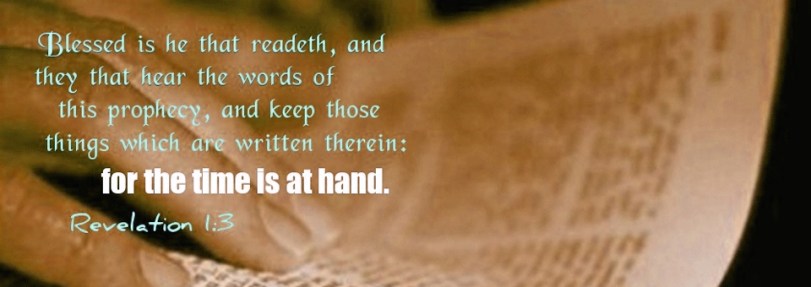
3] “Blessed is he that readeth, and they that hear the words of this prophecy, and keep those things which are written therein: for the time is at hand.”

“Read… Hear… Keep”: From a total of 66 books in our Bible, this is the only book with a special promise if you do these three things. But if all 66 books are highly anointed and inspired by God Himself, then why is He making the statement that specifically the Book of Revelation is the one Book that will cause someone to become blessed in some way?

Notice this statement is being made right at the very beginning of this book. Through the blessing, God is encouraging all of us to read and assimilate what is in this last book. Most Christians, including many pastors, are afraid to try and get into this book and to make an attempt to fully understand it. Some feel it is too hard to try and fully understand the content while for others, it is just too frightening due to the extreme events that will be taking place in the end times. They prefer to keep their heads buried in the sand and not face the fact that God will be releasing His wrath and fury on this world in a way that the world has never seen before and will never see again. They are the same people who also reject the reality of the Great Tribulation, which will be the last 7 years on this earth before Jesus comes back to set up His Millennium Kingdom from the city of Jerusalem. Many even disagree on the fact that Christ will reign on earth, from the throne of David for a thousand years although it is mentioned six times in Revelation 20.

There are three main reasons as to why God wants us to read this last book, and then attempt to fully grasp and assimilate the knowledge and revelation that it contains:

  • As the last book in the Bible, it is the climax to our whole story in the Lord. As such, each Christian should know exactly how everything will eventually play out and what our final ending is going to be in the Lord. Ironically, many Christians believe in what the Bible teaches about the beginning but reject what it teaches about the ending thereof.

Many Christians only know that when they die and depart from this earth, “they will go straight to Jesus, where they will live with all of their saved loved ones forever and ever up in heaven.”

They have no understanding of the rapture of the Church and what it really means when 1 Thess 1:10 says, “And to wait for his Son from heaven, whom he raised from the dead, even Jesus who delivers us from the wrath to come.” 1 Thessalonians 5:9 says, “For God hath not appointed us to wrath, but to obtain salvation by our Lord Jesus Christ.” Luke 21:36 says, “Watch ye therefore, and pray always, that ye may be accounted worthy to escape all these things that shall come to pass, and to stand before the Son of man.” Yet, sadly those without proper Biblical knowledge so often attack the doctrine of the rapture of the Church.

Unless you have read (and study) the book of Revelation and all of the other prophetic Scripture that pertain to these coming end time events in context, you will not know that there are three more chapters that will play itself out before you die or after you had already died and entered into heaven.

After the rapture, the next thing that will occur is that all of the saints who have been living with Jesus up in heaven will be coming back down with Him to rule this earth during His Millennium Kingdom. This Millennium Kingdom will last 1000 years.

After this 1000 years has passed, the next, last, and final event will be God the Father creating a New Heaven and a New Earth where He will then bring both Himself and the city of New Jerusalem down upon our new earth where He and Jesus will then rule this new earth from this new holy city of Jerusalem for the rest of all eternity. The New Heaven and New Earth will be our final resting place with the Lord, and this information and knowledge can only be found in the Book of Revelation.

  • The second key reason that every Christian should be fully armed with knowledge on this topic is because it provides a good idea of the season that we are living in. The generation that sees these things starting to happen, will be the one that will live through all of these end time events if not saved. (Matthew 24:34, “Verily I say unto you, this generation shall not pass, till all these things be fulfilled.”)

Once these end time events start taking place, your knowledge on this subject, your blessed hope and your faith in the Lord will be the only three things that will help get you through until the rapture. You will need to know exactly how everything is going to play out. If not, you could easily lose your faith in the Lord due to the extreme activity that will be occurring during these perilous times (2 Timothy 3). This is why the Lord wants to give all of us more than enough fair warning on exactly what will be coming down the road, so we can properly prepare ourselves to be able to handle all of it once it does start to come our way, until our redemption.

Many teachers on this subject in this day and age believe that there is a very good possibility that our current generation may be the generation that will see the return of our Lord back to this earth. No one obviously knows the exact date or hour of our Lord’s return back to this earth, but there is no question that the end time events prophesied to occur from our Bible are all starting to come to pass. As such, each and every Christian should have some basic fundamental knowledge on this part of our walk with the Lord.

  • The last of the three key reasons is the sharing of knowledge, even with the lukewarm and the unbeliever. The Bible of the Christian faith is the only holy book on earth that contains prophecies for which fulfilment is measurable and evident. This in itself proof that the God of the Bible is real, and His Word is alive. Through prophecy, eyes could thus be opened, God willing.

There is also a second advantage in sharing our knowledge with the lukewarm and the unbeliever. As we read in the book of Revelation, many will turn to Christ subsequent to the rapture of the Church. These are called Tribulation Saints. In their darkest hours the will most probably remember what was shared with them and then study the book of Revelation. It should guide them through this terrible time and also encourage them to hold fast to the truth and their redemption.

THAT THIS IS NOT THE ONLY BLESSING …

There are in fact seven beatitudes (blessings) found in the book of Revelation ( Revelation 1:3; 14:13; 16:15; 19:9; 20:6; 22:7, 14.)

As we saw in part 1 of this series, seven is the predominate number in the book of Revelation. “Blessed” is the Greek word “makarios,” meaning happy, fortunate, or blessed. The seven blessings in Revelation are:

  • Revelation 1:3 as discussed above. This echoes Psalm 1:2. It is God from whom all blessings flow.
  • Revelation 14:13, “And I heard a voice from heaven saying unto me, Write, Blessed are the dead which die in the Lord from henceforth: Yea, saith the Spirit, that they may rest from their labours; and their works do follow them.”

God pronounces this blessing just before the seven bowl judgments of Revelation 16. People who become believers and die during the tribulation will find rest and reward with the Lord. While they pass through many troubles – even death itself – it is all temporary. God’s blessings are eternal.

  • Revelation 16:15, “Behold, I come as a thief. Blessed is he that watcheth, and keepeth his garments, lest he walk naked, and they see his shame.”

This reminds us of many other pieces of Scripture regarding the coming of Christ (cf. Matt 24:42-43; Luke 12:39-40; 1 Thess 5:2; 2 Pet 3:10; Rev 3:3). In Revelation 16:15, Jesus warns those in the tribulation, just prior to the Battle of Armageddon, that He will soon come as a thief. He encourages the Tribulation Saints to endure until the end. As believers, the Bible instructs us to be watchful, and to be spiritually clothed with the Word of God and the rest of the armor of God (Eph 6:12-18).

  • Revelation 19:9, “And he saith unto me, Write, Blessed are they which are called unto the marriage supper of the Lamb. And he saith unto me, These are the true sayings of God.”

The marriage supper of the Lamb is the feast of all feasts (Matt. 22:2; Luke 14:15; 22:16; cf. Isa 25:6). Note the contrasts between this blessed feast and the horrific feast of Revelation 19:17-18. More will be said about the marriage supper, later in this series.

  • Revelation 20:6, “Blessed and holy is he that hath part in the first resurrection: on such the second death hath no power, but they shall be priests of God and of Christ, and shall reign with him a thousand years.”

Daniel 12:2 summarizes the two different fates facing mankind: “Many of them that sleep in the dust of the earth shall awake, some to everlasting life, and some to shame and everlasting contempt.” Everyone will be raised from the dead, but not everyone will share the same destiny.

Revelation 20:4-6 mentions a “first resurrection” and identifies those involved as “blessed and holy.” The second death (the lake of fire, Revelation 20:14) has no power over these individuals. The first resurrection, then, is the raising of all believers before the thousand years when Christ will reign on earth. It corresponds with Jesus’ teaching of the “resurrection of the just” (Luke 14:14) and the “resurrection of life” (John 5:29). Unbelievers will only be raised at the end of the thousand year reign, when the White Throne judgement takes place.

  • Revelation 22:7, ” Behold, I come quickly: blessed is he that keepeth the sayings of the prophecy of this book.”

There is a relationship between the one who heeds (Rev 1:3) and the one who keeps (Rev 22:7) the “words of this book” (Rev 22:10, 18, 19). Reading and hearing the Word is not enough, if not followed by obedience.  John clearly calls this book “prophecy,” not history (compare the unbiblical hyper-preterism view, which views the book mostly as past history). Later in this series we will look at the consequences for adding to, or taking away from this book of prophesy (Revelation 22:18-19).

  • Revelation 22:14, “Blessed are they that do his commandments, that they may have right to the tree of life, and may enter in through the gates into the city.”

Salvation comes from having one’s robes washed in the Lamb’s blood (Revelation 7:14). Only blood-washed believers have the right to partake of the tree of life from which mankind has been barred since the Fall. Only those with robes of righteousness are able to do His commandments and have access to the Holy City (see Psalm 118:20; Isaiah 35:8).

CHRISTIANS, TOXIC FAMILY AND USE AND ABUSE

In a recent article by Christian Sinclair, called “WHY CUTTING OUT TOXIC FAMILY IS A SPIRITUAL ACTION,” he gave some proper guidelines regarding the use and abuse often being practiced by some of our family members. Let’s start this post with some of the highlights from the article.

We often hear people say things such as, “You never turn your back on family,” “It’s the only family you’ve got,” or “Family is forever” The sayings and sentiments around family are endless. We see and hear about loving families and our hearts often aches if we think about some members in our own. We hope and wish that maybe they will change. We think “Maybe if I love them enough, they will see my efforts and know how much I care and that will be enough.” We want to believe that somehow our family will have a pivotal moment that transforms their thoughts, actions, and behaviors and that the family we long to have will finally manifest. Unfortunately, more often than not, some people will never change and instead we are left building ourselves up, while our families let us down or even misuse and abuse us.

It’s normal to want to have a good relationship with our family. However, there comes a time where we have to cut our losses and realize that by staying in the relationship with some of our family members we are allowing ourselves to stay in harm’s way. The fact that you were born into a family does not mean you need to subject yourself to the way they treat you.

When you put crabs together in a bucket and one tries to escape, the other crabs will claw and grab it, pulling it back down into the bucket. Similarly, this is how human nature and family nature can work as well. When you escape the family dynamics, or family mentality, they may be less than thrilled and attempt to pull you back into the bucket. If you are healing, expanding and growing your consciousness you may not be able to make yourself fit into the old family dynamic or be able to stomach the old behavior. This doesn’t make anyone better than another, it simply means your energy and intentions are no longer aligned and may have difficulty coexisting.

WHY IT’S IMPORTANT TO CUT TOXIC FAMILY FROM YOUR LIFE

In every family there are roles that each member plays. If our family is unhealthy it may be difficult or impossible to step out of that role and become your most authentic self. They will see you as the person you were and project that identity on you in the present which may also cloud your perception and personal growth. By disconnecting from your family, you give yourself the ability to unapologetically grow into the real you without staying stuck in the ideas they have of who you are.

If you break a bone and it doesn’t set properly you risk rebreaking it or worse, letting it “heal” the wrong way. When we are attempting to heal relationships, we have to take ourselves out of the situation in order to heal it properly. Especially regarding family. There are many paradigms that are built in a family dynamic and sometimes it requires objective observation that comes from having. distance. By allowing yourself that distance you allow yourself to fully process your own thoughts and feelings without justification or denial from the other party.

HOW TO KNOW WHEN YOUR FAMILY IS TOXIC

There are many types of toxic people and that can take many forms, loudly or passively. A basic guideline is that your family should never demean, criticize, or harm you emotionally, mentally, physically or spiritually.

Your family should always do everything in their power to:

Love and support you, encourage your wellbeing, listen to you, speak kind words, remember important dates and support or at least respect things that matter to you. They should see your worth, value you and your opinion and stand up for you. If needed, they should apologize, take responsibility, and change if they fail or fall short on any of these things. A family that is centered in using these guidelines as a healthy foundation will most likely be a family worth having, supporting, and keeping in your life.

Alternatively, there are many ways family foundations are unhealthy, unstable, or even abusive. You cannot let yourself be mistreated just because you want to be in contact with your family. If your family is continuously treating you badly or disrespecting you should then consider separating from them. Sometimes it can be difficult to recognize how unhealthy their behavior is because you may be used to it.

Some of the most toxic family personalities and behaviors are:

1.They Are Mentally, Physically, Emotionally, Sexually, or Spiritually Abusive

Abuse takes many forms and styles. We tend to think that if abuse doesn’t look the way it does in the movies that it’s “Not that bad.” But abuse in ANY form is wrong and unacceptable. You have the right to feel safe and respected in your body, mind and spirit, and if you feel violated in any way you have the right to cut that person(s) out of your life. You do not have to explain it or justify it beyond that.

2.They Are Narcissists

This is absolutely one of the most difficult obstacles when it comes to family. The term narcissist has become a trendy word that is quite frequently used to describe someone who seems to have an inflated ego. Unfortunately, the real psychological disorder of narcissism far exceeds simply thinking a little too highly of oneself. Narcissists typically lack empathy, are manipulative, have a heightened sense of self importance, see themselves as “holier than thou,” are arrogant, and demanding. The difficulty with having one or more narcissists in your family is that since they think so highly of themselves they generally refuse to accept responsibility for anything and are therefore unwilling to change. They see themselves as above average and everyone else as the problem and their denial keeps them from ever changing or growing. You urgently need to realize that you should have no place for their behavior or personality in your life and the only remedy is to cut them out.

  1. They Are “Latter Day” Worldly People

Their worldliness has a direct impact on your life. They are “lovers of themselves, lovers of money, boasters, proud, blasphemers, disobedient to parents, unthankful, unholy, unloving, unforgiving, slanderers, without self-control, brutal, despisers of good, traitors, headstrong, haughty, lovers of pleasure rather than lovers of God, having a form of godliness but denying its power.” (2 Tim. 3) Paul says, “from such people turn away!”

  1. They Never Follow Through With Their Promises

If your family is consistently breaking their word or engaged in lies, you may need to cut them out. Even worse, do they tell you they will change hurtful behavior but won’t?

  1. They Make You Feel Insane

While some family members may be more aggressive in their toxicity, some can be more passive or manipulative which may even go unnoticed to the outside world. These types of family’s members may make you feel insane or question your sanity. One example of this is when they are wrong in a situation but manipulate you into not only wondering if you were wrong all along, but also make you feel guilty for calling attention to their behavior. This could also be a form of gaslighting, which is a form manipulation that downplays your thoughts, feelings, and emotions and makes you question your sanity. Whether intentionally gaslighting you or not, if you hear yourself asking questions like, “Am I the crazy one here?” When interacting with your family, you probably aren’t. You are probably experiencing gaslighting in some form and need to break free of the behavior to be able to better understand it.

  1. You Just Don’t Resonate With Them

It can feel easier to cut someone out of our lives who is aggressively hurting us, but what if you just don’t resonate with your family as people? Sometimes Christian folk feel like their family doesn’t get their spiritual path or even worse, are being mocked because of their Christian lives and believes.

STEPS OF CUTTING OUT TOXIC FAMILY

Cutting out family members may vary depending on the degree of their behavior and of course depends on your own intuition and what you are aligned with.

1.Start With Boundaries.

Focus on setting some fair, but solid boundaries with yourself and your family. The people who have the biggest problems with boundaries are the ones who like to push them, so your family may not like this. They may also begin to adjust and adapt accordingly which will assist everyone’s expansion.

  1. You May Have To Cut Them Out Completely

If you set boundaries and don’t feel like your family is respecting them you may have to cut them out completely. This is a more extreme measure but sometimes the only option. You may also just need to cut them out with out bothering with boundaries in the first place. You know your family and situation best.

The quote, “People treat you the way you allow them to treat you” is very true. Setting boundaries or changing what you allow may be shocking to your family system, but we are in families to help each other wake up. If they are not willing then it takes the more spirituality minded soul to put the shift in motion. You cannot repeatedly give all of yourself to your family only to be disregarded, mistreated, or abused. If your family refuses to change, grow, or heal, you will have to be the one to change the pattern. They will not suddenly love or appreciate you because you give all of yourself. Please acknowledge that you have done all you can, you have done more than needed, and it is not your responsibility to save them. Sometimes the most spiritual action is walking away and letting someone see just how far from their inner being they are living.

(https://christiansinclair.com/2018/07/17/why-cutting-out-toxic-family-is-a-spiritual-action/)

BEING A CHRISTIAN, THE ABOVE ARTICLE MAY COME FORTH AS A LITTLE HARSH … BUT WHAT DOES THE BIBLE TEACHES IN THIS REGARD?

You may wonder whether it isn’t sinful and wrong to cut off ties with family, even if they were or are abusive. Isn’t the proper thing to do, to be patient and tolerant of their sins?

I don’t believe for one second that the Lord wants us to be endlessly patient and tolerant of others who choose to sin, especially those who sin directly against us. If that were the case, God would find it a sin for us to protect ourselves in any ways, and He doesn’t. Choosing not to entertain the shameful use and abuse of toxic family members, does not make us less-Christian, or “un-Christian,” or ungodly, or anything else along those lines.

It’s hard for a person that has never experienced abuse to understand how a family relationship could be so toxic; toxic to the point it resulted in casting one’s family members out of your life.  My prayer is that you come to understand the worth that God has truly placed on you, and I pray you find the strength to embrace that with all of your being; honoring yourself and loving yourself for all that He truly made you to be. (1 Corinthians 10:13, Romans 12:2, Psalm 139:13-14)

I agree that forgiving is the proper thing to do, for our own peace of mind. Revenge is God’s alone (Romans 12:10) but I am also mindful that the Bible does not tell us to forgive unrepentant people. (Luke 17:3-4). And nowhere in the bible are we instructed to continue on in an abusive, unhealthy, toxic relationship.

There is a thing like second chances, or even a third of a forth, but somewhere a long the lines we need to come to terms with the fact that some people will never change. Even the most Godly and righteous men of God did nott have to keep going back for more. No one has the right to expect us to live our lives being abused, or to judge us for turning our back on them. (Proverbs 31:9)

In the bible, patience is listed as a “gift of the Holy Spirit” and is considered a righteous person’s trait. (Galatians 5:22-23) When this is taken out of context it has a completely different meaning from the way it is presented in Scripture. “Patience”, in the Biblical context, generally refers to not losing faith in God when we are going through hard times, being patient in waiting for Him to rescue us from our trials, and persevering in our faith until we reach our reward in heaven (Proverbs 3:5-6, Psalm 27:13-14). It does NOT refer to being patient in waiting for evil people to change their ways. This is a total misrepresentation of the Word of God. Biblical “patience” never refers to us being patient with wickedness, hurtfulness, abuse, or offensive behavior.

The Bible does not tell us to continue in relationships with people who have damaged us, or are still damaging us, family or not. In fact, the Scriptures are full of teachings instructing us to leave relationships with wicked or evil people, to be separate from them, to shun, outcast, and purge them from our midst. (1 Corinthians 15:33, Proverbs 13:20, Psalm 1:1, Proverbs 6:27, 1 Corinthians 5:11, 1 Corinthians 10:13 – these are just a few). Parents and siblings are no different.

Jesus told the disciples, “But when they persecute you in this city, flee ye into another.” (Matthew 10:25). God did not tell them not to love, He told them to love them from a distance, a great distance because we all must love – we are commanded to love but we are not commanded to love what the evil do.

Spreading the word and teaching others about God’s love for us and encouraging them is not just taught through words, it’s taught in the way that we each live our lives. It’s the light that we shine on the world. This includes the people that we surround ourselves with (Philippians 2:16-16, John 8:12, Matthew 15:16, 1 Peter 2:9, Colossians 3:17, Ephesians 5:8 – there are so many more).

THE REVELATION FRAMEWORK – IN SMALL CHUNKS (PART 2) – CHAPTER 1

OUTLINE OF CHAPTER 1

Verses 1-3 – Introduction

Verses 4-11 – Salutation & Occasion

Verses 12-18 – Vision of the Risen Christ

Verse 19 – Outline of the Book of Revelation

Verse 20 – Prep for Chapters 2 & 3

VERSES 1-3 – INTRODUCTION

MEANING OF “SHORTLY” AND “TIME IS NEAR”

Verse 1] “The Revelation of Jesus Christ, which God gave unto Him, to show unto His servants things which must SHORTLY come to pass; and He sent and signified it by his angel unto His servant John

The word Revelation = “Apocalypsis” and relates to the unveiling of something (18 times used in the NT). Jesus Christ is the key figure in this book as it is all about His second coming. It is no longer a sealed book (Rev 22:10) as it used to be in the time of Daniel (Dan 12:4) and needs be understood by all Christians.

The book of Daniel and the book of Revelation certainly both speak about the same end times period, and yet there is a difference in the commands given to the writer at the end of each book:

This is what Daniel was told at the end of his writing (Dan 12:4):

But as for you, Daniel, conceal these words and seal up the book until the end of time; many will go back and forth, and knowledge will increase.”

This is what John was told at the end of his writing (Rev 22:10):

And he said to me, “Do not seal up the words of the prophecy of this book, for the time is near.

It says that these things must “shortly” come to pass and in verse 3 it also mentions that “time is near.” These verses were written over centuries ago, and these things have still not yet taken place. It’s only natural to wonder how words like “shortly” and “near” could allow for such a long span of time. Preterists argue that these words demand that the prophecies of Revelation must have been fulfilled a long time ago.

The word in verse 1 that is translated as “soon” or “shortly” is the Greek word “tachei” [Strong’s #5034]. Notice how this word is defined: Strong’s — quickness, speed; hastily, immediately.

It’s important to notice that the primary meaning of this word refers to the speed by which an event approaches rather than the duration of time before it arrives. In fact, this same word is generally translated in terms of speed elsewhere in the New Testament, as shown in the following examples:

Luke 8 — 8 “I tell you that He will bring about justice for them QUICKLY. However, when the Son of Man comes, will He find faith on the earth?

Acts 12 — 7 “And behold, an angel of the Lord suddenly appeared and a light shone in the cell; and he struck Peter’s side and woke him up, saying, “Get up QUICKLY.” And his chains fell off his hands.”

Acts 22 — 18 “and I saw Him saying to me, ‘Make haste, and get out of Jerusalem QUICKLY, because they will not accept your testimony about Me.”

Therefore, verse 1 is saying only that God is causing the fulfillment of these prophecies to approach quickly. Regardless of how long it takes, we are not to construe the apparently long delay as idleness on God’s part.

The word in verse 3 that is translated as “time” is the Greek word “kairos” [Strong’s #2540]. Let’s see how this word is defined: Strong’s — fitting season, season, opportunity, occasion, time.

Notice that the primary notion of “time” conveyed by this word isn’t “elapsed time” (as in relation to a clock or calendar), but rather it is “appropriate time”. There are several examples of this word being used this way elsewhere in scripture (e.g. Matt 8:29; Matt 16:3; Matt 24:45; Mark 1:15; Acts 24:25; Rom 5:6; 1 Tim 6:15). So, where John’s says “for the time is near“, it means that it is now (or it is becoming) the appropriate time for these things to happen. This wording emphasizes the appropriateness of the time rather than the shortness of time. The time for these things to happen was appropriate when John wrote Revelation, and it is just as appropriate today.

The only thing that it could mean is that the fulfillment of these things is imminent. The admonition John is making in these verses is to be ready for these things, because they could come any time.

The key thing that makes an event imminent is that, as far as we know, it’s ready to happen but it’s timing is unknown. This agrees exactly with the way Jesus described His return in the end times:

Mark 13:32-37 “32 But of that day or hour no one knows, not even the angels in heaven, nor the Son, but the Father alone. 33 Take heed, keep on the alert; for you do not know when the appointed time will come. 34 It is like a man away on a journey, who upon leaving his house and putting his slaves in charge, assigning to each one his task, also commanded the doorkeeper to stay on the alert. 35 Therefore, be on the alert—for you do not know when the master of the house is coming, whether in the evening, at midnight, or when the rooster crows, or in the morning— 36 in case he should come suddenly and find you asleep. 37 What I say to you I say to all, ‘Be on the alert!’”

Jesus tells us to be alert and watchful precisely because we don’t know when he will return. Specifically, verse 35 says his return could be “in the evening, at midnight, or when the rooster crows, or in the morning”. This is clearly a figurative way to say that we must allow the widest possible range of time for His return to occur.

Any Christian, from the first century onward, should be ready for the possibility of Christ to return in their lifetime — and yet at the same time accept that He might not return until long after their lifetime is over.

There are some other passages that hint that our wait could seem to us like a long time:

2 Pet 3:3-4  “3 Know this first of all, that in the last days mockers will come with their mocking, following after their own lusts, 4 and saying, “Where is the promise of His coming? For ever since the fathers fell asleep, all continues just as it was from the beginning of creation.”

Peter is telling us that in the last days, there will be scoffers who mock believers who still look forward to Christ’s return. Their mistake is to think that because the earth has been effectively ruled by man for such a long time (since creation as well as since Christ promised to come), it will continue that way, which rules out Christ returning to reign as king. Peter answers by saying:

“8 But do not let this one fact escape your notice, beloved, that with the Lord one day is like a thousand years, and a thousand years like one day. 9 The Lord is not slow about His promise, as some count slowness, but is patient toward you, not wishing for any to perish but for all to come to repentance.”

Since Peter mentions a thousand years here in the context of Christ’s return, we should at least accept that a time delay of that scale is possible.

In Matthew 24:45-51, Jesus is teaching His followers to remain faithful until the (unknown) time of His return. As an analogy, he describes a master who goes away, leaving his household in the care of his servants, expecting that they will carry out their duties until he returns. In verses 48-49, he describes a servant who acts wickedly after reasoning that master is not returning for a long time. Again, Jesus is at least raising the idea that people will become dismissive of the possibility that He might return within their own lifetimes.

(Key Source: https://revelationlogic.com/articles/what-does-soon-mean/ )

MEANING OF “SIGNIFIED”

 Verse 1] “The Revelation of Jesus Christ, which God gave unto Him, to show unto His servants things which must shortly come to pass; and He sent and SIGNIFIED it by his angel unto His servant John

Revelation contains symbolism of reality and no prophecy is of private interpretation (2 Pet 1:20). Due to the use of the verb “signified” in Revelation 1:1, some indicate that the book of the Revelation is to be taken as a prophetic communication of symbolism, rather than literalism. But is this a valid understanding and restriction due to the use of the verb “signified”?

The verb “signify” in Revelation 1:1 is translated from the Greek verb “semaino.” This Greek verb is also employed five other times throughout the New Testament, and every one of those times it is translated with some form of the English verb “signify.”  These five other times are as follows:

John 12:32-33 – “And I, if I be lifted up from the earth, will draw all men unto me.  This he said, SIGNIFYING what death he should die.

John 18:31-32 – “Then said Pilate unto them, Take ye him, and judge him according to your law. The Jews therefore said unto him, It is not lawful for us to put any man to death: that the saying of Jesus might be fulfilled, which he spake, SIGNIFYING what death he should die.

John 21:18-19 – “Verily, verily, I say unto thee, When thou wast young, thou girdedst thyself, and walkedst whither thou wouldest: but when thou shalt be old, thou shalt stretch forth thy hands, and another shall gird thee, and carry thee whither thou wouldest not.  This spake he, SIGNIFYING by what death he should glorify God.  And when he had spoken this, he saith unto him, Follow me.

Acts 11:28 – “And there stood up one of them named Agabus, and SIGNIFIED by the Spirit that there should be great dearth throughout all the world: which came to pass in the days of Claudius Caesar.

Acts 25:27 – “For it seemeth to me unreasonable to send a prisoner, and not withal to SIGNIFY the crimes laid against him.

Not in a single one of these five verses does the use of the Greek verb “semaino,” as translated by some form of the English verb “signify,” means “a communication of information through symbolism.”  Rather, in every one of these five cases, the verb means “a communication of information through description.”  Although it may include some symbolism, the meaning of the verb itself does not at all indicate a communication with a focus upon communicating through symbolism, but rather indicates a communication with a focus upon communication through description.  Even so, although the prophetic utterances of the book of the Revelation may indeed include some symbolisms, the use of this verb in Revelation 1:1 would move us to expect, not a prophetic utterance that is primarily symbolic language, but a prophetic utterance that is PRIMARILY LITERAL description.

(Key Source: Pastor Scott Markle, Independent Fundamental Baptist)

Imagine how fearful these event would be if mainly literal. No wonder Jesus described this as a time “such as has not been since the beginning of the world until this time, no, nor ever shall be.”

Unbelievable how Catholics, Preterists and Amillennials refuse to accept Revelation as a prophetic book about end time events, but consider it merely as a book on church history. I am still waiting on them to present any historical evidence that any of these events have taken place in the past.

THE REVELATION FRAMEWORK – IN SMALL CHUNKS (PART 1)

BIBLICAL PRESUPPOSITIONS

  • God means what He says and says what He means.
  • The Bible is an integrated whole: Every detail is there by design (Mt 5:17,18).
  • Nothing is trivial: All things are for our learning (Rom 15:4).
  • God is His own interpreter.

REVELATION: “THE UNVEILING”

  • The consummation of all things.
  • 404 verses containing over 800 allusions from the Old Testament.
  • It presents the climax of God’s Plan for Man.

REVELATION: A PROPHETIC BOOK

Revelation 1:19 says, “Write the things which thou hast seen [The Vision of Christ, Chapter 1], and the things which are [The Seven Churches, Chapters 2,3], and the things which shall be hereafter [That which follows after the Churches, Chapters 4-22]”

The Book of Revelation covers the things of the past, present and future:

  • Past – The Things Which Thou Hast Seen (Rev 1:12-18)
  • Present – The Things Which Are (Rev 2 & 3)
  • Future – The Things Which Shall Be Hereafter (Rev 4-22)

Nevertheless, as seen above, the book mainly claims be of a futuristic / prophetic nature (1:3; 22:7, 10 18-19; cf.10:11):

  • In the Old Testament, there are 1,845 references to Christ’s rule on the earth as 17 OT books give prominence to the event.
  • In 216 chapters of the New Testament, there are 318 references to the Second Coming. It is mentioned in 23 of the 27 books.
  • For every prophecy relating to His First Coming, there are eight that relate to His Second Coming.
  • The New Testament is in the Old Testament concealed; The Old Testament is in the New Testament revealed.

We are being plunged into a period about which the Bible says more than about any other period in history – the end times. Sadly, there are however three different key interpretations being used by Christians:

BOOK WITH A SPECIFIC BLESSING

It is the only book in the Bible that contains a specific blessing, “Blessed is he that readeth, and they that hear the words of this prophecy, and keep those things which are written therein: for the time is at hand.”

In fact, it contains seven beatitudes

  • Blessed is he that readeth, and they that hear and keep those things… (Rev 1:3).
  • Blessed are the dead who die in the Lord (Rev 14:13).
  • Blessed is he that watcheth and keepeth his garments (Rev 16:15).
  • Blessed are they who are called unto the marriage supper of the Lamb (Rev 19:9).
  • Blessed and holy is he that hath part in the first resurrection (Rev 20:6).
  • Blessed is he that keepeth the words of the prophecy of this book (Rev 22:7)
  • Blessed are they that wash their robes (Rev 22:14).

THE STRUCTURE OF SEVENS

  • Seven Churches 1:4,11,20; 2; 3
  • Seven Seals 5; 6
  • Seven Trumpets 8, 9
  • Seven Bowls 15; 16; 17:1; 21:9
  • Seven Lampstands 1:12, 13, 20; 2:1
  • Seven Spirits 1:4; 3:1; 4:5; 5:6
  • Seven Stars 1:16, 20; 2:1; 3:1
  • Seven Lamps 4; 5
  • Seven “Title-pairs” 2; 3
  • Seven Promises to the Overcomer 2;3
  • Seven Horns 5:6
  • Seven Eyes 5:6
  • Seven Angels 8:2,6; 15:1,6,7,8; 16:1; 17:1;21:9
  • Seven Thunders 10:3, 4
  • Seven Thousand 11:13
  • Seven Heads 12:3; 13:1; 17:3, 7, 9
  • Seven Crowns 12:3
  • Seven Plagues 15:1, 6, 8; 21:9
  • Seven Mountains 17:9
  • Seven Kings 17:10,11
  • Seven Years of Judgments 11:3; 12:6,14; 13:5
  • Seven “I Am’s” of Christ 1:8, 11, 17, 18; 21:6; 22:13,16;
  • Seven Doxologies in heaven 4:9-11; 5:8-13; 7:9-12; 11:16-18; 14:2,3; 15:2-4 ;19:1-6
  • Seven New Things 20, 21

…and many, many more.

THE PATMOS EXILE

Patmos is a small island, 6 miles by 10 miles, 40 miles from Miletus and 24 miles from the coast of  Turkey. John was exiled by Domitian (A.D. 81-96), the brother of Titus who destroyed Jerusalem. According to Irenaeus (2nd century A.D.), Revelation was written by John during the reign of Domitian.

Irenaeus, Clement, and Eusebius wrote that after Domitian died, John returned to Ephesus, went to the churches, and appointed leaders, and set things in order.

THE JUDGEMENTS

There are 3 categories of judgement, namely the Seals (Rev 8:5); Trumpets (Rev 11:19); and, Bowls (Rev 16:18).

THREE WOMEN

Revelation deals with the three women:

COMPARISON BETWEEN GENESIS VS REVELATION

GENESIS (Beginning) REVELATION (End)
Earth Created 1:1 Earth Passed away 21:1
Sun, moon, stars 1:14-16 Sun, moon, stars 4:12; 8:12
Earth’s government 37 Earth’s judgment 16:8
Sun to govern Day 1:16 No need of sun 21:23
Darkness called night 1:5 No night there 22:5
Waters He called seas 1:10 No more sea 21:1
A river for earth’s blessing 2:10-14 A river for New Earth 22:1,2
Man in God’s Image 1:26 Man Headed by Satan’s Image 13
Entrance of sin 3 End of sin 21, 22
Curse pronounced 3:14-17 No more curse 22:3
Death entered 3:19 No more death 21:4
Cherubim first mentioned 3:24 Cherubim final mention 19:4
Man driven out of Eden 3:24 Man restored 22
Tree of life guarded 3:24 Access to Tree of life 22:14
Sorrow & suffering enter 3:17 No more sorrow 22:4
Nimrod founds Babylon 10:8-10 Babylon falls 17, 18
God’s Flood to Destroy evil generation 6 – 9 Satan’s flood to Destroy elect generation 12
A bow: God’s promise 9:13 A bow for remembrance 4:3; 10:1
Sodom & Egypt: Corruption, judgement 13, 19 “Sodom & Egypt” (Jerusalem) 11:8
A confederation vs. Abraham’s people 14 Abraham’s Seed 12
A bride for Abraham’s son 24 A bride for Abraham’s Seed 19
Marriage of 1st Adam 2:18-23 Marriage of Last Adam 19
Promised Seed: Possess gate of enemies 29:8 Promised Seed possessing 19
Man’s dominion ceased, and Satan’s begun 3:24 Satan’s domain ended and man’s restored 22

A CHANGING WORLD – SOME KEY THEMES OF PROPHECY

  • Scattering and Regathering of Israel
  • Redemption and Judgement of the Righteous
  • Jerusalem
  • Russia (Magog)
  • Temple
  • Antichrist and False Prophet
  • European Super State
  • Ecumenical Religion
  • Global Government
  • Rise of the Occult
  • Babylon
  • Tribulation
  • The Wrath of God
  • The Second Coming
  • Spiritual Healing of Israel
  • The Millennial Reign of Christ On Earth
  • Judgement of the Unrigteous
  • Eternity – New Heavens and a New Earth

(KEY SOURCE: Supplemental Notes: The Book of Revelation – Chuck Missler)

DEALING WITH FALLEN CHURCHES AND TOXIC PASTORS

In the Bible, we see the moral failure of many leaders and they act as a reminder to us that even those near to God are tempted to turn away. Many pastors fall as a result of unaccountability, pride, and a distorted view of the Bible or even the image of God in all. The rash of well-known church leaders that we have seen fallen within the past two or three years, have nearly all engaged in moral failure or departure from the truths of the Word of God. They have made wrong decisions regarding the proper and biblical way to act as leaders.

There are some churches that would tell you right up front that they are and want to be Biblical, and if someone is in such a church, they would have an opportunity to search the scriptures with their elders and the pastor, as the Bereans did.  On the other hand, there are some churches that are openly liberal, openly experiential, and they have no interest or basis for understanding or for sound doctrine.

In a relatively short period of time, three of my closest friends shared their hardship about things going wrong in their churches, while they received very little to no support from their pastors to address and correct these issues. In all 3 instances, concerns relate to ideas that were promoted by their churches or some of its members, that have no Scriptural basis or completely go against God’s Word.

So now, the questions are whether to act or not and if needed to do so, how should the church and the pastor be approached?

The vision of the body of Christ as having different members must be recalled on a regular basis. Your own role in the church, whether larger or smaller, is critical. Therefore, we should know how to respond to spiritual abuse in our churches. Most people are paralyzed by such situations, not knowing what to do and often in shock that it could even happen.

As leaders, pastors’ call is to speak what must be said and to lead their people into places of safety and openness. If church members have questions over moral failings or unbiblical teachings and practices, they should be allowed to ask these questions in safe places and receive affirmation and comfort that their concerns are valid and will be addressed.

People are hurting in many churches, and leaders either often don’t know or aren’t responding as they ought to, to those who have serious questions and concerns. Some are placing their proverbial fingers in their ears in denial over the serious and deeply troubling conditions in the church today, while others are too afraid to address these issues and upset those in the wrong. A good pastor will never hide from people with hard questions. Sometimes it’s more than just a moral failure— and that may take an honest conversation of a different kind. This is called following Jesus in serving others.

Pastors need godly people, deacons and elders, Sunday school teachers, friends and well-meaning church members to hold us accountable and make sure they accurately handle the Word of Truth (2 Tim 2:15).

The pastor is supposed to confront members of his congregation who are involved in wrongdoing and false teaching and should also be open-minded if his own preaching or moral values are questioned. This is one of his responsibilities as a minister. He should preach on the whole council of God – “preach the word; be ready in season and out of season; reprove, rebuke, exhort, with great patience and instruction,” (2 Tim. 4:2). The Scriptures thus clearly teach that the pastor is to reprove, rebuke, and exhort the congregation. Since individuals are members of the congregation, then the pastor is supposed to go to those individuals and lovingly call them to repentance if needed.

Thom Ranier is a church consultant who has quantified fourteen symptoms of a Toxic Leader. Here are a few symptoms that come to mind: a toxic pastor…

  • manipulates people to promote their personal agenda
  • dodges, deflects, or rejects criticism
  • consistently rationalizes and minimizes their negative behavior
  • intimidates people with their biblical and persuasive arguments
  • twists scripture to support his or her claims
  • turns criticism back on the person who confronts them, shutting them down
  • shields himself or herself from critics and marginalizes them
  • insists on their agenda despite the concerns of others.
  • justifies their agenda by saying that “God told them.”

The pastor’s inner circle is muted, eliminating any kind of accountability. Those on the outer circle don’t feel like they are close enough to the pastor to say anything. They notice questionable behavior but don’t have enough evidence, or proximity to the pastor, to feel confident to say anything. If the inner circle is silent, who are they to say anything? And so it goes.

As time goes by, habits are cemented into place. The pastor is effectively insulated from any correction. He or she is free to perpetrate their toxic behavior because the insiders are silent, and the outsiders have no access. The majority of the church has no idea what’s going on because they only see the pastor on Sunday. If someone does suggest a problem they are often shot down as being critical or rebellious because most people aren’t aware of what’s really happening.

SO WHAT SHOULD WE DO?

I do not encourage people to just pack your bags and leave.  Someone once said if you’re looking for the perfect church and you find it, don’t join it because you will ruin it. Remember, we are not perfect ourselves.  Things that we understand today, we did not understand ten years ago as we do now, and we cannot expect that everybody must have the same maturity in the faith and the same understanding of everything as how we understand these things. Check your motives. Do you want your pastor to be able to hear you and receive what you say? Or do you just need to get something off your chest?

2 Timothy 2:23-24 says, “But avoid foolish and ignorant disputes, knowing that they generate strife. And a servant of the Lord must not quarrel but be gentle to all, able to teach, patient.” On the other hand, we may never compromise with the gospel. Make sure that this is a real issue and that you have gone about it in a gracious, loving, humble manner.

Deal with the issues you have quickly and wisely. Some people wait for year before they raise an issue which had been rankling them. During that time, the individuals who are holding back become bitter and distance themselves from the pastor or church, and sadly, in some instances from the ministry of the Word.  Deal with matters in a timely manner in order to prevent bitterness. As Scripture says, “Be angry and do not sin; do not let the sun go down on your anger and give opportunity to the devil” (Eph. 4:26).

Seek confirmation. Before you confront a pastor, talk to your spouse or a trusted friend in confidence to make sure it’s not just you. Be careful not to use this as an excuse to gossip. The goal is to check the accuracy of what you see as wrong.

Pray before you go. Ask God to season your words with salt and to help you to speak the truth in love. Pray for wisdom as you speak. We may believe that another person, like a friend or even the pastor, will have all the answers to our questions. Here’s the thing: they won’t. Jesus calls us to bring our hurt and pain to Him first. He reminds us that He is the answer to all the wrongs in the world, and that He will one day make things right.

Going to the pastor can feel overwhelming. Who are you to challenge a pastor? Well, if the pastor isn’t open to being challenged then he or she shouldn’t be a pastor. Pastors need to model transparency and humility. The door should always be open. If you feel overwhelmed, it’s fair to speak to a trusted friend or counselor to prep you for the meeting, and even go with you for support.

Ask permission to “go there”.  When you approach your pastor, give him a heads-up that you need to “create a little chaos.” It gives the pastor the opportunity to humble himself and pray for a teachable spirit.

How you deliver your message is everything. Humbly, graciously, not with the idea of being right and the others wrong. Raise a sincere question and ask the pastor if you both could go to the Word of God, that he can show you the contrary to what you believe, if he differs from your views.  Remember, in the Bible Paul said to Timothy not to rebuke an elder, but to entreat him as a father.  Seek to edify and build up your pastor (Eph 4:29). If your goal isn’t to strengthen and help him and the church, even if you need to say difficult things, then you have no business approaching him.

When giving criticism, be ready to receive criticism. Your problem with your pastor may simply be a spiritual problem in your own life. If you object to something he preaches or allows in the church, it may be that he never intended to preach falsely or did not realize what was going on in the church. That said, he is a sinner just like you and may also have been unfaithful in his preaching. Remember that both you and your pastor are sinners. There may be fault on both sides. “Therefore let anyone who thinks that he stands take heed lest he fall” (1 Cor. 10:12).

If the pastor is truly toxic, he will either reject your criticism or placate you with false assurances. Then you need to take your concerns to the next level. Jesus said the next step is to go again, but with two or three witnesses (Matthew 18). These witnesses are people that see the same problem you see or at least trust what you see and will support you and your concerns. If they agree with you, ask them to go with you to the pastor and have them support you and even represent you.

The church is supposed to be a blessing to the world. The pastor should be a champion of grace and truth. There is nothing more perverse and distorted than a toxic pastor. Please do something! Leave or confront. But don’t sit by passively and allow it to continue. So much abuse has been allowed to happen because people have been overly cautious.

If you are not being heard, then you have to decide whether you should leave the church or not. Some people choose to stay and persistently stand opposed to the toxicity. Others feel that a biggest statement is made by leaving. There is no right or wrong response. You must do what you feel is best – but pray for guidance in your final decision.

Never leave a church without having attempted to resolve problems with your pastor. Ducking out is not an option. It is just plain sinful. It is sin against God chiefly, but also against His church. You may have genuine concerns with the ministry of your pastor and the direction of the church. But to leave without speaking to them may lead to further damage in the church. Your voice, rightly and humbly used, may be the instrument God uses to bring godly change in a man’s life. “The heart of the wise teaches his mouth, and adds persuasiveness to his lips. Pleasant words are a honeycomb, sweet to the soul and healing to the bones.” (Prov. 16:23-24)

Philippians 2:14-16 reads, “Do all things without complaining and disputing, that you may become blameless and harmless, children of God without fault in the midst of a crooked and perverse generation, among whom you shine as lights in the world, 16 holding fast the word of life, so that I may rejoice in the day of Christ that I have not run in vain or labored in vain.”

Don’t give up hope. These may be dark days for the church, but Jesus is the light of the world, and as we press on to purify ourselves, his light will shine brighter and brighter. Hebrews 12:12-13 reminds us, “Therefore lift your drooping hands and strengthen your weak knees, and make straight paths for your feet, so that what is lame may not be put out of joint but rather be healed.”

Indeed, we are in a very difficult season and by all outward standards the church is on a perilous path. But for the grace of God who works in us. It is hard. But it is essential as people matter and the gospel matters.