HAS GOD LOST CONTROL?

evil

We are witnessing things happening that we would never have imagined, even 5 or 3 years ago. Evil things. And many ask, “Where is God in all of this?” How can He allow these things? Did He lose control?

The answer to these questions is that He is still omnipresent and in total control. This is all part of His ultimate plan of redemption.

He offers men the ultimate opportunity to give expression to the evil from within. To show their “true colours.” To decide whether to follow in the footsteps of His Son, Jesus Christ or to allow the spirit of the Antichrist to indwell them. And being a righteous God, He will judge all accordingly.

This “opportunity” leads to the perilous end times, Paul warned about in 2 Timothy 3:1-5. The opposite of evil is good. The ultimate of evil is Satan while the ultimate of good is Jesus Christ. That is why we witness the attack of everything that is associated with Christ (God). They question creation and even gender … men in dresses are now legally considered to be “women.” They break his laws in the most evil ways … “You shall not murder” … millions of mothers kill their own unborn babies. The rise in Anti-Semitism and persecution of Christians speak for itself. Jesus said, “If the world hates you, you know that it hated Me before it hated you.” (John 15:18)

Humanity is reaching a point where “the wrath of God is revealed from heaven against all ungodliness and unrighteousness of men, who suppress the truth in unrighteousness.” (Romans 1:18) “Therefore God also gave them up to uncleanness, in the lusts of their hearts, to dishonor their bodies among themselves.” (Romans 1:24). He will eventually “send them strong delusion, that they should believe the lie, that they all may be condemned who did not believe the truth but had pleasure in unrighteousness.” (2 Thessalonians 2:11-12)

Men has a last chance to live as such as to “be counted worthy to escape all these things that will come to pass,” (Luke 21:36). What we witess is only the beginning of the sorrows (Matthew 24:8).

The “opportunity” to either express one’s evil, or to follow Christ is in some way also the beginning of God separating the sheep and the goat.

First, Christ will remove His bride. He will keep her “from the hour of trial which shall come upon the whole world, to test those who dwell on the earth.” (Revelation 3:10) The unwise virgins (Matthew 25:1-13) and the ungodly will be left behind. This event will shock many and they will turn to God. But they will pay a price for their redemption – probably with their lives. Sadly, most will rather mock and swear at God and eventually take the mark of the beast.

With the church being removed, the Antichrist will sign a covenant with “many” (Daniel 9:27) and introduce a false peace. But “when they shall say, Peace and safety; then sudden destruction cometh upon them, as travail upon a woman with child; and they shall not escape.” (1 Thessalonians 5:3) All “hell” will then break loose. What we are seeing now will look like a play in a kindergarten. Jesus warned that “then there will be great tribulation, such as has not been since the beginning of the world until this time, no, nor ever shall be.”

So dear friend – fill your lamps with oil. “Watch ye therefore, and pray always, that ye may be accounted worthy to escape all these things that shall come to pass, and to stand before the Son of man.” “Look up and lift up your heads, because your redemption draws near.” “Therefore comfort one another with these words.” (1 Thessalonians 4:18) “Wherefore comfort yourselves together, and edify one another, even as also ye do.” (1 Thessalonians 5:11)

THE SEVEN FUTURE JUDGEMENTS

A Sheep & Goat

There will be seven judgements in future:

  1. The Judgment Seat of Christ (2 Corinthians 5:10)

Church-age believers will appear before the judgment seat of Christ in heaven for reward. This will happen soon after the rapture of the church.

  1. Old Testament Believers (Daniel 12:1-3)

All Old Testament believers will be resurrected and rewarded after the Second Coming.

  1. Tribulation Believers (Revelation 20:4-6)

Those who trust Christ during the Tribulation and are martyred will be resurrected and rewarded at the end of the Tribulation.

  1. Jews Living at the Second Coming (Ezekiel 20:34-38)

All Jews who survive the Tribulation will be judged right after the Second Coming. The saved will enter the millennial kingdom, and the lost will be purged.

  1. Gentiles Living at the Second Coming (Matthew 25:31-46)

All Gentiles who survive the Tribulation will be judged immediately after the Second Coming when Christ sits on His glorious throne. This is often referred to as the judgment of the “sheep and the goats.” The righteous will enter the millennial kingdom, and the unrighteous will be cast into hell.

  1. Satan and Fallen Angels (Revelation 20:10)

The final judgment of Satan and fallen angels (demons) will take place after the millennial kingdom (Matthew 25:41; 2 Peter 2:4; Jude 6).

  1. The Great White Throne (Revelation 20:11-15)

The judgment of unrighteous people will occur at the end of the Millennium. They will be judged according to their works and cast into the lake of fire.

BIBLICAL INTERPRETATION OF PROPHECY – JOHN F. WALVOORD

EVERY PROPHECY

THE IMPORTANCE OF PROPHECY

In the history of the church, the eschatological or prophetic portions of Scripture have suffered more from inadequate interpretation than any other major theological subject. The reason for this is that the church turned aside from a normal and grammatical literal interpretation of prophecy to one that is nonliteral and subject to the caprice of the interpreter. This false approach to interpreting prophecy is contradicted beyond question by the fact that so many hundreds of prophecies have already been literally fulfilled.

In the first two centuries of the Christian era the church was predominantly premillennial, interpreting Scripture to teach that Christ would fulfill the prophecy of His second coming to bring a thousand-year reign on earth before the eternal state will begin. This was considered normal in orthodox theology.

The early interpretation of prophecy was not always cogent and sometimes fanciful, but for the most part, prophecy was treated the same way as other Scripture.

In the last ten years of the second century and in the third century, the heretical school of theology at Alexandria, Egypt, advanced the erroneous principle that the Bible should be interpreted in a nonliteral or allegorical sense.

In applying this principle to the Scriptures, they subverted all the major doctrines of the faith, including prophecy. The early church rose up and emphatically denied the Alexandrian system and to a large extent restored the interpretation of Scripture to its literal, grammatical, historical sense. The problem was that in prophecy there were predictions that had not yet been fulfilled. This made it more difficult to prove that literal fulfillment was true of prophecy. The result was somewhat catastrophic for the idea of a literal interpretation of prophecy, and the church floundered in the area of interpretation of the future.

Augustine (AD 354–430) rescued the church from uncertainty as far as nonprophetic Scripture is concerned, but continued to treat prophecy in a nonliteral way with the purpose of eliminating a millennial kingdom on earth. Strangely, Augustine held to a literal second coming, a literal heaven and a literal hell, but not to a literal millennium. This arbitrary distinction has never been explained.

Because amillennialism, which denies a literal millennial kingdom on earth following the second coming, is essentially negative and hinders intelligent literal interpretation of prophecy, there was little progress in this area. The church continued to believe in heaven and hell and purgatory, but neglected or explained away long passages having to deal with Israel in prophecy and the kingdom on earth as frequently revealed in the Old Testament. Even in the Protestant Reformation, prophecy was not rescued from this hindrance in its interpretation.

Though remnants of the church still advanced the premillennial view, it was not until the nineteenth and twentieth centuries that a movement to restore the literal truth of prophecy began to take hold. The twentieth century was especially significant in the progress of prophetic interpretation in that many details of prophecy were debated and clarified in a way that was not possible before.

Though amillennialism continues to be the majority view of the church, among those who hold a high view of Scripture the premillennial interpretation has been given detailed exposition, serving to provide an intelligent view of the present and the future from the standpoint of biblical prophecy.

The importance of prophecy should be evident, even superficially, in examining the Christian faith, for about one-fourth of the Bible was written as prophecy. It is evident that God intended to draw aside the veil of the future and to give some indication of what His plans and purposes were for the human race and for the universe as a whole. The neglect and misinterpretation of Scriptures supporting the premillennial interpretation is now to some extent being corrected.

In the nature of Christian faith a solid hope for the future is essential. Christianity without a future would not be basic Christianity. In contrast to the eschatology of heathen religions, which often paint the future in a forbidding way, Christianity’s hope is bright and clear and offers a Christian the basic idea that the life to come is better than this present life. As Paul stated in 2 Corinthians 5:8, “We are confident, I say, and would prefer to be away from the body and at home with the Lord.” In the Christian faith the future is painted as one of bliss and happiness in the presence of the Lord without the ills that are common to this life.

The revelation of prophecy in Scripture serves as important evidence that the Scriptures are accurate in their interpretation of the future. Because approximately half of the prophecies of the Bible have already been fulfilled in a literal way, it gives a proper intellectual basis for assuming that prophecy yet to be fulfilled will likewise have a literal fulfillment. At the same time it justifies the conclusion that the Bible is inspired of the Holy Spirit and that prophecy, which goes far beyond any scheme of man, is instead a revelation by God of that which is certain to come to pass. The fact that prophecy has been literally fulfilled serves as a guide to interpret the prophecies that are yet ahead.

Scriptural prophecy, properly interpreted, also provides a guideline for establishing the value of human conduct and the things that pertain to this life.

For a Christian, the ultimate question is whether God considers what he is doing of value or not, in contrast to the world’s system of values, which is largely materialistic.

Prophecy is also a support for the scriptural revelation of the righteousness of God and a support for the assertion that the Christian faith has an integral relationship to morality. Obviously, the present life does not demonstrate fully the righteousness of God as many wicked situations are not actively judged.

Scripture that is prophetic in dealing with this indicates that every act will be brought into divine judgment according to the infinite standard of the holy God, and accordingly, prophecy provides a basis for morality based on the character of God Himself. Prophecy also provides a guide to the meaning of history. Though philosophers will continue to debate a philosophy of history, the Bible indicates that history is the unfolding of God’s plan and purpose for revealing Himself and manifesting His love and grace and righteousness in a way that would be impossible without human history. In the Christian faith, history reaches its climax in God’s plan for the future in which the earth in its present situation will be destroyed, and a new earth will be created.

A proper interpretation of prophecy serves to support and enhance all others areas of theology, and without a proper interpretation of prophecy all other areas to some extent become incomplete revelation.

In attempting to communicate the meaning of Scripture relative to the prophetic past and future, prophecy serves to bring light and understanding to many aspects of our present life as well as our future hope. In an effort to understand and interpret prophecy correctly as a justifiable theological exercise, it is necessary to establish a proper base for interpretation.

THE INTERPRETATION OF PROPHECY

General Assumptions in Biblical Interpretation

As in all sciences, theology is based on assumptions. Mankind finds itself living in an ordered world with observable natural laws and evidence of design. The nature of the ordered world in which we live reveals an evident interrelationship of purposes requiring the existence of a God who is infinite in power, rational, and has the basic elements of personality, intellect, sensibility, and will. The observable facts of nature as well as revelation through Scripture must be consistent with such a God. These facts, organized into a rational system, are the substance of theology, making it a science embracing revealed facts about God, creation, and history. To the observable facts in nature, Scripture reveals the additional truth that the God of history is gracious, holy, loving, patient, faithful, good, and has infinite attributes of knowledge, power, and rational purpose.

What is true of theology as a whole is especially true of biblical interpretation. In approaching the interpretation of the Bible, at least four assumptions are essential.

  1. In order to have a coherent and consistent interpretation of the Bible, it is necessary to assume that there is ample proof that the Bible was inspired by the Holy Spirit and that the human authors were guided in the writing of Scripture and in the selection of the very words that they used. Accordingly, the Bible is an inerrant revelation containing all the truth that God intended to be included and excluding all facts that were not intended to be included. As the inspired Word of God, it should be expected that, properly interpreted, the Bible does not contradict itself.
  2. The Bible was intended to communicate truth about God and the universe, to record historical facts, to reveal ethical principles, to provide wisdom for human judgments, to reveal moral and material values, and to provide prediction of future events.
  3. The Bible progressively reveals the truth of God in such a way that changes in the moral rule of life are recognized, such as the contrast between the Mosaic law and the present age of grace. Later revelation may replace earlier revelation as a standard of faith without contradicting it.
  4. Though the Bible is an unusual book, in many respects it is a normative piece of literature, using words to convey truth, and yet providing a great variety of literary forms, such as history, poetry, and prophecy, and sometimes using normal figures of speech. Though a supernatural book, the Bible nevertheless speaks in normative ways that can be illustrated in literature outside the Bible.

General Rules of Biblical Interpretation

Though the interpretation of the Bible is an exceedingly complex problem, if certain general rules are followed, they will keep the interpreter from misunderstanding Scripture.

  1. In approaching Scripture, first of all there must be study of the words that are used, their general usages, variety of meaning, historical context, theological context, and any determination of the probable meaning of the word used in a particular context.
  2. Words in Scripture are used in a grammatical context that should be observed, including such matters as whether the word is used in a statement of fact, a command, a desired goal, or an application to a particular situation.
  3. In any interpretation it is most important to decipher to whom the Scripture is addressed, as this involves the application of the statement.
  4. Scripture should never be interpreted in isolation from its context. Careful thought should be given to the immediate context, the general context, and the context of the whole of Scripture. This will serve to relate the revelation contained to other divine revelations.
  5. The literary character of the Scripture interpreted should be taken into consideration as the Bible is written in a variety of literary styles—such as history, poetry, worship, prediction—and uses a variety of figures of speech. These factors determine the interpretation of a particular text.
  6. If the Scripture is inspired by the Holy Spirit and without error, it is important to compare any particular text to all other Scripture that might be relative. For instance, the book of Revelation may often be interpreted through a study of the book of Daniel. One Scripture will serve to cast light on other Scriptures.
  7. Though the Bible is largely written in factual style to be interpreted as a normal, factual presentation, the Bible, like all other literature, uses figures of speech, and they should be recognized for their intended meaning. All forms of biblical literature ultimately yield a factual truth.
  8. In interpreting the Bible, one must seek the guidance of the indwelling Holy Spirit who casts light on the Scriptures and guides its interpretation.

Guidelines for Interpretation of Prophecy

The interpretation of prophecy has its own peculiar problems of interpretation when prophecy reveals some future event or is couched in figurative or apocalyptic form. In some instances it is difficult to determine the precise meaning of the text because there is no corroborative comparison with history. In general, however, prophecy is factual. Because so many prophecies have already been literally fulfilled, the nature of this fulfillment provides guidelines for the interpretation of prophecy which is yet unfulfilled. In addition to the general rules of interpreting the Bible, certain additional guidelines assist the interpretation of prophecy.

  1. As is true in the interpretation of all Scripture, it is most important to determine the meaning of significant words in the interpretation of prophecy. Often these words have a historical background that will help in understanding the reference.
  2. One of the important decisions necessary in the interpretation of prophecy is the determination of whether the prophecy concerns the present or the future, that is, whether it refers to a situation now past or present or is prophetic of future events. A biblical prophet, especially in the Old Testament, often delivered contemporary messages that dealt with current problems which were not necessarily futuristic in their revelation. This problem is compounded by the fact that many times prophecy was given in the past tense, where the writer of Scripture took a position of looking back on the prophecy as if it were already fulfilled. Normally, however, it is possible to determine quickly whether the prophecy deals with the past, present, or the future.
  3. Many prophecies of Scripture were fulfilled shortly after their revelation. At least half of the prophecies of the Bible have already been fulfilled literally. Such fulfillment confirms the fact that unfulfilled prophecy will also be literally fulfilled. Fulfilled prophecy is an important guide in interpreting unfulfilled prophecy and generally confirms the concept of literal interpretation of a prophecy.
  4. Prophecies may be conditional or unconditional. This becomes an important aspect of the conclusion that may be reached from the revelation of the prophecy. If a prophecy is conditional, it is possible it will never be fulfilled. If it is unconditional, then it is certain to be fulfilled, regardless of human response. This is an area of confusion in the interpretation of prophecy, as some have assumed that prophecy is conditional when there is no supporting data that indicates this.
  5. Prophecies sometimes have more than one fulfillment. This is referred to as the law of double reference. It is not unusual in Scripture for a prophecy to be partially fulfilled early and then later have a complete fulfillment. Accordingly, what seems to be a partial fulfillment of a prophecy should not be assumed to be the final answer as the future may record a more complete fulfillment.
  6. One of the most important questions in the interpretation of prophecy is whether a prophecy is literal or figurative. As discussed earlier, early in the history of the church, especially in the third century, a school of prophetic interpretation arose in Alexandria that attempted to interpret all the Bible in an allegorical or a nonliteral sense. The influence of this school was one of the major reasons why premillennialism in the early church faded and a form of amillennialism became dominant.

Though the Alexandrian school of theology is labeled by all theologians as heretical, the effect of nonliteral interpretation on prophecy was rendered acceptable by the theological writings of Augustine who applied allegorical interpretation only to prophecy and not to other forms of Scripture revelation. This influence continued through the Protestant Reformation to the present day.

Among conservative interpreters of the Bible, the issue of literal versus figurative or allegorical interpretation is a major issue because on it hangs the question as to whether the Bible teaches a future millennial kingdom following the second advent, or whether it does not. Because the church is divided on this issue, full attention should be given to the interpretation of prophecy as this unfolds in the Bible to see what the Scriptures themselves indicate concerning literal versus nonliteral interpretation.

Confusion also reigns in terminology that sometimes contrasts the literal to the spiritual or the literal to the typical. The nonliteral interpretation of the Bible is not necessarily more spiritual than the literal. The consideration of types in this connection is another confusing aspect. Types, however, depend on the historical fact which is then used as an illustration of a later truth, but it is not prophetic in the ordinary sense. Though it may be demonstrated that most prophecy should be interpreted literally, this does not rule out figurative revelation, allegories, apocalyptic Scriptures, or other forms of nonliteral prophecy. Though it is difficult to deal with these things in the abstract, when studying a particular Scripture, it is not too difficult to determine to what extent it is literal.

  1. Apocalyptic literature is in a place all by itself because all agree that this is not, strictly speaking, literal in its revelation. Outstanding examples, of course, are the books of Daniel, Ezekiel, and Revelation. The fact that such revelation is not literal, however, does not deny it reveals specific facts. Here, skill in interpretation is most necessary, and careful comparison of Scripture with Scripture is essential in determining the actual meaning. This will be illustrated as prophecies of Scripture are interpreted.

As in reading all other types of literature, it may be presumed in studying prophecy that a statement predicting a future event is factual and literal unless there are good reasons for taking it in another sense. Here, the good judgment of the interpreter and avoidance of prejudice and preconceived concepts are most important to let the passage speak for itself.

MAJOR THEOLOGICAL INTERPRETATIONS OF PROPHECY

Amillennial Interpretations

Within orthodox interpretations of the Bible the most prominent theological interpretation of prophecy since the fourth century of the Christian era has been amillennial or non-millennial. Beginning with Augustine, the amillennial interpretation held that there would be no literal future thousand-year reign of Christ on earth, but that the millennium referred to the present age or possibly the last thousand years of the present age. Because this did not provide a literal interpretation of millennial passages, it has been designated as amillennial since the nineteenth century.

The amillennial interpretation within the limits of orthodox theology has had various explanations of fulfillment of the millennial prophecies. The most popular, the Augustinian interpretation, relates the millennium in the present age as a spiritual kingdom ruling in the hearts of Christians or embodied in the progress of the gospel in the church.

Amillenarians of the nineteenth and twentieth centuries have offered varied interpretations, some holding that the millennium is fulfilled in the time between the death and resurrection of a Christian. Some in the twentieth century hold that the millennium will be fulfilled in the new heaven and the new earth as described in Revelation 21–22. Some amillenarians have also suggested that the millennial passages are conditional and will not be fulfilled due to the departure of Israel from the faith. Still others suggest that the kingdom of earth was fulfilled in the reign of Solomon who controlled the land promised to Abraham (Gen. 15:18).

Within twentieth-century amillennialism the neo-orthodox interpretation of Scripture may also be considered. This view considers the kingdom being fulfilled now in the experience of individual Christians. Generally speaking, neo-orthodox scholars hold that God directly communicates to Christians supernaturally, but the Bible is not considered in itself an infallible record of revelation.

Liberal theologians also are amillennial in the sense that they do not believe any future millennium will ever take place.

Postmillennial Interpretation

Beginning with Daniel Whitby in the eighteenth century, an interpretation of prophecy became popular that held specifically that the millennium would be the last one thousand years of the present age. Adherents of this view believed the gospel would triumph to such an extent in the world that the whole world would be Christianized, bringing in a golden age that would correspond to the millennial kingdom. Like amillennialism, it places the second coming of Christ at the end of the millennium. Postmillennialism in its original form attempted a more literal interpretation of the millennium than was followed by the later postmillenarians of the twentieth century.

In the twentieth century, however, postmillennialism, influenced by evolution, became less biblical and adopted the concept of spiritual progress over a long period of time as in a general way bringing in a golden age. These postmillenarians, however, are not considered orthodox. As a theological movement, postmillennialism largely died in the first part of the twentieth century, but small groups have attempted to revive it in current theological discussion.

Premillennial Interpretation

From the first century, Bible scholars have held that the second coming of Christ will be premillennial, that is, the second coming will be followed by a thousand years of Christ’s literal reign on earth. This was a predominant view of the early church as witnessed by the early church fathers. By the third century, however, the Alexandria school of theology, bringing in sweeping allegorical interpretation of Scripture, succeeded in displacing the premillennial view.

In the last few centuries, however, premillennialism has been revived by biblical scholars and now is held by many who are orthodox in other respects.

Unlike amillennialism and postmillennialism, the premillennial interpretation has no liberal adherents as it builds on the concept that the Bible is the Word of God and that prophecies are to be interpreted in their normal literal sense.

The premillennial view has much to commend it, as it has the same principles of interpretation regarding prophecy as is normal in other areas of theological interpretation. The premillennial view is generally adopted in the interpretation of prophecy in this work. The fact that so many prophecies have already been literally fulfilled lends support for the expectation that prophecies yet to be fulfilled will have the same literal fulfillment.

(Source: Every Prophecy In The Bible – John F. Walvoort)

THESSALONIANS –THE RAPTURE, THE DAY OF THE LORD & ANTICHRIST

0 thes rapture

Through the prophet Isaiah, God declared, “My purpose will be established, and I will accomplish all My good pleasure” (Isa. 46:10), and “I act and who can reverse it?” (Isa. 43:13).

Paul had preached the sobering truth about the Day of the Lord to the Thessalonians during his relatively brief stay in their city (2 Thess. 2:5). After he left, questions arose in their minds about both the Rapture and the Day of the Lord. Second Thessalonians was written from Corinth a few months after 1 Thessalonians

LONGING, WAITING, HOPING

“and to wait for His Son from heaven, whom He raised from the dead, that is Jesus, who rescues us from the wrath to come.” (1 Thes 1:10)

Those who love Christ long for and anticipate His return. To wait for the Lord’s return is a recurring theme in the Thessalonian letters (1 Thess. 2:19-20; 3:13; 4:15–17; 5:8, 23; 2 Thess. 3:6–12).

Paul also said:

“In the future there is laid up for me the crown of righteousness, which the Lord, the righteous Judge, will award to me on that day; and not only to me, but also to all who have loved His appearing.” (2 Tim. 4:8)

“For the grace of God has appeared, bringing salvation to all men, instructing us to deny ungodliness and worldly desires and to live sensibly, righteously and godly in the present age, looking for the blessed hope and the appearing of the glory of our great God and Savior, Christ Jesus.” (Titus 2:11–13)

Wrath is God’s eternal judgment against sin. Unfortunately, in the postmodern world the idea of divine wrath is largely rejected, so the Rescuer is not needed or heeded.

As true believer we eagerly look forward to Christ’s return because we know that God will rescue us from the wrath to come. Some believe that the mentioning of “the wrath to come” refers to the tribulation and see this rescue as the promise of the pretribulation Rapture. But the immediate context of Paul’s discussion of election and salvation in chapter 1, rather than eschatology, mainly rules out temporal wrath and points to eternal wrath, as does the wrath mentioned in 1 Thessalonians 1:5:9—“For God has not destined us for wrath, but for obtaining salvation through our Lord Jesus Christ.”

“For who is our hope or joy or crown of exultation? Is it not even you, in the presence of our Lord Jesus at His coming? For you are our glory and joy.” (1 Thes 2:19–20)

Paul always lived and taught others to live in the light of Jesus Christ’s return (Rom. 13:12; Phil. 3:20; 2 Tim. 2:12; 4:8, 18; cf. 1 Cor. 1:7–8; Phil. 4:5; Titus 2:13), and here he plainly stated that the glory to come to believers when Christ returns, provides a powerful motivation for ministering.

The crown of exultation (cf. Prov. 1:9; 1 Cor. 9:25; 2 Tim. 4:8; James 1:12; 1 Peter 5:4; Rev. 2:10; 3:11; 6:2) is the festive wreath or victor’s crown, awarded for athletic triumph, and exultation denotes the exuberant expression of joyful feelings, and sometimes is translated “boasting,” in the righteous sense. From the Greek, one can literally render this phrase, “the crown which is rejoicing.” Similarly, “the crown of life” (James 1:12) is “the crown which is life,” and “the crown of righteousness” (2 Tim. 4:8) is “the crown which is righteousness.” The “incorruptible” crown (1 Cor. 9:25 KJV) is the reality of salvation’s triumph over believers’ corruption. The crown or wreath denotes the overwhelming victory God gives His own over sin, suffering, death, and judgment (cf. 1 Peter 5:4).

“so that He may establish your hearts without blame in holiness before our God and Father at the coming of our Lord Jesus with all His saints.” (1 Thes 3:13)

The final objective of Paul’s prayer for the Thessalonians was that they might look to their glorification, which produces a purifying hope. The nature of that hope is best stated in 1 John 3:2, “Beloved, now we are children of God, and it has not appeared as yet what we will be. We know that when He appears, we will be like Him, because we will see Him just as He is” (cf. Phil. 3:20–21).

Paul knew that the promise of Christ’s return to Rapture and reward the church is the essence of believers’ purifying hope.

THE RAPTURE

“For this we say to you by the word of the Lord, we who are alive and remain until the coming of the Lord, will not precede those who have fallen asleep.” (1 Thes 4:15)

The Rapture does not rest on the shaky foundation of whimsical theological speculation, but on the sure foundation of the death, resurrection, and revelation of the Lord Jesus Christ. Two groups of people will participate in the Rapture: those who are alive at the coming of the Lord and those who have fallen asleep.

In Romans 13:11-12 Paul wrote, “Do this, knowing the time, that it is already the hour for you to awaken from sleep; for now salvation is nearer to us than when we believed. The night [of man’s sin and Satan’s rule] is almost gone, and the day [of Christ’s return] is near.” The salvation of which he wrote was the redemption of the body (Rom. 8:23) that takes place when Christ returns.

He wrote to the Corinthians, “Behold, I tell you a mystery; we will not all sleep, but we will all be changed, in a moment, in the twinkling of an eye, at the last trumpet; for the trumpet will sound, and the dead will be raised imperishable, and we will be changed” (1 Cor. 15:51–52). As he concluded that letter Paul wrote, “If anyone does not love the Lord, he is to be accursed. Maranatha” (1 Cor. 16:22). Maranatha comes from two Aramaic words that mean “Oh Lord, come!” and expresses Paul’s strong hope that the Lord would return soon.

Paul fully realized that he might die before the Rapture. In 1 Corinthians 6:14 he acknowledged that he might be among those resurrected at the Rapture: “Now God has not only raised the Lord, but will also raise us up through His power.” He affirmed to the Philippians his desire that “Christ will even now, as always, be exalted in my body, whether by life or by death” (Phil. 1:20).

Paul lived in constant expectation of Christ’s return. But the apostle nevertheless reassured the Thessalonians that those of their number who had died would not miss the Rapture, which will also include those who have fallen asleep. Moreover, the living will not precede the dead. They will not take precedence over them or gain an advantage over them. Those who die before the Rapture will in no sense be inferior to those who are alive. All Christians will participate in the Rapture.

“For the Lord Himself will descend from heaven with a shout, with the voice of the archangel and with the trumpet of God, and the dead in Christ will rise first. Then we who are alive and remain will be caught up together with them in the clouds to meet the Lord in the air, and so we shall always be with the Lord.” (1 Thes 4:16–17)

First, the Lord Himself will return for His church. He will not send angels for it, in contrast to the gathering of the elect that takes place at the Second Coming (Mark 13:26–27).

Second, Jesus will descend from heaven, where He has been since His ascension (Acts 1:9–11).

Third, when Jesus comes down from heaven, He will do so with a shout. The Lord’s shout of command will be similar to His raising of Lazarus, when “He cried out with a loud voice, ‘Lazarus, come forth’” (John 11:43). This is the hour “when the dead will hear the voice of the Son of God, and those who hear will live” (John 5:25). The righteous dead of the church age will be the first to rise—a truth that must have greatly comforted the anxious Thessalonians.

Fourth, the voice of the archangel will sound. There is no definite article in the Greek text, which literally reads, “an archangel.” Jude 9 is the only other passage in Scripture that mentions an archangel, the archangel is Michael. Scripture does not say whether or not he is the only archangel (there were seven archangels according to Jewish tradition). Thus, it is impossible to say who the archangel whose voice will be heard at that Rapture is. Whoever he is, he adds his voice to the Lord’s shout of command.

Fifth, to the Lord’s command and the archangel’s voice will be added the sounding of the trumpet of God (cf. 1 Cor. 15:52). Trumpets were used in Scripture for many reasons. They sounded at Israel’s feasts (Num. 10:10), celebrations (2 Sam. 6:15), and convocations (Lev. 23:24), to sound an alarm in time of war (Num. 10:9) or for any other reason it was necessary to gather a crowd (Num. 10:2; Judg. 6:34) or make an announcement (1 Sam. 13:3; 2 Sam. 15:10; 20:1; 1 Kings 1:34, 39, 41). The trumpet at the Rapture has no connection to the trumpets of judgment in Revelation 8–11. It seems to have a twofold purpose: to assemble God’s people (cf. Ex. 19:16–19) and to signal His deliverance of them (cf. Zech. 1:16; 9:14–16).

Sixth, the dead in Christ will rise first, their glorified bodies joining with their glorified spirits to make them into the image of Christ, as the apostle John wrote: “We know that when He appears, we will be like Him, because we will see Him just as He is” (1 John 3:2). Those who were in Christ in life will be so in death; death cannot separate believers from God (Rom. 8:38): “therefore whether we live or die, we are the Lord’s” (Rom. 14:8).

Finally, those believers who are alive and remain will be caught up together with the dead saints in the clouds to meet the Lord in the air, and so we shall always be with the Lord. Harpazō (caught up) refers to a strong, irresistible, even violent act. In Matthew 11:12 it describes the taking of the kingdom of heaven by force. In John 10:12 it describes a wolf snatching sheep; in John 10:28–29 it speaks of the impossibility of anyone’s snatching believers out of the hands of Jesus Christ and God the Father; in Acts 8:39 it speaks of Philip’s being snatched away from the Ethiopian eunuch; and in 2 Corinthians 12:2, 4 it describes Paul’s being caught up into the third heaven. It is when living believers are caught up that they are transformed and receive their glorified bodies (Phil. 3:21). “In a moment, in the twinkling of an eye” believers “will be changed” (1 Cor. 15:52), rescued from the grasp of Satan, the fallen flesh, the evil world system, and the coming wrath of God.

TIMING OF THE RAPTURE

The time of the Rapture cannot be discerned from this passage alone. But when it is read with other Rapture texts (John 14:3; Rev. 3:10; cf. 1 Cor. 15:51–52; Phil. 3:2–21), and compared to judgment texts (Matt. 13:34–50; 24:29–44; Rev. 19:11–21), it is clear that there is no mention of judgment at all in the Rapture passages, whereas the others major on judgment. It is therefore necessary to conclude that the Rapture occurs at a time other than the judgment. It is best, then, to separate the two events. That initiates the case for the Rapture to occur imminently, before the elements of judgment described in Scripture as leading up to the Second Coming in judgment.

Although no solitary text of Scripture makes the entire case for the pretribulation Rapture, when one considers all the New Testament evidence, a very compelling case for the pretribulational position emerges, which answers more questions and solves more problems than any other Rapture position.

The following arguments present a strong case in favour of the pretribulation Rapture:

First, Revelation 6–18 does not mention the church as being on earth. Because Revelation 1–3 uses the Greek word for church nineteen times, one would reasonably assume that if the church were on earth rather than in heaven during the tribulation, they would use “church” with similar frequency, but such is not the case.

Second, Revelation 19 does not mention a Rapture even though that is where a posttribulational Rapture (if true) would logically occur.

Third, a posttribulational Rapture renders the Rapture concept itself inconsequential. If God preserves the church during the Tribulation, as posttribulationists assert, then why have a Rapture at all? It makes no sense to Rapture believers from earth to heaven for no apparent purpose other than to return them immediately with Christ to earth.

Fourth, if God raptures and glorifies all believers just prior to the inauguration of the millennial kingdom (as a posttribulational Rapture demands), no one would be left to populate and propagate the earthly kingdom of Christ promised to Israel. It is not within the Lord’s plan and purpose to use glorified individuals to propagate the earth during the Millennium. Therefore, the Rapture needs to occur earlier so that after God has raptured all believers, He can save more souls —including Israel’s remnant—during the seven-year Tribulation.

Fifth, the New Testament does not warn of an impending tribulation, such as is experienced during Daniel’s seventieth week, for church-age believers. It does warn of error and false prophets (Acts 20:29–30; 2 Peter 2:1; 1 John 4:1–3), and of present tribulation (1 Thess. 2:14–16; 2 Thess. 1:4; all of 2 Peter). Thus it is incongruous that the New Testament would be silent concerning such a traumatic change as Daniel’s seventieth week if posttribulationism were true.

Sixth, Paul’s instructions here to the Thessalonians demand a pretribulational Rapture because, if Paul were teaching them posttribulationism, one would expect them to rejoice that loved ones were home with the Lord and spared the horrors of the Tribulation. But, in actuality, the Thessalonians grieved. In addition, with a posttribulational teaching one would expect them to sorrow over their own impending trial and inquire about their future doom; however, they expressed no such dread or questioning.

Seventh, Revelation 3:10 teaches that the Lord will remove the church prior to the Tribulation. In the Greek, the phrase “I also will keep you from” can mean nothing other than “I will prevent you from entering into.” Jesus Christ will honor the church by preventing it from entering the hour of testing, namely Daniel’s seventieth week, which is about to come upon the entire world. Only a pretribulational Rapture can explain how this will happen.

The final step in the plan of the Rapture is the blessed, comforting truth that after Christ returns to gather us (believers) to Himself, we shall always be with the Lord.

“Therefore comfort one another with these words.” (1 Thes 4:18)

Paul’s goal in teaching the Thessalonians about the Rapture was to comfort them. Paul calls the return of Christ “the blessed hope” (Titus 2:13).

SANCTIFICATION’S GOAL AND CULMINATION

“be preserved complete, without blame at the coming of our Lord Jesus Christ.” (1 Thes 5:23c)

At the coming of the Lord Jesus Christ, God will make all believers sinless forever. First Corinthians 15:50–54 affirms that reality: “Now I say this, brethren, that flesh and blood cannot inherit the kingdom of God; nor does the perishable inherit the imperishable. Behold, I tell you a mystery; we will not all sleep, but we will all be changed, in a moment, in the twinkling of an eye, at the last trumpet; for the trumpet will sound, and the dead will be raised imperishable, and we will be changed. For this perishable must put on the imperishable, and this mortal must put on immortality. But when this perishable will have put on the imperishable, and this mortal will have put on immortality, then will come about the saying that is written, “Death is swallowed up in victory.”

A NEW REVELATION

Although the Gospels talk about a trumpet and the gathering of the elect, the differences between those passages and the passage in 1 Thessalonians 4:15 outweigh the similarities, as Robert L. Thomas notes:

“Similarities between this passage in 1 Thessalonians and the gospel accounts include a trumpet (Matt. 24:31), a resurrection (John 11:25, 26), and a gathering of the elect (Matt. 24:31)…. Yet dissimilarities between it and the canonical sayings of Christ far outweigh the resemblances…. Some of the differences between Matthew 24:30, 31 and 1 Thessalonians 4:15–17 are as follows: (1) In Matthew the Son of Man is coming on the clouds, … in 1 Thessalonians ascending believers are in them. (2) In the former the angels gather, in the latter the Son does so personally. (3) In the former nothing is said about resurrection, while in the latter this is the main theme. (4) Matthew records nothing about the order of ascent, which is the principal lesson in Thessalonians.” (“1, 2 Thessalonians,” in Frank E. Gaebelein, ed. The Expositor’s Bible Commentary, vol. 11 [Grand Rapids: Zondervan, 1979], 276–77)

Further, in 1 Corinthians 15:51 Paul referred to the Rapture as a mystery; that is, a truth formerly hidden but now revealed. That indicates that Jesus did not disclose the details of the Rapture during His earthly ministry. (He referred to the Rapture in John 14:1–3 in a general, nonspecific sense.) Paul’s teaching on the Rapture was new revelation, possibly given by God through a prophet (such as Agabus; Acts 21:11) but more likely directly to Paul himself. The Thessalonians had apparently been informed about the Day of the Lord judgment (5:1–2), but not about the preceding event—the Rapture of the church —until the Holy Spirit through Paul revealed it to them. This was new revelation, unveiled mystery.

THE DAY OF THE LORD

“Now as to the times and the epochs, brethren, you have no need of anything to be written to you. for you yourselves know full well that the day of the Lord will come just like a thief in the night.  hile they are saying, “Peace and safety!” then destruction will come upon them suddenly like labor pains upon a woman with child, and they will not escape.” (1 Thes 5:1–3)

From the blessed event of the catching away of the church, Paul turned to the horrible event that follows it, namely the destruction of the wicked rejecters of the Lord Jesus Christ. As history continues to unfold the eternally planned purposes of God, one event looms large on the horizon: The Day of the Lord. That event will mark the end of man’s day, as God acts in judgment to take back direct control of the earth from the usurpers (both human and demonic) who presently rule it. It will be an unprecedented time of cataclysmic judgment on all unrepentant sinners.

The phrase the times (chronos) and the epochs (kairos) refers in a general sense to the end times (cf. Dan. 2:21; Acts 1:7). Chronos refers to chronological time, while kairos views time in terms of events, eras, or seasons, such as the times of the Gentiles (Luke 21:24).

The Thessalonians did not need to know when the Day of the Lord would come; they already knew all that God intended them to know. There were no need of anything to be written in this regard.

“For you yourselves know full well that the day of the Lord will come just like a thief in the night. While they are saying, “Peace and safety then destruction will come upon them suddenly like labor pains upon a woman with child and they will not escape.” (1 Thes 5:2–3)

The Thessalonians knew for certain that the Day of the Lord will arrive unexpectedly. Jesus said, “But be sure of this, that if the head of the house had known at what time of the night the thief was coming, he would have been on the alert and would not have allowed his house to be broken into” (Matt. 24:43; cf. Rev. 16:15). Like the Day of the Lord, the exact time of the Second Coming will not be revealed, though there will be signs that Christ’s return is imminent (Matt. 24:4–33).

The metaphor of a thief coming is never used to refer to the Rapture of the church. It describes the coming of the Lord in judgment at the end of the seven year Tribulation period, and the judgment at the end of the thousand-year kingdom of Christ on earth (2 Peter 3:10).

The biblical term the day of the Lord describes God’s cataclysmic future judgment on the wicked. It is mentioned explicitly nineteen times in the Old Testament (Isa. 2:12; 13:6, 9; Ezek. 13:5; 30:3; Joel 1:15; 2:1, 11, 31; 3:14; Amos 5:18 [2 times], 20; Obad. 15; Zeph. 1:7, 14 [2 times]; Zech. 14:1; Mal. 4:5) and four times in the New Testament (cf. Acts 2:20; 2 Thess. 2:2; 2 Peter 3:10), and is alluded to in other passages (cf. Rev. 6:17; 16:14). Scripture three times calls the Day of the Lord the “day of vengeance” (Isa. 34:8; 61:2; 63:4).

The Day of the Lord must be distinguished from the “day of Christ” (Phil. 1:10; 2:16), the “day of Christ Jesus” (Phil. 1:6), the “day of the Lord Jesus” (1 Cor. 5:5), and the “day of our Lord Jesus Christ” (1 Cor. 1:8); all of those terms refer to the time when believers will receive their rewards from the Lord Jesus Christ (Rom. 14:10; 1 Cor. 3:11–14; 4:1–5; 2 Cor. 5:9–10). The Day of the Lord must also be distinguished from the “day of God” (2 Peter 3:12), which refers to the eternal state.

The historical days of the Lord, as mentioned in the Old Testament, were merely a prelude to the final eschatological Day of the Lord, which will be far greater in extent and more terrible in its destruction. These passages often have both a near and a far fulfillment, as does much Old Testament prophecy.

Unlike the Rapture, which will not be preceded by any signs, there will be several precursors that will herald the arrival of the eschatological Day of the Lord. Some of these precursors will be discussed later on in this article.

The terrible outpouring of God’s wrath in judgment will happen while they are saying, “Peace and safety!” The lying deceivers will dupe the world into believing that peace and prosperity are just around the corner, despite the ominous signs that the Day of the Lord is fast approaching.

Olethros (destruction) does not refer to annihilation, but separation from God (cf. 2 Thess. 1:9). God will accomplish the destruction of unbelievers by casting them into the eternal torment of hell (2 Thess. 1:9).

By using the term them (a reference to unbelievers), Paul reassured the Thessalonians that they will not face destruction. As he states plainly in verse 4, the Thessalonians will not experience the Day of the Lord; they will be raptured before it begins. The Day of the Lord will come suddenly and unexpectedly on unbelievers. They will not escape divine judgment. “How will we escape if we neglect so great a salvation?” (Heb. 2:3).

THE DISTINCTIVENESS OF BELIEVERS’ DESTINY

“For God has not destined us for wrath, but for obtaining salvation through our Lord Jesus Christ, who died for us, so that whether we are awake or asleep, we will live together with Him. Therefore encourage one another and build up one another, just as you also are doing.” (1 Thes 5:9–11)

The blessed truth for believers is that God has not destined us for wrath (cf. 1:10; John 3:18, 36; 5:24; Rom. 5:1, 9; 8:1, 33–34).  Believers will not experience the wrath God will pour out on unbelievers on the Day of the Lord, and for eternity in hell.

The word destined expresses the inexorable outworking of God’s sovereign plan for believers’ salvation. Orgē (wrath) does not refer to a momentary outburst of rage, but to “an abiding and settled habit of mind” It is a general reference to the final judgment, when God’s wrath will be poured out on the wicked (Matt. 3:7; John 3:36; Rom. 1:18; 2:5, 8; 3:5; 4:15; 5:9; 9:22; 12:19;Eph. 5:6; Col. 3:6; Rev. 14:9–11). But God’s wrath here must also include the Day of the Lord, since that was the Thessalonians’ primary concern.

Salvation in this passage refers to glorification. Jesus declared, “Truly, truly, I say to you, he who hears My word, and believes Him who sent Me, has eternal life, and does not come into judgment, but has passed out of death into life.” Nor will they face His condemnation, because “there is now no condemnation for those who are in Christ Jesus” (Rom. 8:1).

The marvelous reality is that all believers will live together with Him, as Jesus Himself promised: “Do not let your heart be troubled; believe in God, believe also in Me. In My Father’s house are many dwelling places; if it were not so, I would have told you; for I go to prepare a place for you. If I go and prepare a place for you, I will come again and receive you to Myself, that where I am, there you may be also. (John 14:1–3; cf. 1 Thess.4:17)

Paul concluded his discussion of the Day of the Lord by exhorting the Thessalonians to encourage one another and build up one another.

THE SECOND COMING

“when He comes to be glorified in His saints on that day, and to be marvelled at among all who have believed—for our testimony to you was believed.” (2 Thes 1:10)

When He comes, two things will happen regarding the believers.

First, Christ will be glorified in His saints on that day. There is coming a day in which God will be glorified through believers in a manner never before seen.

This is the glorious manifestation of believers that Paul wrote about in Romans 8:18–19: “For I consider that the sufferings of this present time are not worthy to be compared with the glory that is to be revealed to us. For the anxious longing of the creation waits eagerly for the revealing of the sons of God.” This glorification will be the final and full redemption of all believers alive when Jesus Christ comes in glory.

Some believers will already be in the glorified condition, having been raptured before the Tribulation. They will have been in heaven since then, in the place prepared for them (John 14:1–3) in resurrection glory enjoying their rewards and fellowship with their Lord. They will return with Christ (Rev. 19:14) to the earth for the Millennium, to join the saints still alive on earth who will receive the earthly kingdom and reign of the Savior. Apparently at the time of Christ’s return, Tribulation saints and Old Testament saints, whose spirits have been with the Lord, will be raised and fully glorified to join those descending from heaven.

This is the resurrection spoken of by Daniel: Now at that time Michael, the great prince who stands guard over the sons of your people, will arise. And there will be a time of distress such as never occurred since there was a nation until that time; and at that time your people, everyone who is found written in the book, will be rescued. Many of those who sleep in the dust of the ground willawake, these to everlasting life, but the others to disgrace and everlasting contempt. Those who have insight will shine brightly like the brightness of the expanse of heaven, and those who lead the many to righteousness, like the stars forever and ever. (Dan. 12:1–3) All the living believers who enter the kingdom will see the glorified saints.

Second, believers will be marveled at among all who have believed. Since only believers enter the kingdom, as the judgment of the sheep and goats makes clear (cf. Matt. 25:31–46; Rev. 20:6), the redeemed will wonder at the glory of Christ that is fully revealed in the resurrected saints.

THE ANTICHRIST YET REVEALED

“Now we request you, brethren, with regard to the coming of our Lord Jesus Christ and our gathering together to Him, that you not be quickly shaken from your composure or be disturbed either by a spirit or a message or a letter as if from us, to the effect that the day of the Lord has come. Let no one in any way deceive you, for it will not come unless the apostasy comes first, and the man of lawlessness is revealed, the son of destruction, who opposes and exalts himself above every so-called god or object of worship, so that he takes his seat in the temple of God, displaying himself as being God. Do you not remember that while I was still with you, I was telling you these things?” (2 Thes 2:1–5)

Paul wrote this section to deal with the Thessalonians’ loss of hope and joy through confusion about the end times. He had already given them explicit instruction about both the Rapture (1 Thess. 4:13–18) and the Day of the Lord (1 Thess. 5:1–11). Yet only a few months later, they had become confused, again fearing that they had missed the Rapture and were in the Day of the Lord. They were directly assaulted by the deception of some false teachers. Paul adds strong evidence to prove that they are not in the Day of the Lord: The Antichrist had not appeared, and his coming will occur just before the Day of the Lord comes.

Man’s religious history has also been plagued by false christs, false teachers and countless other charlatans and wolves in sheep’s clothing. But one is coming who will surpass them all, both in the extent of his power and the evil of his person. He is known in Scripture by many names. In this chapter, Paul describes him as “the man of lawlessness” (v. 3), the “son of destruction” (v. 3), “that lawless one” (v. 8), and “the one whose coming is in accord with the activity of Satan” (v. 9). But he is best known as the Antichrist (1 John 2:18).

Daniel 7:25 depicts him as a blasphemer who “will speak out against the Most High.” He also will “make alterations in times and in law,” replacing the world’s religious ceremonies and observances with new ones in honor of himself and introducing a satanically inspired morality.

But Antichrist’s oppression will be divinely limited to “a time, times, and half a time” (v. 25; cf. 9:27; Rev. 11:2, 3; 12:14; 13:5), the last three and a half years of the Tribulation when his reign of terror is in full swing.

The Thessalonians had forgotten that Paul told them when he was there that the Day of the Lord will not come unless the apostasy comes first. It is important to note that he did not tell his readers that they would live to experience the apostasy and the unveiling of the man of lawlessness. Paul’s point was merely that the apostasy will precede the Day of the Lord.

The basic meaning of apostasia (apostasy) is “revolt,” or “rebellion. Apostasy will reach its peak in the end times as seen in 2 Tim.3:1–5, 13; cf. 1 Tim. 4:1; 2 Peter 3:3–4 and Jude 17–18. But Paul’s use of the word apostasy in this passage reveals that he had in mind not a general flow or trend, but a specific, identifiable act of apostasy. The apostasy will be a blasphemous act of unprecedented magnitude. The apostle identified the apostasy by naming the key character connected with it: the man of lawlessness.

After initially posing as the friend of religion (cf. Rev. 17:13), The Antichrist will suddenly reveal his true nature when he commits blasphemy against God and opposes and exalts himself above every so-called god or object of worship (cf. Rev. 13:15–16). He will exalt himself by taking his seat in the temple of God, displaying himself as being God. He will thus desecrate the temple by committing the abomination of desolation spoken of in Matt. 24:15.

Paul takes a deeper look at the man himself. He lists four aspects of Antichrist’s career: his revelation, destruction, power, and influence.

HIS REVELATION

“And you know what restrains him now, so that in his time he will be revealed. For the mystery of lawlessness is already at work; only he who now restrains will do so until he is taken out of the way. Then that lawless one will be revealed” (2 Thes 2:6–8a)

The Greek verb translated restrains (katechō; “to hold back,” “to hold down,” “to suppress”) appears in this text as a neuter participle, prompting commentators to suggest numerous options as to the identity of that restraining force. The most significant problem with most of opinions expressed is that they relate to human forces and therefore cannot restrain the supernatural power of Satan that seeks to release the Antichrist. The most logical of those choices, the church, has never been able to restrain even human evil.

God does the restraining so that in his time he will be revealed. Not even the purposes of hell operates independently of God’s sovereign timetable. In Isaiah 46:10 God declares, “My purpose will be established, and I will accomplish all My good pleasure.”

Though Antichrist may be restrained, evil will not be; in fact, the mystery of lawlessness is already at work. Evil, lies, hypocrisy, immorality, and false religion permeate the world and grow increasingly worse, so that every generation is more wicked than those before (2 Tim. 3:13), but sin’s ultimate manifestation is yet to come. It should be noted that not only will the man of lawlessness be revealed, but God will also release demons from being bound in hell to inundate the earth (Rev. 9:1–19).

The sovereign, divine force that currently restrains Antichrist is exerted by a person—the Holy Spirit. Only He has the supernatural power to hold Satan in check. Some believe that He will continue His restraining work until the midpoint of the Tribulation. The removal of the Holy Spirit’s restraint therefore cannot be identified with the Rapture of the church, since that event takes place three and a half years earlier, before the Tribulation.

The phrase taken out of the way must not be interpreted to mean that the Holy Spirit will be removed from the world. That is impossible, since He is omnipresent. Nor could anyone be saved during the Tribulation (cf. Rev. 7:14) apart from His regenerating work (John 3:3–8; Titus 3:5). The phrase refers not to the removal of the Holy Spirit from the world, but rather to the cessation of His restraining work.

HIS DESTRUCTION

“whom the Lord will slay with the breath of His mouth and bring to an end by the appearance of His coming;” (2 Thes 2:8b)

Just as Antichrist will be revealed at God’s appointed time, so also is the moment of his destruction divinely ordained. At the height of his power, when he seems invincible, he will meet his end. Daniel 7:26 says, “His dominion will be taken away, annihilated and destroyed forever”; Daniel 11:45 notes that “he will come to his end, and no one will help him.” Revelation 17:11 declares that Antichrist “goes to destruction,” and that destruction is graphically described in Revelation 19:20: “And the beast was seized, and with him the false prophet who performed the signs in his presence, by which he deceived those who had received the mark of the beast and those who worshiped his image; these two were thrown alive into the lake of fire which burns with brimstone.”

The Lord will slay him with the mere breath of His mouth.” The concept that the Lord will destroy His enemies with the breath of His mouth stems from the Old Testament. Isaiah 11:4 says that the Lord “will strike the earth with the rod of His mouth, and with the breath of His lips He will slay the wicked.”

HIS POWER

“that is, the one whose coming is in accord with the activity of Satan, with all power and signs and false wonders, and with all the deception of wickedness for those who perish,” (2:9–10b)

The Antichrist’s great power will not be his own but will be in accord with the activity of Satan. The Antichrist’s power and signs and false wonders will not only be deceptive tricks, like falsifying his own death and resurrection (Rev. 13:3, 12, 14; 17:8, 11), but also actual manifestations of Satan’s supernatural power. Power (miracles; cf. Matt.7:22; 11:20, 21, 23, etc.) refers to supernatural acts; signs point to the one who performs them; wonders describes the astonishing results. They will cause people to believe the lie that he is a divine being and worship him.

DELUSION AND JUDGEMENT

“because they did not receive the love of the truth so as to be saved. For this reason God will send upon them a deluding influence so that they will believe what is false, in order that they all may be judged who did not believe the truth, but took pleasure in wickedness.” (2:10c–12)

“Therefore I said to you that you will die in your sins; for unless you believe that I am He, you will die in your sins…. But because I speak the truth, you do not believe Me. Which one of you convicts Me of sin? If I speak truth, why do you not believe Me? He who is of God hears the words of God; for this reason you do not hear them, because you are not of God.” (John 8:24, 45–47)

The terrifying reality is that God will seal the fate of those who hate the gospel by “sending upon them a deluding influence so that they will believe what is false.” He will sentence unbelievers to accept evil as if it were good and lies as if they were the truth. The story of Pharaoh is a grim reminder that God will judicially harden the hearts of those who persist in hardening their hearts against the truth.

Satan as an instrument of His judgment, in order that they all may be judged who did not believe the truth, but took pleasure in wickedness. Satan will, through Antichrist and the false prophet, delude the world into believing the lie that the Antichrist is God. Unbelievers will be confirmed in that belief because they will choose not to love the truth, but rather to take pleasure in wickedness.

(Main Source: The MacArthur New Testament Commentary – 1 & 2 Thessalonians by John MacArthur)

THE NATION OF ISRAEL – FOR THE SAKE OF GOD’S NAME

God has chosen Israel as His physical nation, in the same way He has chosen individuals from the gentile nations as His elect. Prophecies are clear that God will be faithful to keep the promises given to their Fathers (Abraham, Isaac and Jacob) even though the nation of Israel has disobeyed Him. Ezekiel 36:16-28 describes that they sinned and would therefore be scattered among the nations (which started in 70AD). But it continues by saying that God will bring them back to their land (which started when they became a nation again in 1948). God is not doing this, based on their obedience, but because of His name’s sake. Lastly the passage states that God will cleanse them and pour out His Spirit upon them and they will be His people, forever.

This will occur during the second coming of Christ. In Romans 11, Paul assured us that the nation of Israel will be saved after the fullness of the gentiles has come in.

Eze 36:16 Moreover the word of the Lord came to me, saying:

Eze 36:17 “Son of man, when the house of Israel dwelt in their own land, they defiled it by their own ways and deeds; to Me their way was like the uncleanness of a woman in her customary impurity.

Eze 36:18 Therefore I poured out My fury on them for the blood they had shed on the land, and for their idols with which they had defiled it.

Eze 36:19 So I scattered them among the nations, and they were dispersed throughout the countries; I judged them according to their ways and their deeds.

Eze 36:20 When they came to the nations, wherever they went, they profaned My holy name–when they said of them, ‘These are the people of the Lord, and yet they have gone out of His land.’

Eze 36:21 But I had concern for My holy name, which the house of Israel had profaned among the nations wherever they went.

Eze 36:22 “Therefore say to the house of Israel, ‘Thus says the Lord God: “I do not do this for your sake, O house of Israel, but for My holy name’s sake, which you have profaned among the nations wherever you went.

Eze 36:23 And I will sanctify My great name, which has been profaned among the nations, which you have profaned in their midst; and the nations shall know that I am the Lord,” says the Lord God, “when I am hallowed in you before their eyes.

Eze 36:24 For I will take you from among the nations, gather you out of all countries, and bring you into your own land.

Eze 36:25 Then I will sprinkle clean water on you, and you shall be clean; I will cleanse you from all your filthiness and from all your idols.

Eze 36:26 I will give you a new heart and put a new spirit within you; I will take the heart of stone out of your flesh and give you a heart of flesh.

Eze 36:27 I will put My Spirit within you and cause you to walk in My statutes, and you will keep My judgments and do them.

Eze 36:28 Then you shall dwell in the land that I gave to your fathers; you shall be My people, and I will be your God.

Hebrew scholar Arnold Fructembaum says:

“The re-establishment of the Jewish state in 1948 has not only thrown a wrench in amillennial thinking, but it has also thrown a chink in much of premillennial thinking. Amazingly, some premillennialists have concluded that the present state of Israel has nothing to do with the fulfilment of prophecy. For some reason the present state somehow does not fit their scheme of things, and so the present state becomes merely an accident of history. On what grounds is the present state of Israel so dismissed? The issue that bothers so many premillennialists is the fact that not only have the Jews returned in unbelief with regard to the person of Jesus, but the majority of the ones who have returned are not even Orthodox Jews. In fact the majority are atheists or agnostics. Certainly, then, Israel does not fit in with all those biblical passages dealing with the return. For it is a regenerated nation that the Bible speaks of, and the present state of Israel hardly fits that picture. So on these grounds, the present state is dismissed as not being a fulfilment of prophecy. However, the real problem is the failure to see that the prophets spoke of two international returns. First, there was to be a regathering in unbelief in preparation for judgment, namely the judgment of the tribulation. This was to be followed by a second world-wide regathering in faith in preparation for blessing, namely the blessings of the messianic age. Once it is recognized that the Bible speaks of two such regatherings, it is easy to see how the present state of Israel fits into prophecy.”

The first worldwide return (fulfilled in the establishment of the nation of Israel in 1948 and the subsequent return of its people) is in unbelief, in preparation for judgement, and is in fulfilment of such verses as Ezek. 20:33-38; 22:17-22; 36:22-24; 37:1–14; Isa. 11:11-12; Zeph. 2:1-2 and Ezek. 38–39

The second worldwide regathering is in belief and is a fulfilment of verses such as Deut. 4:29-31; 30:1-10; Isa. 27:12-13; 43:5-7; Jer. 16:14-15; 31:7-10; Ezek. 11:14-18; Amos 9:14-15; Zech. 10:8-12; Matt. 24:31

The return from Babylon does not fulfil these scriptures as many amillennials and preterists believe:

  1. Isaiah 11 (above) speaks of a 2nd gathering from a world wide (the four corners of the earth) dispersal. The Babylonian captivity was not a worldwide captivity. The worldwide dispersal started in 70AD. The first regathering, as mentioned above, from the world wide dispersal was in unbelief following the formation of Israel as a nation again in 1948. The second one mentioned is in belief at that end of the tribulation.
  2. The return from the Babylonian captivity was a return from the east. The return from the worldwide dispersal is from all directions such as stated in Isa 43:5-6.
  3. The prophets foretold of a regathering of the Jews to Israel from which they would never be uprooted from again. Seeing that they were uprooted in 70Ad and dispersed among the nations, these prophecies can only apply to a regathering after 70AD – and it says they will never be uprooted again.

‘I will plant them, and not uproot them.’ (Jeremiah 24:6). ‘I will plant Israel in their own land, never again to be uprooted from the land I have given them.’ (Amos 9:15). Jerusalem ‘shall never again be uprooted or overthrown.’ (Jeremiah 31:40).

(MAIN SOURCE: JESUSPLUSNOTHING)

ISLAMIC TIES TO JERUSALEM

“The burden of the word of the LORD against Israel. Thus says the LORD, who stretches out the heavens, lays the foundation of the earth, and forms the spirit of man within him: “Behold, I will make Jerusalem a cup of drunkenness to all the surrounding peoples, when they lay siege against Judah and Jerusalem. And it shall happen in that day that I will make Jerusalem a very heavy stone for all peoples; all who would heave it away will surely be cut in pieces, though all nations of the earth are gathered against it. In that day,” says the LORD, “I will strike every horse with confusion, and its rider with madness; I will open My eyes on the house of Judah, and will strike every horse of the peoples with blindness.” (ZECHARIAH 12:1-4)

God says that in a coming day Jerusalem will intoxicate and stupefy the surrounding peoples. The Arab peoples surrounding Jerusalem have a passion for possessing the city that is not justified by history. Muslims claim Jerusalem as their third-holiest city, but Jerusalem is not mentioned once in the Koran. “During the centuries when Jerusalem was under complete Arab control, no Arab ruler or Islamic leader ever made it the object of a religious pilgrimage – again a strange indifference toward a city which is now considered to be the third-holiest religious site in Islam after Mecca and Medina” (Dave Hunt).

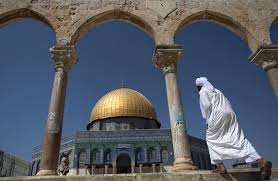
Jerusalem’s importance to Muslims comes from the belief that in the Dome of the Rock shrine there is a rock where two significant things happened – where Abraham intended to offer Isaac as a sacrifice, and where Mohammed allegedly ascended into heaven. Though this tradition is firmly in the Muslim mind, it is of recent origin. It was invented by Yasser Arafat’s uncle – Haj Amin el-Husseini, who was the past Grand Mufti of Jerusalem. He promoted this myth in the 1920’s and 1930’s to arouse Arab passions against the growing Jewish presence in Jerusalem.

The verse in the Koran that describes Mohammed’s trip to heaven is Surah 17:1: Glorified be He who carried His servant by night from the Inviolable Place of Worship to the Far Distant Place [al-Aqsa] of Worship the neighbourhood whereof We have blessed, that We might show him of Our tokens! The Islamic interpretation says that the Inviolable Place of Worship is Mecca, and this is accepted by all. It then says that the Far Distant Place of Worship is Jerusalem – but this has no substantiation because Jerusalem had never been a place of Islamic worship to that time, nor would it be for centuries afterward. Jerusalem isn’t even mentioned by name in the Koran, so how could it be a place of worship according to the Koran? Most significantly, inside the Dome of the Rock hundreds of verses from the Koran are inscribed – and Surah 17:1 is not among them! The very passage that later supposedly justified the building of the Dome of the Rock is not even included among the hundreds of passages of the Koran inscribed in it!

The Dome of the Rock was built not because of the Koran, but because the Muslim ruler Abdal-Malik wanted to gain revenue from pilgrims and worshippers, and because he wanted to prevent the rebuilding of a Jewish Temple. Islamic passion for Jerusalem is indeed like drunkenness.

This is exactly fulfilled in modern Jerusalem. In recent peace negotiations between Israel and the Palestinian Authority, Israel was willing to concede almost everything to the Palestinians in an amazing willingness to make peace. The only thing Israel would not concede was sovereignty over Jerusalem, and the entire deal was ruined over that one point. The problem between Jews and the Arab world has boiled down to one point: Jerusalem.

If Muslim passion for Jerusalem is a mystery, the Jewish claim to the city is entirely Scriptural. “The very fact that Jerusalem is mentioned more than 800 times in the Bible makes it worthy of special attention. This unique city is the only one upon which God has bestowed His distinctive blessing and protection (Ps 132:13-14), and the only city for whose peace we are commanded to pray (Ps 122:6). God says He has chosen Jerusalem as the place where He has put His name forever (2 Chr 6:6; 33:7; Ps 46:4; 48:1-8; 87:3). The new heavens and new earth will contain ‘the city of my God…new Jerusalem’ (Rv 3:12; 21:2). That there will be a ‘heavenly Jerusalem’ (Heb 12:22) but no ‘heavenly’ New York, Paris, London, Damascus, Cairo, etc. speaks volumes” (Dave Hunt, The Berean Call – September 2000).

(SOURCE: ENDURING WORD ©2018 David Guzik)

DO NOT INSULT THE WATCHMEN!

watchmen

Many may think that I am obsessed with end time prophecies, the rapture and my strong opposition against heretic theologies such as amillennialism, replacement or fulfilment theology and the unbiblical allegorical interpretation of God’s holy Scripture. But whatever people may think is fine with me as I honestly believe that being a watchman is a calling from God. And in no way do as say this in arrogance.

As watchmen we are often being accused by those who reject the literal meaning of Bible prophecy and who follow the eschatology of men, that we are wasting time that could rather have been used on preaching the Gospel of Salvation to an unbelieving world.

But what does the Bible teach on this topic?

THE GREAT COMMISSION AND UNITY IN DIVERSITY

We read about the Great Commission in Matthew 28:16-20.

“16 Then the eleven disciples went away into Galilee, to the mountain which Jesus had appointed for them. 17 When they saw Him, they worshiped Him; but some doubted. 18 And Jesus came and spoke to them, saying, “All authority has been given to Me in heaven and on earth. 19 Go therefore and make disciples of all the nations, baptizing them in the name of the Father and of the Son and of the Holy Spirit, 20 teaching them to observe all things that I have commanded you; and lo, I am with you always, even to the end of the age.”

In this passage, we see three key activities – Make disciples, baptize them and teach them.

1 Corinthians 12 says, “4 There are diversities of gifts, but the same Spirit. 5 There are differences of ministries, but the same Lord. 6 And there are diversities of activities, but it is the same God who works all in all. 7 But the manifestation of the Spirit is given to each one for the profit of al.”

This is indeed how things work, even today. There are evangelists, some going to foreign countries, to preach the gospel. We also see street preachers and many Christians who share the Gospel on social media, only to name a few. On the other hand, there are preachers running churches – baptizing and teaching those who have already heard of the Gospel. And so does each and every reborn Christian plays his or her role in light of the Great Commission – some roles bigger and some smaller. “If the whole body were an eye, where would be the hearing? If the whole were hearing, where would be the smelling? (v.7)

But there is also another type of ministry … that of the watchmen, who teach and prepare people to be ready for the return of Jesus Christ. Unfortunately, these are the brothers and sisters who often get mocked when executing their God-given assignments.

WATCHMEN IN ANCIENT TIMES

In ancient times, watchmen stood guard on a city’s walls to see to the welfare of its citizens and to warn of coming trouble. Through Isaiah the prophet, God promises the watchful eye of servants who will hold day and night vigils for the peace of Jerusalem and its inhabitants:

“I have set watchmen on your walls, O Jerusalem; they shall never hold their peace day or night. You who make mention of the Lord, do not keep silent, and give Him no rest till He establishes and till He makes Jerusalem a praise in the earth” (Isaiah 62:6-7).

Jeremiah and others like him have stood in the role of a watchman. “Also, I set watchmen over you, saying, ‘Listen to the sound of the trumpet!’ But they said, ‘We will not listen.’ Therefore hear, you nations … Behold, I will certainly bring calamity on this people —the fruit of their thoughts, because they have not heeded My words nor My law, but rejected it” (Jeremiah 6:17-19).

The role of the ancient watchmen is best described in Ezekiel 33:1-6;

“1 Again the word of the Lord came to me, saying, 2 “Son of man, speak to the children of your people, and say to them: ‘When I bring the sword upon a land, and the people of the land take a man from their territory and make him their watchman, 3 when he sees the sword coming upon the land, if he blows the trumpet and warns the people, 4 then whoever hears the sound of the trumpet and does not take warning, if the sword comes and takes him away, his blood shall be on his own head. 5 He heard the sound of the trumpet, but did not take warning; his blood shall be upon himself. But he who takes warning will [a]save his life. 6 But if the watchman sees the sword coming and does not blow the trumpet, and the people are not warned, and the sword comes and takes any person from among them, he is taken away in his iniquity; but his blood I will require at the watchman’s hand.”

WATCHMEN AND THE GREAT COMMISSION

If we continue to read from Ezekiel 33, we soon realize that the role of the watchman still applies today and also forms part of the Great Commission.

Ezekiel 33:8-11;

8 When I say to the wicked, ‘O wicked man, you shall surely die!’ and you do not speak to warn the wicked from his way, that wicked man shall die in his iniquity; but his blood I will require at your hand. 9 Nevertheless if you warn the wicked to turn from his way, and he does not turn from his way, he shall die in his iniquity; but you have [b]delivered your soul. 10 “Therefore you, O son of man, say to the house of Israel: ‘Thus you say, “If our transgressions and our sins lie upon us, and we pine[c] away in them, how can we then live?” ’ 11 Say to them: ‘As I live,’ says the Lord God, ‘I have no pleasure in the death of the wicked, but that the wicked turn from his way and live. Turn, turn from your evil ways! For why should you die, O house of Israel?’

WATCH FOR THE COMING OF CHRIST

In the New Testament, we as Christians are instructed to watch and prepare for the coming of our Lord, Jesus Christ. In Mark 13:33-37, during Jesus’ prophecy of the end time, He urges His disciples three times to “watch” during the times leading to His second coming.

Paul warns in 1 Thessalonians 5:1-6;

1 But of the times and the seasons, brethren, ye have no need that I write unto you. 2 For yourselves know perfectly that the day of the Lord so cometh as a thief in the night. 3 For when they shall say, Peace and safety; then sudden destruction cometh upon them, as travail upon a woman with child; and they shall not escape. 4 But ye, brethren, are not in darkness, that that day should overtake you as a thief. 5 Ye are all the children of light, and the children of the day: we are not of the night, nor of darkness. 6 Therefore let us not sleep, as do others; but let us watch and be sober.

Paul also wrote: “And do this, knowing the time, that now it is high time to awake out of sleep; for now our salvation is nearer than when we first believed” (Romans 13:11) The closer we draw to the second coming of Christ, the more urgent it is that we awake out of spiritual sleep! Indeed, we have entered the fearful end-time years that are the grand climax of human civilization. If ever there was a time to pay attention and get prepared, it is now!

To know where to focus our attention, we particularly need to know the Bible prophecies of the end time, especially the prophecies surrounding the second coming of Christ. We are to “eagerly wait for” Christ’s return, not just passively wait around (Hebrews 9:28). Jesus was emphatic that His followers should hope for His return, expect His return and pray for His return! In addition, our enthusiastic anticipation and excitement will intensify as we see more and more world events fulfilling Bible prophecies—especially those that point to the increasing nearness of Christ’s return.

“Let your waist be girded and your lamps burning; and you yourselves be like men who wait for their master, when he will return from the wedding, that when he comes and knocks they may open to him immediately. Blessed are those servants whom the master, when he comes, will find watching ” (Luke 12:35-36).

Jesus concluded His message by saying, “Therefore you also be ready, for the Son of Man is coming at an hour you do not expect” (Luke 12:40).

Luke 21:28 says, “And when these things begin to come to pass, then look up, and lift up your heads; for your redemption draweth nigh” and in verse 36 we read, “Watch therefore, and pray always that you may be counted worthy to escape all these things that will come to pass, and to stand before the Son of Man”

In Revelation 16:15  we read, “Blessed is he who watches, and keeps his garments, lest he walk naked and they see his shame”

According to the Gospel of Matthew 25:1-13, the five virgins who are prepared for the bridegroom’s arrival are rewarded, while the five who are not prepared are disowned.

God warns us through the message of the prophets that sins will demand a day of reckoning. People cannot continue worshipping the false gods of materialism and self, blindly stumbling along in their own righteousness, and expect their affluent standard of living to continue.

By prayer and righteous living, we stay tuned to Jesus Christ. Through this way of life one can discern the moral climate of the times and avoid being tossed around with every shifting ideology of modern culture. Walking in God’s laws and instruction insulates us from the course of the world and its deceptions.

In his article, “The Role Of A Watchman,” Darris McNeely writes;

“Amos the prophet walked into the city of Samaria, capital of the northern kingdom of Israel, and boldly told the king and city leaders to repent or face captivity at the hands of the Assyrians. He pointed to neighboring states that had fallen and said, “You are no better than they were.”

He rebuked those who did not want to hear a “message of doom.” To those who stocked their homes with the finest luxury goods and gourmet foods, trusting that affluence was a sign of God’s blessing, he said, “Don’t trust in materialism.” The citizenry, at all levels, looked only to their comfort and ease and did not grieve “for the affliction of Joseph” (Amos 6:6).

Those who “grieve” and “sigh and cry” over societal sins are called to a unique role. They are part of God’s elect, called to the duty of proclaiming the announcement of the Kingdom of God. That message includes the good news of Jesus Christ’s return to restore all things (see Acts 3:19-21). The message also contains a warning to repent and receive God’s blessing or ignore the warning and face the judgment of God. It is a double-edged message—plain-spoken, yet full of hope.”

MORE ON THE ROLE OF THE WATCHMEN

Do we sigh and cry for the moral condition of our nation? Do we see the world through God’s eyes and understand how far people have strayed from His righteous commandments? If so, then we have a duty to help others understand what is coming when God sets His hand in judgment on the nations.

Do you see yourself in this group of watchmen? Is there a role for you among those who watch today’s world and yearn to make it better? Putting a number of scriptural commands and principles together, it becomes clear that today’s true Christians are meant to shoulder this grave responsibility now in the last days. We are to share in the role of standing vigil like a watchman of old, and showing the way forward through the suffering and evil in much of our world.

Fulfilling the role of a watchman requires courage, perseverance and a love for the people addressed. One of the best examples of this was the prophet Jeremiah. Jeremiah spent more than 40 years in the role of a watchman to the nation of Judah, urging people to heed his warnings and return to the ways of God.

These special servants understand the dangers of the present world. They see the dark clouds gathering on the world’s horizon and are moved to proclaim a warning message to all who will hear.

The message would also include teaching the way to personal peace for those who listen. It will show the true teachings of God and the way to salvation and how one could escape the judgment God will bring on the world.

The end result of fulfilling the role of a watchman within the Body of Christ—to be found standing in the faith, blessed of God at the dawn of His Kingdom on this earth. “How beautiful upon the mountains are the feet of him who brings good news, who proclaims peace, who brings glad tidings of good things, who proclaims salvation, who says to Zion, ‘Your God reigns!’ Your watchmen shall lift up their voices, with their voices they shall sing together; for they shall see eye to eye when the Lord brings back Zion” (Isaiah 52:7).

(Main source: “The Role Of A Watchman” by Darris McNeely)

JOHN’S VISION OF THE CHURCH IN HEAVEN

church in heaven

REVELATION 4:1–11.

This chapter follows the messages to the seven churches and is introduced by the important phrase “AFTER THIS.” Most of the struggles of scholars attempting to interpret the book of Revelation stem from a failure to understand that the book of Revelation is a book of prophecy and that prophecy has a chronological order. This becomes the key to unlocking the book of Revelation.

In Revelation 1:9–20, John was instructed, “Write, therefore, what you have seen, what is now and what will take place later” (v. 19). Simplistic as this statement is, it provides an inspired outline of the book of Revelation.

  • “What was” — it refers to the experience of John seeing Jesus in His glory in chapter 1;
  • “What is now” – it refers to the messages to the seven churches, that represent the churches in this present age;
  • “What will take place later” – it refers to that which is future.

Confusion in the interpretation of Revelation stems almost entirely from the failure to observe this divine outline. The opening of chapter 4 with the phrase “AFTER THIS,” referring to the churches, should make clear that as from chapter 4 onwards, the book of Revelation is dealing with future events.

Apart from these indications in the text of the chronological outline, a number of important arguments support this concept, which is so essential in understanding this book. One of the most convincing arguments that the future is discussed as from chapter 4, is the fact that the events described, either in symbolic or other ways, find no literal fulfillment in the history of the church. The historical school of interpretation, which regards the book of Revelation as being fulfilled in history, has been unable to provide any consensus on its interpretation and offers only confusion.

If the events described have any literal fulfillment, they, accordingly, must be fulfilled at some future time. This is in harmony with the concept that the book is prophetic rather than history or simply descriptive of the moral conflict that exists in the world. This also explains why, apart from the futuristic prophetic view, there has been no coherent, or majority interpretation. Each of the major views—allegorical, preterist, and historical—when applied to this book yield entirely different answers according to the person doing the study. Only the futurist view provides any reasonable coherence between what the book states and what the fulfillment of its prophecy would indicate. Though there are some instances where interpretation is not entirely clear, other events stand out as being specific future events and provide enough guidance so that the book of Revelation becomes a majestic unfolding of the future with the revelation of Christ at the second coming as its main theme.

One of the important conclusions in prophecy is the concept that the church composed of the saved of the present age will be in heaven while the great events of the tribulation and of the end time take place. This is exactly what is described in Revelation 4–5. The church in heaven is in contrast to the great time of trouble that will take place on the earth prior to the second coming of Christ. Accordingly, though the specific prophecies regarding the church are not the main topic of these two chapters, the vision of heaven plays off when the saints and angels and the sovereign God on His throne form an intelligent background for other events that will take place both in heaven and on earth.

John stated at the opening of Revelation 4: “AFTER THIS I looked, and there before me was a door standing open in heaven. And the voice I had first heard speaking to me like a trumpet said, ‘Come up here, and I will show you what must take place after this’” (v. 1).

Actually, John was on the Isle of Patmos where he had been exiled, and the revelation was given to him at this location. In this instance, however, he stated, “At once I was in the Spirit, and there before me was a throne in heaven with someone sitting on it” (v. 2). It may be debated whether John was physically caught up to heaven or whether simply in his vision he is caught up in heaven. In either case, he saw the scene as he would if he had been present. The voice that provided the invitation, according to John, was the same voice he had heard in 1:10 where he was instructed to write the message to the seven churches (v. 11).

Because John’s experience is similar to what will happen at the rapture when the church is caught up to heaven, some have equated the two events, but actually, John was not raptured, and his natural body was probably still on the Isle of Patmos. Accordingly, it is better to regard this as a special situation. It may be going on beyond the intent of this passage to hint that the rapture is going to take place in the period following the church age, but from the context in which the event is placed in the book of Revelation, it is reasonable to conclude that the rapture has taken place and that what John is seeing is a setting for events in heaven that will take place in heaven and on earth in the period after the rapture.

The word church, prominent in chapters 2–3, does not re-occur until 22:16, though the bride mentioned in 19:7, no doubt, is a reference to the church. The total absence of any reference to the church or any synonym of the church in chapters 4–18 is highly significant because ordinarily the church would be in the center of the activities. Rather, Jews and Gentiles are spoken of separately as individuals who are saved or unsaved.

John’s first experience upon arrival in heaven was to behold “a throne in heaven with someone sitting on it” (4:2). He described the personage on the throne in these words: “And the one who sat there had the appearance of jasper and carnelian. A rainbow, resembling an emerald, encircled the throne” (v. 3). The personage on the throne is said to resemble in His glory the jasper and the carnelian stones. The jasper, described in 21:11, is a clear stone in contrast to the jasper stone known on earth as an opaque stone. Accordingly, some have concluded that it may be a diamond in appearance. The carnelian stone is red in color like a ruby.

Though the colors of the stone, enhanced by the rainbow, resembling an emerald, which is green in color, provide the glorious appearance, the significance of these stones may be derived from their use in Israel. On the breastplate of the priest there were twelve stones, each representing a tribe of Israel. The high priest represented all twelve tribes before God when he performed his priestly functions. The jasper and the carnelian stones were the first and last of the twelve stones (cf. Ex. 28:17–21). Further, the jasper represented the tribe of Reuben, the first tribe, and the carnelian stone represented Benjamin, the youngest tribe. Mention of these two stones, accordingly, was intended to include all the twelve tribes of Israel.

Further, the names of Reuben and Benjamin have significance because Reuben has the meaning of “behold the son,” and Benjamin means “son of my right hand.” Christ, of course, fulfills both of these functions, and He is the first-begotten Son. Like Benjamin, He is “the Son of My right hand,” also speaking of Christ in His relationship to God the Father. Taking all these things into consideration, it would seem best to interpret this passage as a description of God the Father sitting on a throne. This is also supported by the fact that Christ is pictured in a different way in this passage as separate from the One on the throne, though actually He occupies the throne with the Father also. The main purpose of this vision, however, was to show the glory of God.

As John surveyed the scene in heaven, he also saw twenty-four other thrones and recorded, “Surrounding the throne were twenty-four other thrones, and seated on them were twenty-four elders. They were dressed in white and had crowns of gold on their heads” (Rev. 4:4). They are obviously a representative group. In Israel, for instance, the many priests were divided into twenty-four groups, and one priest would represent each of the twenty-four.

The question has been raised, however, as to whether these twenty-four elders represent all the saints, both Old and New Testament, or only the church of the present age, or perhaps they are angelic figures. These and other interpretations have been advanced by scholars.

They were described as having white robes, speaking of righteousness in the presence of God, and wearing crowns of gold, which were not the crown of a ruler (Gr., diadem), but rather the crown of a victor (Gr., stephanos), crowns awarded victors in the race. The implication is that these have already been rewarded as symbolized in the throne.

In reconstructing the events of the end time, if the church is raptured before the end-time events and is judged at the judgment seat of Christ, it would provide a plausible explanation that these twenty-four elders are representatives of the church.

John was then made aware of ominous sounds indicating divine judgment: “From the throne came flashes of lightning, rumblings and peals of thunder” (4:5). The setting in heaven foreshadows the judgments to come on the earth. A similar experience of thunders, lightnings, and trumpets was experienced in the giving of the Mosaic law in Exodus 19:16. The scene in heaven that he saw was, of course, the forerunner of the terrible judgments to be inflicted on the earth in the period that followed.

John also recorded, “Before the throne, seven lamps were blazing. These are the seven spirits of God” (Rev. 4:5). Mention of these seven spirits is found earlier in 1:4 and 3:1. Though no explanation is given, it is probably best to consider this a representation of the Holy Spirit in a sevenfold way rather than consider them relating to seven angels, which would be an alternate explanation.

The Holy Spirit, not ordinarily visible, on certain occasions has assumed physical form as here, and in the case of the Holy Spirit descending as a dove on Christ at His baptism (Matt. 3:16; Mark 1:10; Luke 3:22; John 1:32). On the day of Pentecost the Holy Spirit was seen as “tongues of fire that separated and came to rest on each of them” (Acts 2:3). In this scene from heaven not only God the Father was revealed on the throne and Christ in the next chapter as “the Lion of the tribe of Judah” (Rev. 5:5) but the Holy Spirit as well, all three persons of the Trinity being present. The term of “seven” in relation to the lamps and the spirits of God is in keeping with the concept that the number seven indicates perfection, and is in keeping also with the seven qualities or attributes of the Holy Spirit revealed in Isaiah 11:2–3.

John recorded, “Also before the throne there was what looked like a sea of glass, clear as crystal” (Rev. 4:6). Though the expression is not interpreted here, there seems to be a relationship to the laver or a bronze basin filled with water in the tabernacle in the Old Testament and the “Sea” in the temple (1 Kings 7:23–25), both of them being washstands designed to provide the priest with water for cleansing. Together they represent the sanctifying power of the Word of God symbolized by the water.

John also recorded, “In the center, around the throne, were four living creatures, and they were covered with eyes, in front and in back. The first living creature was like a lion, the second was like an ox, the third had a face like a man, the fourth was like a flying eagle. Each of the four living creatures had six wings and was covered with eyes all around, even under his wings” (Rev. 4:6–8). There is considerable diversity among interpreters concerning what the four living creatures represent. Probably the best interpretation is that they are physical embodiments of the attributes of God, as the seven lamps represent the Holy Spirit (v. 5). They are compared to a lion, ox, man, and flying eagle. Some relate this to the four Gospels: Matthew represented the lion or the king; Mark, the ox or servant; Luke, man in his humanity; and John, the flying eagle representing the deity of Christ. Still others compare them to angels and find support in the fact they had six wings. Their ministry was to worship God, and John recorded, “Day and night they never stopped saying: ‘Holy, holy, holy is the Lord God Almighty, who was, and is, and is to come’” (v. 8).

Their worship of God also is a call to the twenty-four elders to worship. “Whenever the living creatures give glory, honor and thanks to him who sits on the throne and who lives for ever and ever, the twenty-four elders fall down before him who sits on the throne, and worship him who lives for ever and ever” (vv. 9–10). The twenty-four elders also give their praise to the Lord, “They lay their crowns before the throne and say: ‘You are worthy, our Lord and God, to receive glory and honor and power, for you created all things, and by your will they were created and have their being’” (vv. 10–11).

Though the entire content of chapter 4 is what John saw in heaven, it also is a revelation of the glory and honor given to God in the future and therefore has a prophetic base. Most important, it emphasizes what events will occur in heaven while end-time events take place on earth.

In Revelation 5:1–10, attention is focused on the fact that Jesus Christ is in heaven and worthy to take the seven-sealed scroll. A separate article will still be posted on this chapter.

(Source: John F. Walvoord –  Every Prophecy of the Bible: Clear Explanations for Uncertain Times (p. 525-530)).

HEAVENLY PROMISES – JOHN 14:1–6

After three years of ministry, Jesus is in the final week of His life on earth.  He will be crucified on Friday afternoon.  He will be the Sacrificial Lamb who takes away the sin of the world, killed at the very time the Jews were killing sacrificial lambs on the Passover that Friday.  He is now in the upper room on Thursday night, His last night with His disciples.

They’ve been with Him for the full three years, 24/7.  They love Him and believe in Him, but they are profoundly confused.  Their hopes and ambitions are collapsing as Jesus continues to tell them He is leaving.

Jesus knew that His hour had come, that He would depart out of this world to the Father, having to leave behind these disciples He so dearly loved.

In John 13:33 He said to them, “Little children, I’m with you a little while longer.  You will see Me; and as I said to the Jews, now I also say to you, ‘Where I’m going you cannot come.  I’m leaving and you can’t come.’”

Down to John 13:36 Peter asked, “Lord, where are you going?”  to which Jesus basically replied, “Where I go, you cannot follow Me now; but you will follow later.” In Chapter 14 He essentially says the same thing again several times.

In verse 12 He says, “Truly I say to you, he who believes in Me, the works that I do will he do; and greater works than these he will do; because I go to the Father.”  Down in verse 28 toward the end of that verse He says again, “I go to the Father and I’ve told you before it happens, so when it happens you’ll believe,” verse 29.

To add to the confusion, the doubt, the fear, and the anxiety, He had even said that among the twelve there was a traitor who was going to betray Him into the hands of His enemies.  He had told them He would be arrested, beaten, and murdered, and it was all prophesied in the Old Testament. And we also read that in Isaiah 53.  He had even declared at the end of chapter 13 to Peter that he would turn out to betray Him by denying Him three times. On top of it all, now they would be left behind in the middle of hateful enemies.

This is a very difficult time and not how it was supposed to end according to their methodology.  He then offers immense comfort to them; and it runs through all these chapters. That is the gracious, compassionate, merciful, loving heart of God.

The comfort comes, first of all, in chapter 14, verse 1: “Do not let your heart be troubled; believe in God, believe also in Me.  In My Father’s house are many dwelling places; if it were not so, I would have told you; for I go to prepare a place for you.  If I go and prepare a place for you, I will come again and receive you to Myself, that where I am, there you may be also.  And you know the way where I’m going.”

Thomas said to Him, “Lord, we do not know where you are going.  How do we know the way?”  Jesus said to him, “I am the way, and the truth, and the life; no one comes to the Father but through Me.”

The six opening verses are the foundation of comfort.  Later on, He will give them “the” Comforter, the Holy Spirit, who will dwell in them.  Those comforts from His promises are increased in power and impact by the indwelling presence of the Comforter.  The theme here then is comfort by trusting in Him. He told them that they should not let their hearts be troubled. He knows everything that is in a heart of a man.

You start there with God all-knowing, all-wise, all-powerful, all-ruling, all-caring, all-sufficient, having all resources, all provision.  “You trust God, you believe in God; you don’t have any trouble with that, so believe also in Me.” John all the way through his gospel makes the case that Jesus is God.  They believe in God whom no one can see God.  God is an invisible spirit. They believe in God and they believe in the revelation of God in the Son of God, and that’s why they said, “You’re the Christ, the Son of the living God,” and, “We know that You’re the Holy One and You have the words of life.” They had been regenerated by God and become believers in the true God. They recognized that Jesus is the one who has come from God.  He is the Holy One from heaven.

But then they have seen Him, and now they need to also believe in Him when He’s gone the same way they believe in the invisible God.  Their faith is tested.

But, although He was about to be removed, He will not be far from them. He says to them later, “never leave you or forsake you.  I will come to you.”

He says, “The Father and I literally will take up residence with you before you take up residence with Us.  I will put my Holy Spirit in you.”  We all live and move in the worship of One we’ve never seen.

Over in chapter 16, verse 7, He says, “I tell you the truth, it is to your advantage that I go away; for if I do not go away, the Comforter will not come to you.  But if I go, I will send Him to you.”  That is the Holy Spirit.

The plea to trust Him is followed by some specific promises.  He would go and prepare a place for us, and He will come again and receive us to Myself, that where He is, there we may also be.

Earlier in the gospel of John, in chapter 2, Jesus went into the temple and overturned the tables.  To those who were selling doves He said, “Take away these things.  Stop making My Father’s house a place of business.”

Here He says in John 14, “In My Father’s house are many dwelling places.” Here He certainly did not refer to the temple again as He pronounced doom on the temple in Matthew 24.

It reminds us of what is said in Hebrews 9:23-24, “Therefore it was necessary that the copies of the things in the heavens should be [a]purified with these, but the heavenly things themselves with better sacrifices than these. For Christ has not entered the holy places made with hands, which are copies of the true, but into heaven itself, now to appear in the presence of God for us.”

The temple was the Father’s house in the sense that it was a copy of the Father’s house which is heaven.  Christ came and cleansed the Father’s house that had been turned, as Luke says, into a den of robbers.  He cleansed the Father’s house on earth and then He destroyed the copy so that He might gather His people and take them into a place prepared for them that was reality in heaven.

The temple at Jerusalem was called the Father’s house, but it was only a copy.  God had designed it and it was His.  He had laid out the prescription as to its architecture and design, and and it was to symbolize His presence among His people.  There He was to be honored and adored and worshipped by His people.

But that worship had become apostate and corrupted.  He sent His Son to attack it and then He sent the Romans in 70 AD to smash it to bits.  There is even today, no longer any earthly copy.  So when Jesus says, “In My Father’s house,” He is talking about heaven.

In ancient times, fathers had a house and when their children got married, they build additions on the house, for every married son in that family.  So also does the heavenly Father’s house has many dwelling places.

People are often confused with the term “Mansions.” This is a family and we are going to be in the Father’s house, one house with many rooms.

Now, if you’re curious about what it is like in heaven, read Revelation 21.  Just a summary, it is golden diamond city.  In the center of this massive, glorious and transparent golden diamond is God’s glory and the glory of the Lamb blazing through and being refracted into the endless new heaven and new earth.  Around the city are massive jewels that spin out the colors of the rainbow.  The city has twelve gates and each one is a single pearl from which the light bounces and adds to the transcendence.

In verses 2 to 3 Jesus said, “In My Father’s house are many [a]mansions; if it were not so, [b]I would have told you. I go to prepare a place for you. 3 And if I go and prepare a place for you, I will come again and receive you to Myself; that where I am, there you may be also.”

These words are of an eschatological nature as He is talking about His second coming. In Acts 1:11 we also read, “… This same Jesus, who was taken up from you into heaven, will so come in like manner as you saw Him go into heaven.” In the meantime, when any believer dies, absent from the body, he or she immediately enters the presence of the Lord.

He will come again and rapture the church, as clearly described in 1 Thessalonians 4 and 1 Corinthians 15, to gather the church to Himself.  We do not know exactly when it is going to happen but judging by the prophecies coming to pass, we know that this glorious event is near. This is an amazing promise.

Jesus then said to them then in verse 4, “You know the way where I’m going.  You know the way where I’m going.”  Thomas replied, “Lord, we don’t know where You’re going.  How do we know the way?” This is the question that any legitimate religion must answer, and none can except Christianity.  Religion is worthless because it provides no way to heaven.  That is “the” question that only Christianity answers:  “How do I become reconciled to God and go to heaven?”

This takes us to the third point.  First, there was the plea, then there was the promise, now there is the provision.

In John 10 Jesus said, “I am the door.  I am the door to that eternal pasture.  I am the door, there is no other door.  Anybody else is a thief and a robber.  I am the door.  I’ve told you that.”

Thomas had to get this right. Jesus said to him, “I am the way, and the truth, and the life.  No one comes to the Father but through Me.  I am.”

Jesus alone revealed God.  Jesus alone was God’s chosen sacrifice and He alone is the Savior.  Faith in Jesus is the only way of salvation.  That is why there is a Great Commission, to take the Word to every creature in the world because there is no other way to saved.

Jesus is the way to God, the truth about God, and the life of God; and no one can come to the Father or enter the Father’s house, except through Him.

(Source: Bible studies, using John MacArthur’s sermons as guidance)

THE FIG TREE GENERATION

THE FIG TREE GENERATION

The fig tree generation is the generation that will not pass till all things prophesied in Matthew 24:32-34. It is the generation that will not pass till they see the rapture, the abomination of desolate talked by Daniel, the Antichrist reign, the great tribulation and Jesus Christ coming in the clouds with a great army.

Fig tree in the Bible represents the Nation of Israel. Hosea 9:10 says:” I found Israel like grapes in the wilderness; I saw your fathers as the first ripe in the fig tree at her first time.” Jesus often used fig tree in parabolic form when communicating things about Israel. In His life on the world, Jesus painted a threefold picture of what will become of the Nation of Israel.

  • The fig tree (the nation of Israel) was to be BARREN. We read about this in the parable in Luke 13:6-9. The 3 years referred to in the parable relate to the 3 years Jesus was in the land of Israel looking for spiritual fruits but Israel was barren spiritually. Therefore, Jesus ordered the dresser of the vineyard to cut it down.

2)    The fig tree was to be CURSED. Even after being dug about and fertilized, Israel did not bear any spiritual fruits and Jesus cursed her. In Mark 11:12-14 we read “And on the morrow, when they were come from Bethany, he was hungry. And seeing a fig tree afar off having leaves, he came, if haply he might find anything thereon: and when he came to it, he found nothing but leaves; for the time of figs was not yet . And Jesus answered and said unto it, No man eat fruit of thee hereafter forever. And his disciples heard it.” Jesus was hungry for spiritual harvest in Israel and as made clear by His actions in the temple (v15-17), there were no fruits to harvest. The fig tree was barren, so He cursed the fig tree. (Matthew 21:19 says, “And seeing a fig tree by the road, He came to it and found nothing on it but leaves, and said to it, “Let no fruit grow on you ever again.” Immediately the fig tree withered away.”)

The fig tree withered and died thus stopped using the land. In 70 AD the Romans annihilated Israel, destroyed the temple and Israel seized being a sovereign nation and stopped using the ground (land).

  • The fig tree was to be REPLANTED. In Matthew 24 Jesus was talking of a replanted fig tree, her branches are tender, putting forth leaves. Matthew 24:32-34 says “Now learn a parable of the fig tree; When his branch is yet tender, and puts forth leaves, ye know that summer is nigh.”

Ezekiel 36-37 is clear about the rebirth (replant) of Israel. Israel ceased to be a sovereign nation from 70 AD to May 14th 1948 when United Nations proclaimed Israel a sovereign nation. It was given her land back thus replanted.

Since 1948, we have seen Israel put forth leaves on her tender branches both economically, military and financially it has become a world force, always in the news all over the world. We are about to see Israel build the Third Temple. There spiritual rebirth will happen at the very end, as seen in Zechariah 12 to 14.

THE FIG TREE GENERATION

Luke 21:29 –32 says, “And he spoke to them a parable; Behold the fig tree, and all the trees. When they now shoot forth, ye see and know of your own selves that summer is now nigh at hand. So likewise ye, when ye see these things come to pass, know ye that the kingdom of God is nigh at hand. Verily I say unto you, This generation shall not pass away, till all be fulfilled.” Jesus confirmed these words by saying, ‘Heaven and earth shall pass away: but my words shall not pass away’ (Lk 21:33). I.e. this generation that sees the fig tree shoot forth will not pass till all these things be fulfilled.

WHO IS THE GENERATION THAT SAW THE FIG TREE SHOOT FORTH?

In May 14th 1948, Israel became a sovereign nation thus the fig tree come back to life and started shooting forth. The 1948 generation will not pass till all things prophesied by Jesus in Mathew 24, Mark 13 and Luke 21 be fulfilled. Those born before or in the year 1948 are of the generation that saw the fig tree shoot forth.

HOW LONG IS A GENERATION?

From the time of Adam up to today, humanity lifespan on earth has been deteriorating, eg Adam lived 930 years, Jacob lived 147 years, Moses lived 120 years and Joshua lived 110 years.

Psalms 90:10 says, “The days of our lives are SEVENTY YEARS; and if by reason of strength they be EIGHTY YEARS, yet is their labour and sorrow; for it is soon cut off, and we fly away.”

The labour and sorrow might also be figurative of the tribulation and Jesus will end it when He comes.

Because of the prophecy in Psalms 90:10, we are using a generation to be between 70 to 80 years.

HOW TO DETERMINE THE “SEASON” (NOT THE DAY AND HOUR) OF THE COMING OF JESUS

The 1948 generation is today (2018) 70 years old and Israel marked 70 years of statehood on 14 May. The 1948 generation can to go up to 80 years for years of labour and sorrow (thetribulation), then soon cut off. That means the latest for Jesus Christ to return may be the year 2028. The cut off will happen when Jesus Christ appears in the Armageddon battle.

There are 7 years of tribulation (the years of labor and sorrow) which must be fulfilled before the generation is cut off (See the last week of Daniel 70 weeks prophecy).

Thus the latest for the tribulation to begin is the year (2028 – 7) = 2021, although it can start any time between now and then. Christians will not be in the tribulation and the church would therefore be raptured during this same period (ie between now and 2021).

Just as Daniel understood by the books the number of the years specified by the word of the Lord through Jeremiah the prophet that He would accomplish seventy years in the desolations of Jerusalem (Dan 9:2) so by the same books do we understand the number of years specified for all to be fulfilled.

I am not attempting in any way, shape, form or fashion to set a day and hour for the return of Son of Man but I am revealing the season for His return and all prophesied be fulfilled. For we, children of light, know the season when Jesus Christ is returning.

But of that day and hour knows no man, no, not the angels of heaven, but my Father only (Mt 24: 36)

Rev 3:3: Remember therefore how you have received and heard, and hold fast, and repent. If therefore you shall not watch, I will come on thee as a thief, and you shall not know what hour I will come upon thee.